

Gaming for Gait: How Virtual Reality Helps Hereditary Spastic Paraplegia
Understanding Hereditary Spastic Paraplegia (HSP)
Okay, so let’s chat about something pretty complex: Hereditary Spastic Paraplegia, or HSP. Think of it as a group of neurological conditions that primarily mess with your legs. We’re talking weakness and stiffness (that’s the spasticity part) in the lower limbs, making simple things like walking a real challenge. It’s a progressive condition, meaning it tends to get worse over time, and it’s got a whole bunch of different genetic flavors – over 84 subtypes, apparently!
HSP can show up in a couple of ways:
- Pure (Uncomplicated) Forms: Mostly just the spasticity, weakness, gait issues, maybe some bladder problems or sensory weirdness in the legs.
- Complex (Complicated) Forms: All the above, *plus* other stuff like cognitive difficulties, balance problems (ataxia), nerve damage, seizures, or even vision/hearing issues.
Even though it progresses slowly, how it plays out can be super different from one person to the next, even within the same family or genetic type. It’s not super common, but understanding it and finding ways to help people manage it is crucial.
The Challenge: Balance and Movement
One of the biggest headaches with HSP is how it messes with your balance and gait. Our brains rely on a bunch of signals – from our inner ear (vestibular system), our muscles and joints (somatosensory system), and our eyes – to keep us upright and moving smoothly. In neurodegenerative conditions like HSP, this signal processing gets impaired. This can make adaptive reflexes tricky, leading to imbalance and that characteristic stiff, stumbling gait. The spasticity and weakness really limit the range of motion in the legs, making lifting the foot difficult and increasing the risk of trips and falls.
Finding effective ways to tackle these issues has been a bit of a puzzle. While there are some pharmacological and physical therapies out there, the research hasn’t always been super clear on what works best. That’s why folks are always looking for new, promising approaches.
Enter Virtual Reality Rehabilitation (VRi)
This is where things get interesting! We know that traditional vestibular rehabilitation (VR) can help improve balance by basically retraining the brain through specific, repetitive exercises. It taps into the brain’s amazing ability to adapt and compensate. But let’s be honest, traditional rehab can sometimes feel a bit… well, traditional.
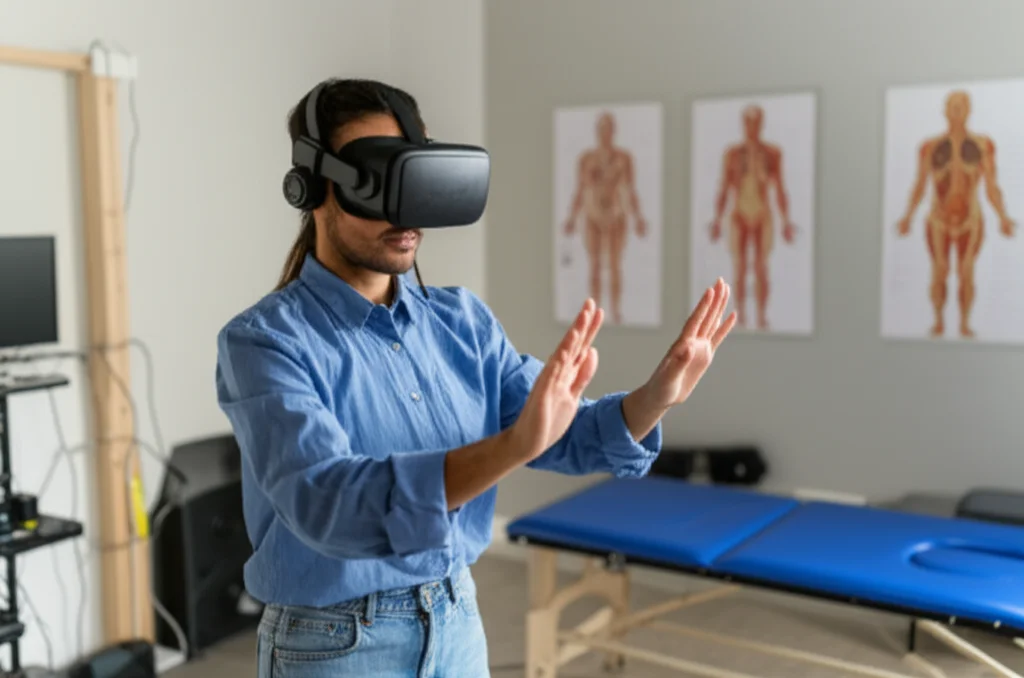
Virtual reality (VRi) steps in as a potentially awesome tool to enhance this. Imagine stepping into a virtual world where you’re playing games that *are* your therapy. It uses artificial stimuli to challenge your balance and coordination in new ways, potentially boosting those brain-body connections even more effectively than conventional methods. VRi can make therapy more engaging, adaptable, and maybe even a bit more fun, which can be a huge motivator for patients.
Putting VR to the Test: A Pilot Study
So, a team decided to run a pilot study – a smaller trial to see if this VR approach had legs (pun intended!) for people with HSP. They gathered 16 adult patients with HSP, split them randomly into two groups:
- Balance Group (BG): Used VR games specifically focused on balance.
- Strength Group (SG): Used VR games for both balance *and* muscle strength.
Everyone went through 20 sessions, twice a week. Before starting, after 10 sessions, and after 20 sessions, they did a bunch of tests to see what changed.
What Did They Measure?
The researchers were pretty thorough. They used:
- Otorhinolaryngological and Vestibular Evaluation: Checking the inner ear system, which is key for balance. Interestingly, many participants showed some abnormalities here.
- Lafayette Dynamometer: A handheld device to precisely measure muscle strength in the legs (hips, knees, ankles). They looked at things like peak force and the rate of force development (how quickly you can generate force), which is super important for movement, especially gait.
- ABC Scale: The Activity-Specific Balance Confidence scale. This is a questionnaire where people rate how confident they feel doing various daily activities without losing their balance. It’s all about self-perception of stability.
- VAS Scale: The Visual Analogue Scale for pain. Just checking if the therapy was causing any discomfort.
- VRi Game Scores: Tracking how well participants did in the virtual reality games themselves.
The Results: Promising Signs!
Alright, the moment of truth! What did they find after 20 sessions of VR gaming?
First off, the good news: the VAS pain scores didn’t really change. This means the VR rehabilitation didn’t seem to make their pain worse, which is always a relief!
Now, for the exciting bits:
- Balance Confidence: Both the Balance Group and the Strength Group reported feeling more confident in their balance when doing daily activities, according to the ABC scale. Before the study, many were in the moderate or low confidence range, but after the VR sessions, a good chunk moved into the high confidence category. That’s a big deal for daily life!
- Muscle Strength: The dynamometer results were pretty encouraging. They saw significant improvements in hip abduction strength (moving your leg away from your body). Even more importantly, they saw significant improvements in the *rate of force development* (RFD) in ankle dorsiflexion (lifting your foot upwards). Why is this important? Because weak dorsiflexion and poor RFD here contribute a lot to the foot drop and stumbling seen in HSP gait. Improving this can really help with walking.
- VR Game Performance: Participants in both groups got significantly better at the VR games over time. This not only validates that they were engaging with the therapy but also suggests that the games were effectively challenging and improving their motor skills and balance control.
While the study didn’t find huge differences *between* the Balance Group and the Strength Group in all measures (it was a small pilot, after all), the overall trend for *both* groups showed positive changes, particularly in balance perception and that crucial ankle strength/RFD needed for better gait.
What Does It All Mean?
So, my take on this? This pilot study strongly suggests that adding virtual reality to vestibular rehabilitation is a really promising avenue for helping people with HSP. It seems to directly address some of the core issues they face – balance problems and muscle weakness, especially in the lower legs.
The VR games likely help by providing intense, engaging practice that improves proprioception (knowing where your body is in space) and coordination. The visual feedback from the VR environment can also help the brain adapt and compensate for underlying neurological issues. Plus, let’s not underestimate the power of motivation! Seeing yourself improve in a game can be incredibly encouraging compared to repetitive traditional exercises. Patients in the study reported feeling better about their body position and coordination, leading to better balance.
This technology isn’t just a gimmick; it looks like a valuable tool that can complement existing therapies and potentially help people with HSP gain more independence and confidence in their daily movements.
Looking Ahead: More Research Needed!
Now, it’s important to remember this was a pilot study. It was relatively small (just 16 participants), and the researchers faced some challenges recruiting more people, partly due to the pandemic and the logistics of getting to sessions twice a week for many who lived further away or needed assistance.
The study also had some limitations. They didn’t specifically measure spasticity levels throughout the trial, which would have been interesting to see how VR might impact that. And while the dynamometer showed improvements, longer follow-ups and maybe different types of strength training (like weight-bearing exercises) could potentially yield even bigger gains.
But despite these points, the findings are exciting! They confirm the potential benefits and highlight the need for bigger, longer studies. We need trials with more participants to really solidify these results, explore the long-term effects, and look at a wider range of outcomes – not just physical improvements, but also how VR rehab impacts quality of life, mental well-being, and social participation for people with HSP.
The use of tools like the Lafayette dynamometer also seems valuable for precisely tracking strength changes in this population, which is key for tailoring rehab programs.
The Bottom Line
To wrap it up, this pilot study gives us a really hopeful glimpse into the future of HSP management. Virtual reality-assisted rehabilitation, combining balance and strength exercises, appears to be a safe and effective way to improve functional capacity, boost balance confidence, and strengthen those crucial leg muscles needed for walking. It’s an innovative approach that taps into technology to make therapy more engaging and potentially more impactful. While more research is definitely needed to fully understand its potential, I’m optimistic that VR could become a significant tool in the toolkit for helping people with Hereditary Spastic Paraplegia live more stable, confident lives.
Source: Springer


