
Unearthing India’s Secret Weapon Against Nuclear Waste: The Power of Vindhyan Clay
Hey there! Let’s chat about something super important but maybe not the usual dinner table topic: nuclear waste. You know, the stuff left over from making clean energy? Managing it safely for, well, *ages* is a massive challenge. But guess what? Folks are looking deep underground for solutions, and I’ve been digging into some fascinating research about a particular kind of clay from India, the Vindhyan argillaceous clay, and how it might just be a superhero in disguise for keeping that waste locked away.
Why Deep Geological Repositories?
So, nuclear energy is pretty awesome for fighting climate change, right? But it leaves us with high-level waste (HLW). India, like many places, reprocesses spent fuel, which is smart, but you still end up with this HLW. The plan is to turn it into glass (vitrification – sounds fancy, basically locks it up) and then bury it *really* deep underground in what’s called a Deep Geological Repository (DGR). Think of it as putting the waste in a super-secure vault far away from us and future generations.
This DGR isn’t just one big hole. It’s a multi-barrier system. There are engineered barriers (like the glass and the container) and then there are natural barriers – the rock itself. Around the world, different rocks are being checked out: granite, salt, and yes, argillaceous rock formations, which are basically clay-rich rocks. India is seriously considering argillaceous clay rock, and for good reason! It’s got some sweet properties:
- Low permeability (stuff doesn’t easily leak through)
- Good thermal conductivity (helps dissipate heat)
- High sorption affinity (it likes to grab onto radioactive bits)
- Pretty low swelling potential (it won’t puff up and cause problems)
But before we commit, we need to *really* understand these potential host rocks. A crucial part is figuring out how well they can hold onto the radionuclides, those radioactive elements, especially the long-lived ones like certain isotopes of Cesium (Cs) and Americium (Am).
Meet the Vindhyan Argillaceous Clay
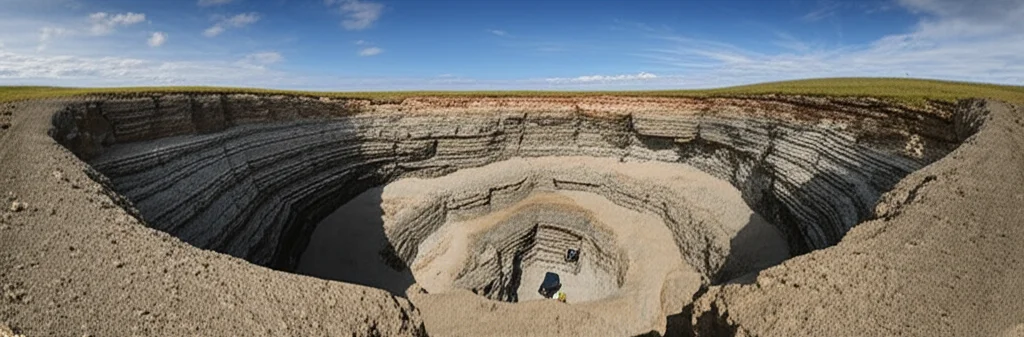
The specific clay we’re talking about comes from the Vindhyan Basin in central India. This basin is ancient, huge, and has incredibly thick layers of sedimentary rock. The particular sample in this study is from the Ganurgarh shale, part of the Vindhyan Super Group. Geologically, it’s bordered by granite, volcanic rock (Deccan traps), and a major tectonic lineament.
Before testing its waste-holding powers, the researchers did a full work-up on this clay. They crushed it up, cleaned it, and then put it through a battery of tests.
- Cation Exchange Capacity (CEC): This measures how many positive ions the clay can swap or hold onto. Our Vindhyan clay clocked in at 210 meq kg−1. That’s pretty high compared to some other clays out there!
- Surface Area: How much surface is available for stuff to stick to? It was 33 m²/g, comparable to some others being studied globally.
- Mineral Composition: Using X-ray diffraction (XRD), they found it’s mostly illite (about 25%) and quartz (about 75%). Illite is a key player in how clay behaves, especially with sorption.
- Elemental Composition: Energy dispersive X-ray spectroscopy (EDS) showed it’s mainly silicon, aluminum, iron, potassium, and titanium.
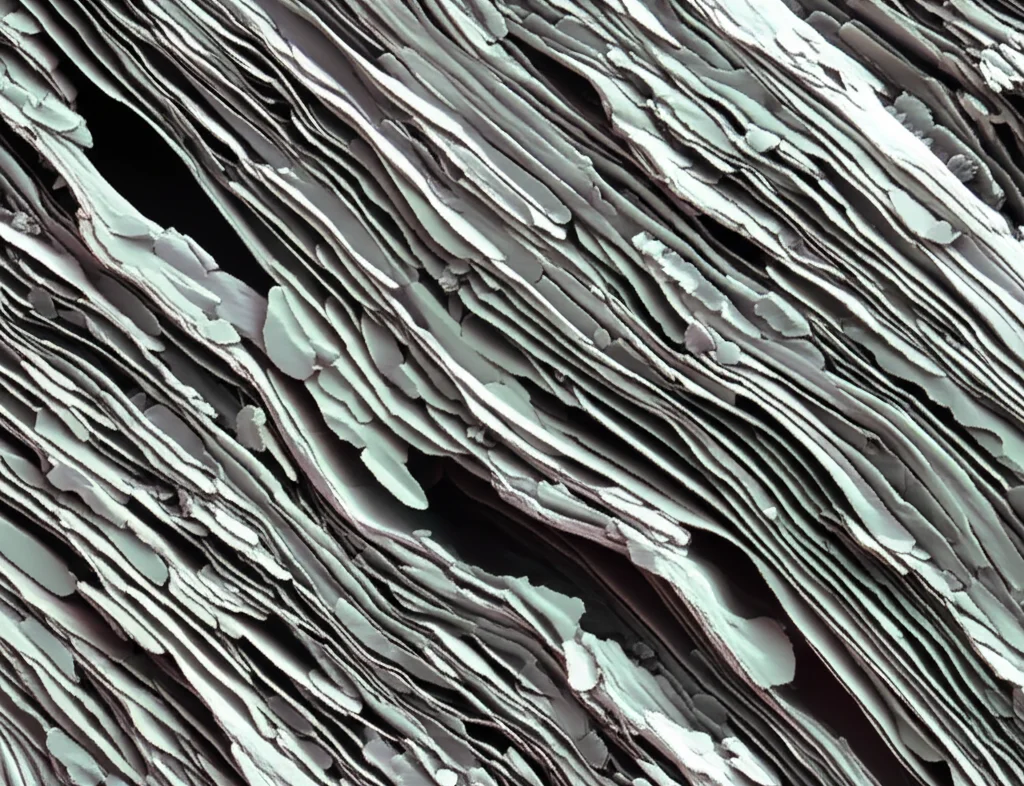
- Morphology: Scanning electron microscopy (SEM) revealed it has that classic flake-like, layered clay structure, but with an “ovoid pod” appearance too – natural clays are always a bit unique!
- Functional Groups: FTIR spectroscopy identified the specific chemical bonds present, like Si-O and Al-O-Si, which are important for how things bind to the surface.
- Time (how fast does it happen?)
- pH (acidity/alkalinity of the water)
- Ionic strength (how salty the water is)
- Radionuclide concentration (how much Cs or Am is there)
- Temperature
- For Cs(I): Sorption decreased as temperature increased. This means it’s an exothermic process (it releases heat). The overall process is spontaneous (negative ΔG°), but the enthalpy (heat) is the main driving force, especially for those high-affinity FES sites. The difference in how easily Cs and other ions like Potassium (K) shed their water shells (hydration energy) plays a big role here.
- For Am(III): Sorption increased as temperature increased. This is an endothermic process (it absorbs heat). It’s also spontaneous (negative ΔG°), but here, the entropy (related to disorder or the number of ways energy can be distributed) is the main driving force. As temperature goes up, shedding that hydration shell around Am(III) becomes easier, making it more likely to stick to the clay.
- Sorption is fast for both Cs(I) and Am(III).
- Cs(I) is held primarily by ion exchange on two types of sites, driven by enthalpy, and is spontaneous.
- Am(III) is held by both ion exchange and surface complexation, driven by entropy, and is also spontaneous (and gets even more so at higher temperatures).
- The clay has a notable capacity to take up both Cs(I) and Am(III).
It’s like getting a full physical for the clay before asking it to do a tough job!
Putting the Clay to the Test: Sorption Studies
Okay, so we know the clay’s stats. Now, how well does it grab onto radioactive elements? The study focused on Cesium-137 (¹³⁷Cs) and Americium-241 (²⁴¹Am). Why these two? ¹³⁷Cs represents those long-lived fission products, and ²⁴¹Am stands in for the trivalent actinides, another group of tricky radioactive elements.
They used a batch sorption method. Basically, mix the clay with water containing tiny amounts of the radioactive elements, let it sit, separate the water from the clay, and measure how much radioactivity is left in the water. The less in the water, the more the clay held onto! They calculated something called the distribution coefficient (Kd) and the percentage of sorption.
They checked how sorption was affected by:
What Did We Find? The Mechanisms at Play
This is where it gets really interesting. Clay minerals have different spots where ions can stick. Think of them as parking spaces: some are always available for swapping ions (ion exchange sites), and some are more like specific docks where molecules can attach (surface complexation sites).
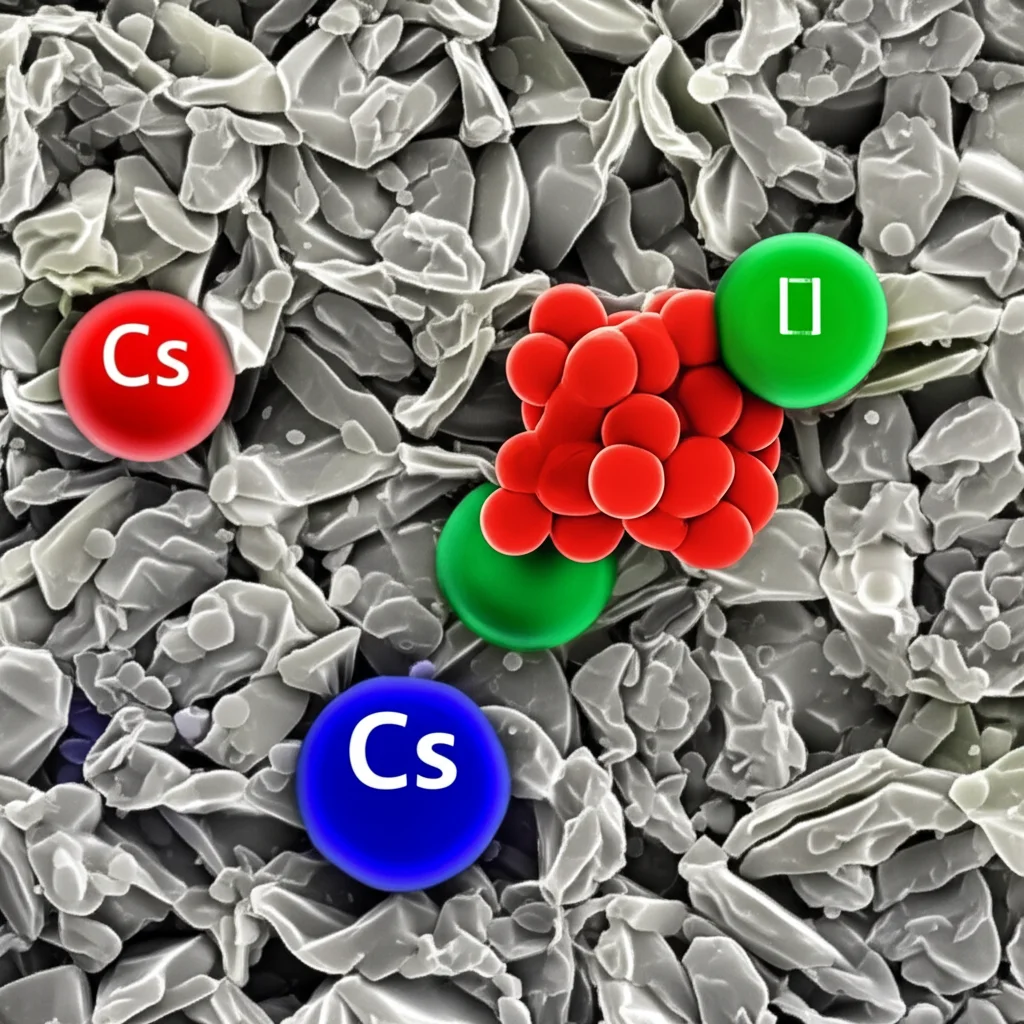
For Cs(I) (that’s Cesium in its +1 state), the study found that sorption is mainly through ion exchange. It’s not super sensitive to pH above 4, which is typical for ion exchange. At really low pH, hydrogen ions compete, so sorption drops a bit. What’s cool is that at low concentrations, this Vindhyan clay showed the *highest* Kd for Cs(I) compared to several other clays studied globally. This suggests it has some high-affinity spots that really love grabbing Cs, even when there’s not much of it around. SEM images even confirmed Cs was stuck onto the clay surface without changing the clay’s overall look.
Am(III) (Americium in its +3 state) is a bit more complex. Its sorption *really* depends on pH, increasing as the water gets less acidic. The ionic strength also matters, but differently depending on the pH. At low pH, increasing saltiness reduces Am(III) sorption – a classic sign of ion exchange (the salt ions compete). But at higher pH, saltiness doesn’t affect it much, pointing towards surface complexation being the main game. So, Am(III) uses both types of parking spots! Its behavior is also tied to how Am(III) itself exists in the water (its speciation – Am³⁺, AmCO₃⁺, AmOH₂⁺, etc.), which changes with pH and carbonate presence.
Kinetics, Isotherms, and Thermodynamics – The Deeper Dive
How fast does this sorption happen? Pretty darn fast! For both Cs(I) and Am(III), equilibrium was reached within about 30 minutes. The kinetics followed a pseudo second-order model, which basically means the rate depends on the concentration of both the radionuclide and the available sites on the clay.
Looking at adsorption isotherms (how much sorbs at different concentrations), the Cs(I) data clearly showed two distinct zones. This confirms what we suspected: there are at least two types of ion exchange sites on the clay. There are high-affinity, low-capacity sites (often called Frayed Edge Sites or FES, which illite is known for) that grab Cs even at tiny concentrations, and then there are lower-affinity, high-capacity sites that come into play at higher concentrations.
The Am(III) isotherms showed saturation – the clay only has so many spots for Am(III).
Now, about temperature – this tells us about the energy involved (thermodynamics).
Modelling these behaviors using software helped confirm these mechanisms and estimate the strength of the interactions (equilibrium constants).
The Verdict (So Far)
So, what’s the takeaway? This Vindhyan argillaceous clay, with its mix of illite and quartz, its decent CEC and surface area, and its unique morphology, shows real promise.
We saw that:
These findings are super valuable for assessing if this clay formation is suitable for a DGR. Its ability to retain these specific radionuclides is a critical natural barrier function.
However, this is just one piece of the puzzle. While we understand the *sorption* (sticking) really well now, for a full safety assessment, we also need to know how these radionuclides would move through the clay over geological timescales – things like diffusion (slow spreading) and advection (movement with water flow). That means more studies are needed to get the complete picture.
But based on this research, the Vindhyan argillaceous clay looks like a strong candidate, potentially offering a robust natural barrier to help keep nuclear waste safely contained deep underground for the long haul. It’s pretty neat how a bit of ancient clay could play such a vital role in our future energy safety!
Source: Springer


