
Feeling the Heat? How Rising Temperatures Might Be Affecting Male Fertility
Hey there! Ever stop to think about how all this climate change talk might be hitting us, well, personally? We all know it’s doing a number on the planet, but I’ve been diving into some fascinating research that suggests these rising temperatures could be messing with something pretty fundamental: male fertility. It’s a bit of a hot topic, literally, and I want to walk you through what we’ve been looking at.
What’s the Big Deal with Male Infertility Anyway?
So, let’s get on the same page. When we talk about male infertility, we mean a situation where a couple can’t conceive naturally after a year of trying, and the issue lies with the male partner. It’s more common than you might think, affecting about 7% of guys globally. That’s a pretty significant chunk of the population, and honestly, it’s becoming a bigger public health headache every year.
Some pretty hefty studies, meta-analyses to be exact, have shown that sperm quality worldwide is on a downward slide, and it’s picking up speed. Think about this: sperm concentration and total sperm count dropped by over 50% between 1973 and 2018! And in 2019 alone, there were around 570 million cases of male infertility. That’s a whopping 76.9% jump since 1990. This isn’t just a personal tragedy for couples; it puts a strain on society and contributes to those declining birth rates we hear about.
Now, male infertility isn’t a one-trick pony. It’s got a whole host of causes:
- Biological, physiological, or genetic factors – the stuff you’re born with or that your body just does.
- Lifestyle choices – you know, smoking, drinking, that sort of thing.
- Environmental factors – and this is where our story really heats up. Think air pollution, nasty chemicals, and, crucially, excessive heat.
- Sociodemographic factors – things like your economic status and where you live.
There’s already a good pile of evidence suggesting that things like air pollution and exposure to toxins can put a damper on male fertility. But what about the heat? That’s what we wanted to explore.
Connecting the Dots: Climate Change and Our Swimmers
With our planet’s climate going through some dramatic mood swings, the thermal environment is changing big time. So, the burning question (pun intended!) is whether this decline in male fertility is linked to rising global average temperatures or those more frequent extreme weather events like heatwaves and cold snaps. It’s something that’s been getting a lot more attention lately.
If you look at the animal kingdom – guppies, chickens, mice, cattle, pigs, you name it – their reproductive systems are super sensitive to heat stress. And for us humans? Studies have shown that sperm production, or spermatogenesis if you want to get fancy, is particularly touchy when it comes to temperature. Both too hot and too cold can lead to lower semen concentration, fewer sperm, and sperm that just don’t swim so well.
Sure, our bodies are pretty good at keeping our internal temperature stable, but a long-term rise in global average temps could mean more heat exposure, and that’s a potential risk for reproductive health. So, we hypothesized that these changes in environmental temperature, driven by climate change, might be playing a part in declining fertility. But, direct evidence linking temperature change to this decline in male fertility has been a bit thin on the ground. Most studies have looked at short-term heat effects or used animal models. We felt there was a gap for a big-picture look using large-scale population data.
How We Dug into the Data
To get to the bottom of this, we designed what’s called an ecological study. We weren’t looking at individuals one by one, but at population-level data across 174 countries and regions from 2000 to 2019. Think of it as looking for patterns on a global scale.
We got our hands on some serious data:
- Male Infertility Data: We used the age-standardized prevalence rate (ASPR) of male infertility from the Global Burden of Disease (GBD) database. This is a massive resource that tracks diseases and risk factors worldwide.
- Temperature Data: For past temperatures, we used the ERA5 dataset from the European Centre for Medium-Range Weather Forecasts – super detailed, high-quality stuff. For future projections (2020-2030), we looked at CMIP6 data, which models different climate scenarios.
- Other Important Bits (Covariates): We also factored in things that could influence the results, like the Sociodemographic Index (SDI – a measure of a region’s development), smoking rates, alcohol consumption, and levels of air pollutants like nitrogen dioxide (NO₂) and ozone (O₃). We even considered which continent a country was on.
A key thing we calculated was the Deviance Percentage of Temperature (DPT). This basically measures how much the annual temperature in a place strayed from its 20-year average. Was it an unusually hot year? Or colder than normal? That’s what DPT tells us.
We then used some clever statistical tools. Geographic detectors helped us see if there were spatial patterns – like, do hotter places tend to have more infertility? Restricted Cubic Spline (RCS) curves let us look for non-linear relationships (spoiler: we found one!). And linear mixed-effects models helped us quantify the link between DPT and male infertility rates, even allowing us to project future trends under different climate change scenarios (like a sustainable path vs. a fossil-fuel-heavy one).
What Did We Find? The Nitty-Gritty Results
Alright, so what did all this number-crunching tell us? Well, quite a bit!
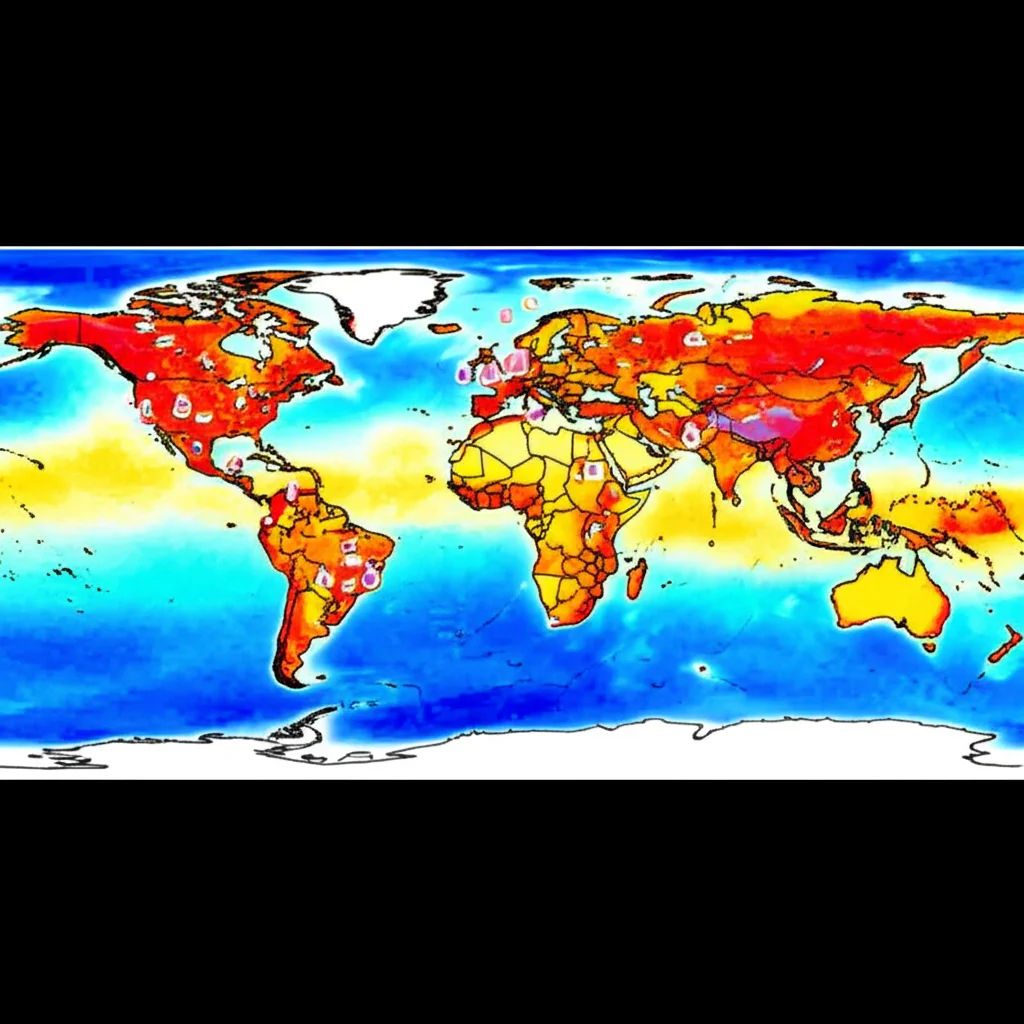
First off, between 2000 and 2019, we did find a spatial association between temperature and the prevalence of male infertility. It wasn’t a simple “hotter is always worse” picture, though. Some warmer areas like sub-Saharan Africa, North Africa, the Middle East, and South Asia had higher average temperatures, while places like North America, Europe, and East Asia were cooler. Interestingly, high rates of male infertility were seen in the Caribbean, sub-Saharan Africa, Europe, and East Asia. So, not a perfect overlap, but a connection was there.
Globally, temperatures showed a wobbly but upward trend during those two decades. Male infertility rates also fluctuated but took a noticeable and rapid jump upwards from 2010 to 2019. Coincidence? Maybe not.
The really cool part came from our RCS curve analysis. It showed a U-shaped relationship between temperature and male infertility. This means there’s a “sweet spot” temperature where infertility rates are lowest – we found this to be around 15.7°C (about 60°F). Go much hotter or much colder than that, and the prevalence of male infertility tends to creep up. This makes sense with what smaller studies on semen quality have found.

And what about those temperature deviations (DPT)? We found a positive correlation. Higher DPT values – meaning bigger swings from the average temperature – were linked to higher male infertility rates. Specifically, a 1-unit increase in DPT was associated with about 39 more cases of male infertility per 100,000 people. That’s not insignificant when you scale it up globally!
Peeking into the Future: What’s on the Horizon?
So, if current temperature trends continue, what does that mean for the future? Our projections, looking out to 2030 under various climate change scenarios (from “we get our act together” to “business as usual”), all pointed in one direction: a continued rise in male infertility prevalence. While the differences between the scenarios weren’t massive by 2030, looking further out to 2040, 2060, 2080, and even 2100, the trend becomes clearer – more warming generally means more infertility.
Regions like North Africa and the Middle East are projected to see even higher levels of male infertility than the global average, while places like Southeast Asia and Andean Latin America might fare a bit better, though still seeing increases. It’s a stark reminder that climate change isn’t just an environmental issue; it’s a human health issue, right down to our ability to start families.
Why Might This Be Happening? The Science Bit
You might be wondering, “Okay, but how does temperature mess with male fertility?” It’s a great question, and science has some pretty solid ideas.
The main suspect is scrotal temperature. For optimal sperm production, the scrotum needs to be about 2-4°C cooler than the core body temperature. The testes are pretty sensitive to their local environment. If things heat up too much, it can throw a wrench in the works of spermatogenesis. Even a 1-1.5°C increase in scrotal temperature can reduce sperm production and lead to abnormal sperm.
What’s going on at a deeper level?
- Increased testicular oxygen consumption and local hypoxia: The testes might work harder in the heat, using up more oxygen and not getting enough blood supply.
- Oxidative stress: This is like cellular rust, causing damage.
- Elevated sperm DNA fragmentation: The genetic material in sperm can get damaged.
- Impaired sperm motility: Heat can mess with key proteins needed for the sperm’s tail to work properly, so they can’t swim as well. It can also affect the mitochondria (the sperm’s powerhouses), reducing their energy.
- Epigenetic alterations: Some recent studies suggest that even sub-chronic increases in ambient temperature might cause changes in how sperm genes are expressed, which could affect reproductive function.
While some animal studies show heat can disrupt sex hormone production, the evidence in humans is a bit more limited, suggesting hormones might not be the main culprit for us.
Regional Hotspots and Socioeconomic Twists
Interestingly, we found that the link between temperature changes (DPT) and male infertility was more pronounced in regions with middle and high Sociodemographic Index (SDI) scores. It was also particularly noticeable in Asia and the Americas, and more specifically in areas like Southeast Asia, Andean Latin America, North Africa, and the Middle East.
Why these differences? It could be a mix of things.
- Better Detection: Higher-SDI regions often have better healthcare, diagnostic tools, and reporting systems, so they might just be better at picking up these associations.
- Compounding Factors: These regions might also have higher levels of industrialization, more exposure to other pollutants, and lifestyle factors (like smoking and drinking) that could amplify the negative effects of temperature.
- Urban Heat Islands: More urbanized areas in these regions can trap heat, making things even warmer.
In contrast, low-SDI regions might face challenges like limited healthcare access and underreporting of infertility, which could mask the true relationship. For places like Southeast Asia, Andean Latin America, North Africa, and the Middle East, it could be a double whammy of high exposure to extreme temperatures and socioeconomic factors increasing vulnerability.
It really highlights how complex this issue is, with temperature, environment, and social factors all tangled up together.
Hold Your Horses: A Few Caveats
Now, as with any big study, ours has its strengths and limitations. A major strength is that we used data from a huge range of regions and relied on high-quality, reliable datasets. That makes our findings pretty robust.
However, we need to be upfront about a few things:
- Correlation, not Causation: Because this was an ecological study (looking at population averages), we can show an association, but we can’t definitively say temperature changes cause male infertility. More research is needed to nail down that causal link.
- Population vs. Individual: We looked at data aggregated at a broad scale. This means we can’t zoom in on individual-level exposure, so we have to be careful about applying these results directly to individuals.
- Other Factors: Healthcare systems and medical conditions vary a lot between countries. While we tried to account for many things, these differences could still influence infertility rates and potentially bias our estimates if not perfectly controlled. We also didn’t account for every environmental pollutant out there.
- Seasonal Swings: The GBD only gives annual estimates for infertility, so we couldn’t really dig into how seasonal temperature changes might affect things month by month.
- Model Limitations: For our future projections, we used one climate model. Using multiple models could give a more well-rounded picture. And, of course, these are projections based on simplified assumptions – the real world is way more complex!
So, these results are more like strong indicators of potential future trends rather than crystal-ball predictions.
So, What’s the Takeaway?
After sifting through all this data, what’s the bottom line? Well, it seems that variations in temperature, especially deviations from the norm, may indeed be linked to a rise in male infertility prevalence on a global scale. That U-shaped curve suggests there’s an optimal temperature for male reproductive health, and both extremes can be problematic.
This really drives home the point that climate change isn’t just about polar bears and sea levels; it’s about our health, our future, and even our ability to reproduce. It’s a potential risk factor for reproductive health that, frankly, deserves a lot more attention than it’s been getting.
Public health authorities should probably start putting a greater emphasis on preventing and managing male infertility, especially in the face of a warming world. And for us researchers? Well, the work continues. We need more studies to really pin down that cause-and-effect relationship between how hot (or cold) it gets and male fertility.
It’s a complex puzzle, but one we absolutely need to solve. Our future generations might just depend on it!
Source: Springer