
Smooth Moves: How Math Helps Robots Dance (Without the Jerk!)
Hey there! Let’s talk about robots. Not the sci-fi kind (well, maybe a little), but the amazing industrial arms that build our cars, pack our groceries, and do all sorts of intricate tasks. For these mechanical marvels to be truly useful and efficient, they need to move smoothly. And I mean *really* smoothly. Think less jerky robot dance, more elegant ballet.
Why is smoothness such a big deal? Well, imagine a robot arm suddenly slamming on the brakes or accelerating wildly. That puts a huge strain on the joints, wears them out faster, and makes it harder to control precisely where the arm is going. In the world of precision manufacturing, a little wobble or jerk can ruin everything. So, planning a robot’s path, or its “trajectory,” is absolutely crucial.
The Trajectory Tango: Time vs. Smoothness
Robot trajectory planning is often a balancing act. On one hand, you want the robot to finish its task as quickly as possible to boost productivity. On the other hand, you need that motion to be smooth to avoid vibrations and wear and tear. This smoothness is often measured by how much the acceleration changes over time – what we call “jerk.” Minimizing time usually means higher speeds and accelerations, which can lead to more jerk. Minimizing jerk means more gradual movements, which takes more time. It’s a classic trade-off!
Plus, robots have limits! They can only move so fast (velocity), accelerate so quickly, and handle so much jerk. Any planned trajectory has to respect these “kinematic constraints.”
Old School Moves: Polynomials and Splines
For years, folks have used different mathematical tools to plan these paths. We’ve seen polynomials, various types of splines (like cubic or B-splines), and Bézier curves popping up in research papers. Higher-order polynomials can give you smoother motion, but sometimes they demand really high speeds. Splines are popular, but some methods can be computationally heavy or struggle with ensuring continuous jerk.
For instance, I’ve read about using cubic splines to optimize for time and jerk, which is neat, but it can require a lot of computing power. B-splines, especially fifth and seventh-order ones, have also been explored extensively, often combined with optimization algorithms to handle constraints and objectives.
Enter the MQ-RBFs: A Fresh Approach
This is where the paper I’ve been diving into introduces something rather cool: using Multiquadric Radial Basis Functions (MQ-RBFs) for trajectory planning. Now, Radial Basis Functions (RBFs) aren’t brand new; they’re great for interpolating scattered data, even in multiple dimensions. Think of them as functions whose value depends only on the distance from a central point.
MQ-RBFs have this nice property of being non-singular and relatively simple to use. They also have a “shape parameter” (esigma;) that you can tweak to influence the shape of the resulting curve. The really exciting part about using MQ-RBFs for robot trajectories is that they can provide *infinite* order of continuous derivatives within the interpolation interval. This means not just smooth velocity and acceleration, but also smooth jerk, and even smoother higher-order stuff if you needed it! This is a big win compared to some other methods that might only guarantee continuity up to acceleration or jerk but not beyond.

Making it Work: Interpolation and Boundary Conditions
The idea is to use MQ-RBFs to create a function that smoothly connects a series of desired points (via-points) that the robot arm needs to pass through in its joint space (the angles of its joints). To make sure the trajectory starts and ends cleanly – often with zero velocity, acceleration, and jerk – the approach adds some clever “virtual” via-points near the start and end. This helps the MQ-RBF interpolation naturally satisfy those crucial boundary conditions.
Mathematically, this involves setting up and solving a system of linear equations to find the right weights for each MQ-RBF centered at the via-points (including the virtual ones). Once you have these weights, you have the complete, smooth trajectory function.
Optimizing for the Perfect Path
Just creating a smooth path isn’t enough; we want the *best* smooth path. This means using optimization to find the right balance between minimum time and minimum jerk, while *always* respecting the kinematic constraints. The paper uses two popular optimization techniques:
- Sequential Quadratic Programming (SQP): This is great for refining a solution to a single objective problem with constraints. You can use it to minimize a weighted combination of time and jerk.
- Elitist Non-dominated Sorting Genetic Algorithm II (NSGA-II): This is a multi-objective evolutionary algorithm. It’s good at finding a whole set of “optimal trade-off” solutions (a Pareto front), showing you the range of possibilities between minimizing time and minimizing jerk.
By using these optimization methods, the approach finds the optimal time intervals between via-points and the best shape parameters (esigma;) for the MQ-RBFs to achieve the desired balance and meet all constraints.
Putting it to the Test: Simulations and a Real Robot!
The paper presents several tests to show how well this MQ-RBF approach works.
First, they compared MQ-RBF interpolation against other types of RBFs (like Gaussian, Inverse Multiquadric, Inverse Quadratic). The results showed that while the position profiles looked similar, the MQ-RBF approach generally produced lower maximum jerk values compared to the others, especially avoiding the oscillating jerk seen with the Inverse Quadratic RBF.
Next, they stacked the MQ-RBF method up against state-of-the-art techniques like fifth-order B-splines and trigonometric splines, using the SQP optimizer on a simulated 6-joint PUMA 560 robot. They adjusted the weighting factors to match the total travel time of the comparison methods (around 9.1 seconds). The MQ-RBF approach consistently resulted in lower maximum jerk values for most joints – showing reductions of 5% to 21% compared to the other methods. This means smoother motion for the same speed!
They also tested the MQ-RBF approach using the multi-objective NSGA-II optimizer and compared it to a fifth-order B-spline method also optimized with NSGA-II. The results here were even more impressive. The MQ-RBF approach generated a Pareto front that offered significantly lower jerk for comparable transfer times. For instance, at a similar minimum time (around 9.1 seconds), the MQ-RBF method needed about 17% less jerk than the B-spline method. And if you were willing to take a bit more time (around 14.8 seconds), the MQ-RBF approach could achieve a 34% lower jerk index!
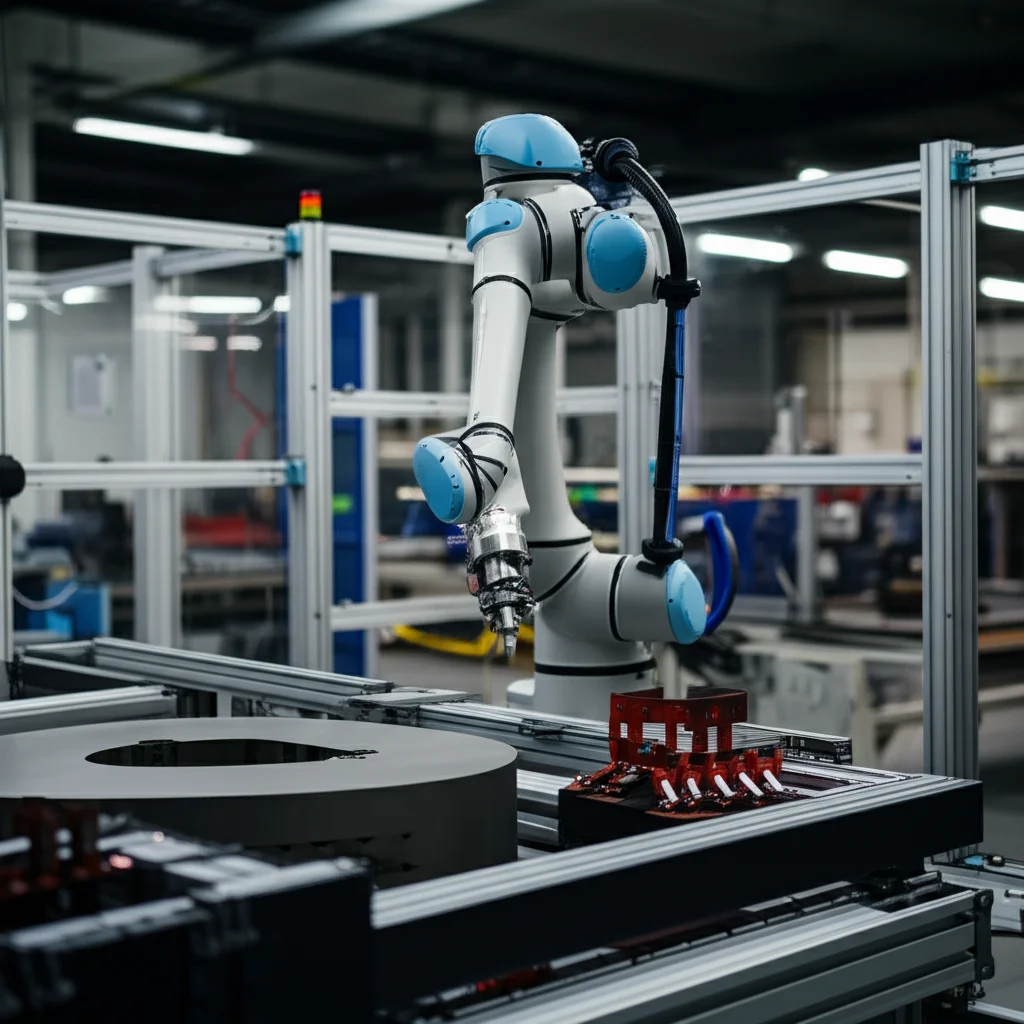
But the real proof is in the pudding, right? They took the optimized trajectory and tested it on a real UR5e robot. This is super important because simulations don’t always capture the messy reality of physical robots. The experimental results showed that the UR5e robot successfully followed the planned trajectory, with the measured joint positions closely matching the simulated ones. There were small deviations, as expected in any real-world system, but the overall motion was smooth and accurate, validating the practical effectiveness of the MQ-RBF approach.
Wrapping it Up: Why MQ-RBFs are Cool
So, what’s the takeaway? This work shows that using MQ-RBFs for robot trajectory planning is a really promising technique. It offers several key advantages:
- Superior Smoothness: It naturally provides continuous derivatives of any order, ensuring very smooth motion, especially when it comes to minimizing jerk.
- Boundary Condition Handling: The clever use of virtual points makes it easy to satisfy zero velocity, acceleration, and jerk conditions at the start and end.
- Jerk Reduction: Compared to several state-of-the-art methods, it achieves significantly lower jerk values, especially when optimizing for time-jerk trade-offs.
- Numerical Stability: It avoids some of the numerical issues (like ill-conditioned matrices) that can pop up with high-degree spline methods.
- Proven in Reality: The experimental validation on a real UR5e robot confirms that this isn’t just a theoretical concept; it works in practice.
Of course, no method is perfect. The paper notes that in some test cases, the average maximum velocity and acceleration weren’t always lower than the comparison methods. But overall, the jerk reduction and smoothness benefits are substantial.
Looking ahead, it sounds like the researchers plan to apply this MQ-RBF magic to other types of robots, like mobile robots and parallel manipulators, and maybe even look at optimizing for even higher-order derivatives like “jounce” (the rate of change of jerk!). They’re also considering other optimization strategies and hybrid RBF methods. Exciting stuff!
It’s fascinating how applying sophisticated mathematical functions like MQ-RBFs can make such a tangible difference in how robots move, making them more efficient, durable, and precise. It’s all about finding the right mathematical “dance steps” for our mechanical partners!
Source: Springer