
High-Speed Six-Pack: Inside the New Vegetable Grafting Machine
Hey there, fellow plant enthusiasts and tech curious folks! Let me tell you, the world of agriculture is constantly buzzing with innovation, and sometimes you stumble upon something that just makes you go, “Wow, that’s pretty neat!” Today, I want to chat about a piece of tech that’s tackling a really tricky problem: grafting vegetables.
Now, grafting, for those who might not know, is basically like performing tiny surgery on plants. You take the top part of one plant (the *scion*) and attach it to the root system of another (the *rootstock*). Why do this? Well, it’s a fantastic way to get the best of both worlds – maybe a tasty tomato variety on a rootstock that’s super resistant to soil diseases. It’s brilliant, but traditionally, it’s been a painstaking, manual job. Imagine doing that hundreds or thousands of times a day! High labor costs, low efficiency, and let’s face it, our population isn’t getting any younger – relying solely on human hands for this is becoming a real challenge.
Existing grafting machines? They’re out there, sure. Countries like Japan and South Korea have some impressive ones, hitting speeds of 800 to 1200 plants per hour. Europe has some with high success rates (like 98%) but they often need specific adhesives or seedling types, which limits their use. China’s been working on it too, even pushing speeds over 2000 plants per hour, but sometimes the success rate takes a nosedive when you go that fast (we’re talking down to 67% – not great!). The big issues often boil down to complexity, cost, versatility, and maintaining quality at speed.
Meet Our Speedy Seedling Surgeon
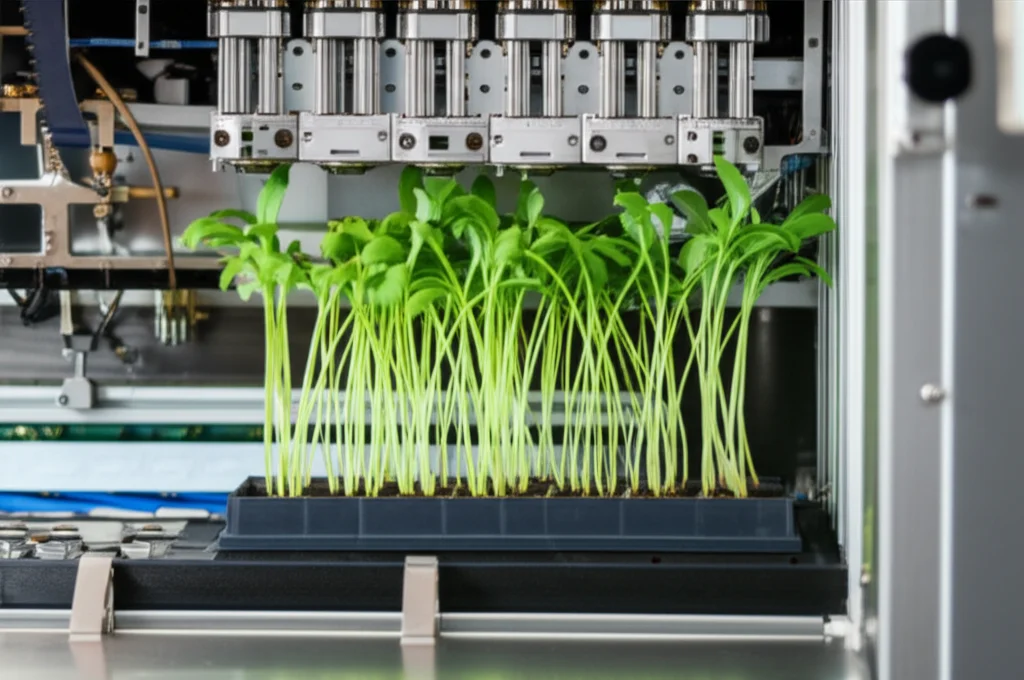
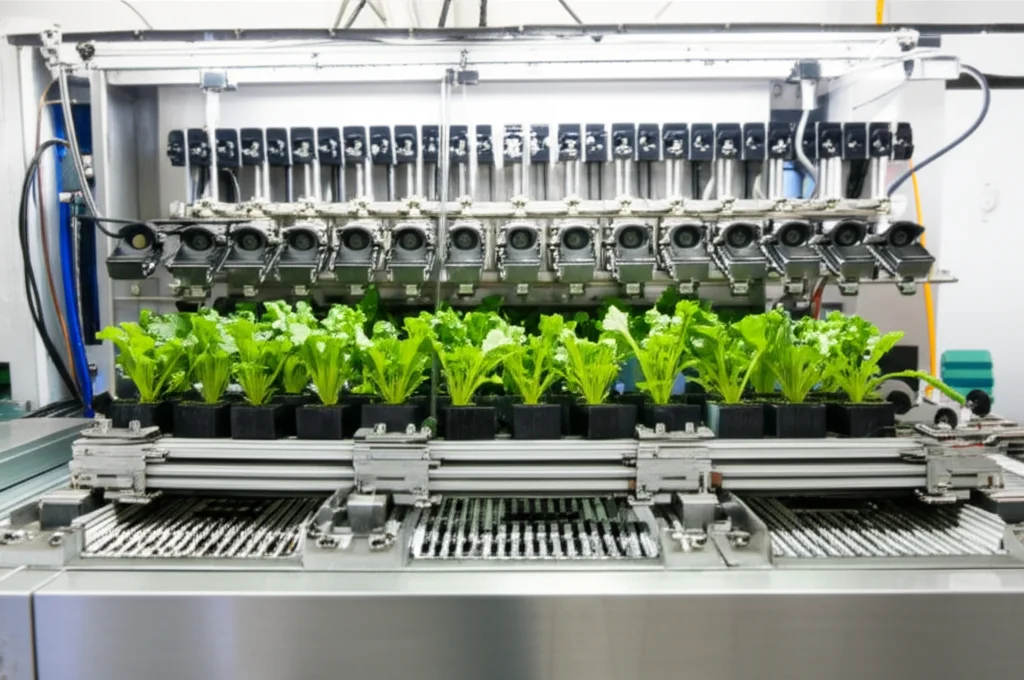
So, what if we could do better? What if we could design a machine that’s not only fast but also gentle and versatile? That’s where this new study comes in. Our team (well, the folks behind this research, let’s say “we” for the sake of the story!) set out to design an *insertion vegetable grafting machine* that could handle *six plants synchronously*. That means it’s prepping and joining six little plant pals all at the same time! The goal? To integrate flexible clamping, dynamic cutting, and precise docking into one smooth operation.
The machine itself is a bit of a marvel, a collection of modules working in harmony. You’ve got conveyor belts for the rootstocks, scions, and even empty plugs, processing units for cutting and punching, clamping mechanisms, and the brains of the operation – the electrical control system. It’s designed to take the seedlings, guide them into position, make the necessary cuts and punches, and then carefully join them together.
The Clever Bits That Make It Work
Designing a machine to handle delicate little plant stems without squishing them is no small feat. One of the key innovations here is the *clamping mechanism*. Instead of rigid grippers, they designed rectangular claws embedded with a flexible material called *EVA* (that’s ethylene vinyl acetate copolymer, basically a soft, cushiony plastic). We tested a few materials like PU and PVC, but EVA gave the lowest clamping pressure on the rootstock (pumpkin) and scion (cucumber) – just 266.35 Pa and 158.92 Pa respectively. These pressures are way below what would damage the fragile seedlings, ensuring they’re held securely but gently. The flexibility of the EVA also helps it adapt to slight variations in stem diameter, so you don’t have to constantly adjust the machine. Pretty smart, right?
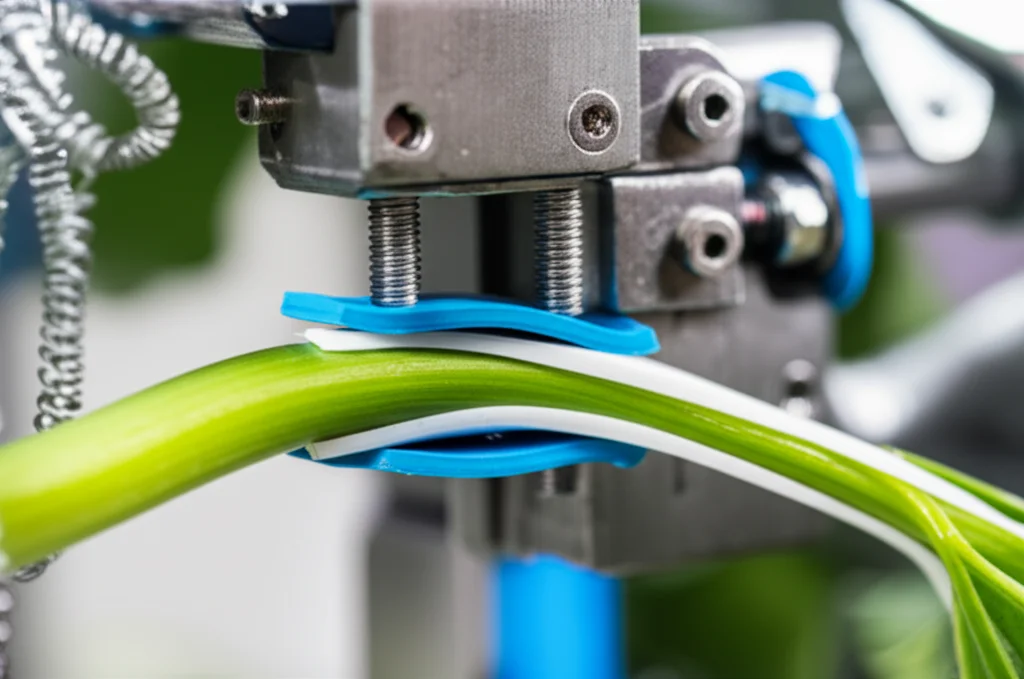
Another challenge is making sure the rootstocks are perfectly aligned for cutting and punching. Seedlings aren’t always standing up straight! To fix this, they designed a *rootstock gathering mechanism* with V-shaped blocks. As these blocks close, they gently guide the rootstock stems towards the center of the plug. They figured out that a 90° opening angle for the V-shape was just right – it effectively centers the stems (even if they start a bit off-center) without needing huge movements from the blocks. They even put cushioning material in the gathering blocks for extra gentleness.
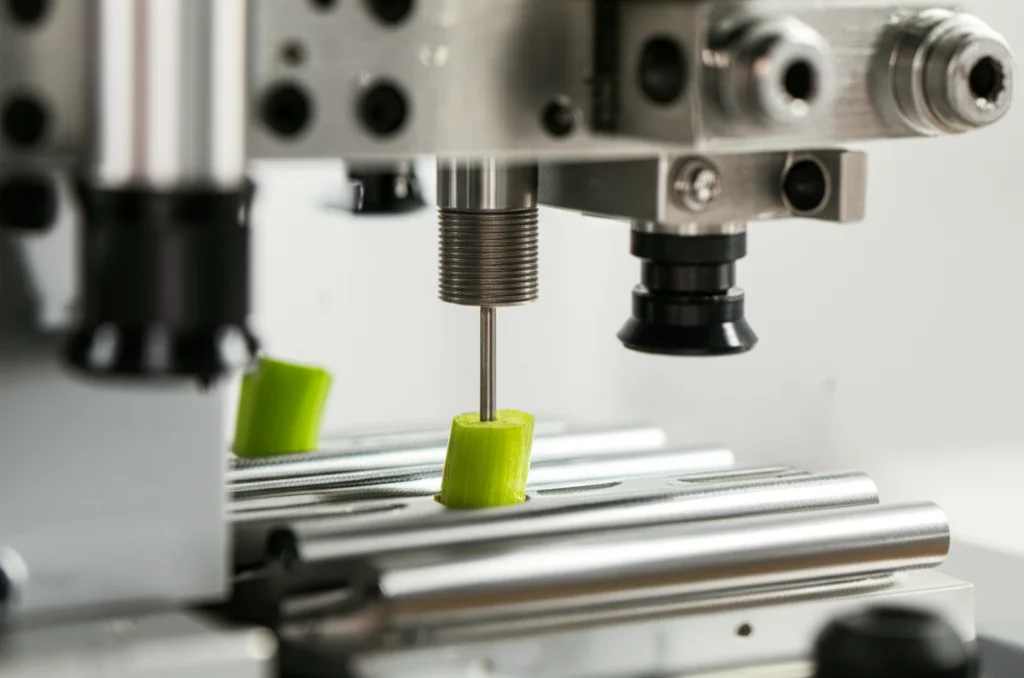
When it comes to cutting, different parts need different approaches. The rootstock’s root is cut with a straight-line sliding cut, while the stem incision uses a *dual cutting system*. The scion (the top part) gets a *rotary cut*. This involves a spinning knife that creates an angled surface. They found that a cutting surface angle of around 20° is ideal for good healing, and they calculated the necessary cutting radius (about 60mm) to get the right arc profile and depth (around 0.1mm) for a snug fit when joining.
Then there’s the *punching mechanism* for the rootstock. This is where a needle creates a hole in the rootstock stem for the scion to be inserted into. The diameter of this punching needle is super important. Too small (like 1.4mm) and it’s hard to insert the scion, leading to a low success rate (only 40% in tests!). Too big (like 2.0mm) and you risk splitting the stem (33.3% success). The sweet spot they found? 1.8mm. This gave the best bonding strength between the scion and rootstock.
Putting It to the Test
After designing all these components and assembling the machine, it was time for rigorous testing. They used “Heiba No.1” white-seeded pumpkin as the rootstock and “Taylor A8” cucumber as the scion – common veggies for grafting. They ran experiments to figure out the optimal operating parameters, focusing on:
- The diameter of the punching needle
- The punching speed
- The docking speed (how fast the scion is inserted into the rootstock)
They measured two key things: the *grafting success rate* (how many grafts actually take) and the *grafting efficiency* (how many plants per hour the machine can process). They used a statistical method called a quadratic orthogonal rotation combination experiment – fancy talk for a structured way to test how these three factors interact and affect the results.
The results from the experiments showed that all three factors had a significant impact, but the *docking speed* seemed to be the most influential on both success rate and efficiency, followed by punching speed and then needle diameter. They crunched the numbers to find the perfect combination of these parameters to maximize both success and efficiency.
The Results Are In!
After all the optimization, the ideal settings they landed on were:
- Punching needle diameter: 1.8 mm
- Punching speed: 40 mm/s
- Docking speed: 60 mm/s
They ran validation experiments with these settings, and the results were fantastic!
- Grafting success rate: 98.26%
- Grafting efficiency: 985 plants/h
Compared to manual grafting, which is typically 200–500 plants/h, this machine is a game-changer, boosting efficiency by nearly 100% to almost 400%! And compared to other insertion grafting machines, it shows a significantly higher success rate than some models, while achieving a competitive efficiency. It really seems to strike a great balance between speed and quality.
What’s Next on the Horizon?
While this machine is a huge step forward, the researchers are already looking at ways to make it even better. They noted a few areas for future work:
- More Veggies, Please! The current tests were mainly with pumpkin and cucumber. They need to verify its performance and perhaps develop adaptive settings for other crops like tomatoes and watermelon, which have different stem characteristics.
- Speed Limits: The current mechanical structure has some speed limitations. Using things like linear motors or lightweight materials (carbon fiber, aluminum alloy) could potentially make movements faster and more precise.
- Smarter Machine: Adding machine vision and deep learning could allow the machine to automatically recognize and position seedlings, reducing the need for manual pre-alignment and improving overall automation.
- Easier Fixes: Right now, maintenance can be a bit tricky. A modular design, where parts like knives and clamps can be quickly swapped out (maybe with magnetic or snap fasteners!), would make life much easier for operators.
Overall, this research presents a really promising design for a high-efficiency, high-success-rate vegetable grafting machine. It tackles some of the core problems of existing tech and offers a viable path towards more automated, factory-scale seedling production, which is crucial for feeding the world in the future. It’s exciting to see how these innovations could help alleviate labor shortages in agriculture and make grafted vegetables more accessible!
Source: Springer


