

Building Math Muscle: How Scaffolding Helps Future Teachers Model the World
Hey there! Let’s chat about something pretty cool in the world of math education: helping future teachers get really good at something called mathematical modeling. You know, taking a messy real-world problem and using math to figure it out? It’s a core skill, but teaching it effectively? That’s a whole other ballgame.
Turns out, one powerful tool in this process is something called *scaffolding*. Think of it like the temporary supports builders use to construct a building. You put them up to help, and then you take them away when the structure is strong enough to stand on its own. In teaching, it’s about providing just the right amount of help at the right time, so learners can tackle things they couldn’t quite manage alone.
Now, scaffolding isn’t exactly new in education research. People have been talking about its benefits for years, especially in math. It can help with critical thinking, problem-solving, and even just getting comfortable with mathematical language. But here’s where it gets interesting: most of the time, when we talk about scaffolding in math modeling, we think about support given *during* the task. Like, while you’re wrestling with the problem.
This study I’ve been looking at takes a slightly different angle. It asks: what happens if you give that expert support *after* the teachers-in-training have already given the problem their best shot? Can that “end-of-task” scaffolding actually stick and help them get better at modeling over time? Spoiler alert: looks like it can!
What’s Modeling Anyway?
So, what exactly is mathematical modeling? Basically, it’s the process of translating a real-world situation into mathematical terms, solving the math problem, and then translating the mathematical answer back into something meaningful for the real world. It’s not always a straight line; you often cycle back and forth, refining your model as you go.
Think about predicting earthquake magnitudes, figuring out flight ticket prices, deciding where to put fire trucks, or optimizing traffic lights. These were the kinds of real-world problems the future teachers in this study tackled. To do this effectively, you need a bunch of different skills, or “sub-competencies,” like understanding the situation, simplifying it, choosing the right math, doing the calculations, interpreting the results, and checking if your answer makes sense back in the real world. It’s a complex dance!
Scaffolding: Your Math Superpower Sidekick
Okay, back to scaffolding. The core idea, rooted in Vygotsky’s Zone of Proximal Development (ZPD), is that a learner can achieve more with guidance than they can alone. Scaffolding is that guidance, helping them bridge the gap between what they *can* do and what they *could* do.
According to one popular model, effective scaffolding has three key characteristics:
- Contingency: The support is adapted to the learner’s specific needs *right now*. If they’re struggling, you might offer more help; if they’re doing well, you back off a bit. It’s dynamic, like a conversation.
- Fading: The support is gradually withdrawn over time as the learner becomes more capable. You don’t want them to rely on the scaffold forever!
- Transfer of Responsibility: As the support fades, the learner takes on more ownership and control of the task themselves. They start thinking like the expert would.
This study zeroes in on these three ideas, looking at how they played out when support was given *after* the modeling work was done.
The Study Setup: Experts, Teachers, and Real Problems
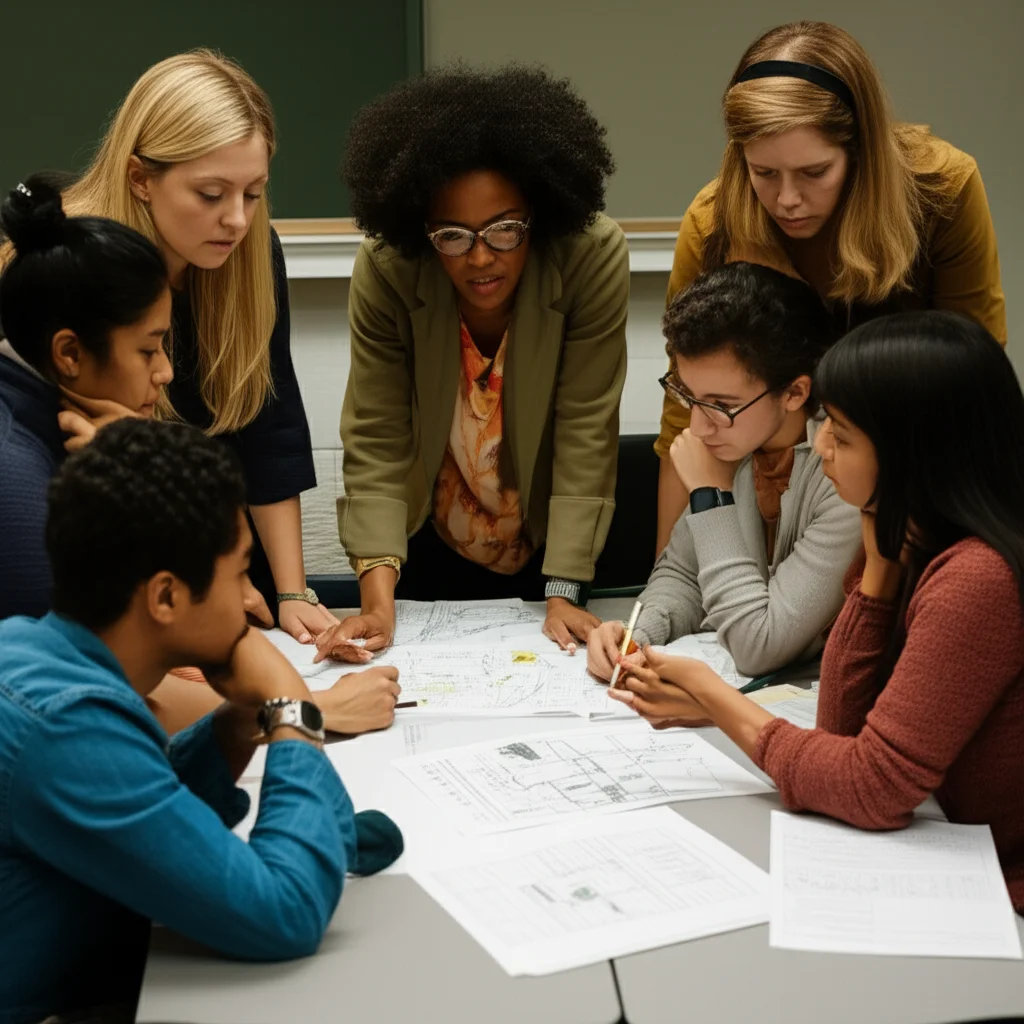
This wasn’t a quick look; it was an eight-week deep dive involving three experienced math education experts and 33 preservice teachers (PSTs) in Turkey. The PSTs worked in small groups on four different real-world modeling tasks. The twist? They worked independently on the tasks first, for about three hours. Only *after* they had finished and presented their models did the experts step in to provide scaffolding through dialogue.
The experts weren’t given a script; they provided support dynamically, based on what the PSTs had done and where they seemed to be struggling. They focused on helping the PSTs reflect on their work, refine their models, and think about what they could do better next time. The idea was that the insights gained from this post-task discussion would carry over and help them in the *next* modeling task.
The researchers collected tons of data: video recordings of the presentations and discussions, the experts’ observations, and the PSTs’ worksheets. They analyzed all this using qualitative content analysis, looking for patterns related to contingency, fading, and transfer of responsibility.
The Big Reveal: What Did They Find?
Okay, so what did all that data crunching reveal about scaffolding at the end of a task?
Contingency: Adapting the Support
The experts definitely provided support that seemed adapted to the PSTs’ needs. They used three main forms of support, similar to what other studies have found:
- Diagnosis: Asking questions like “What did you do?” or “Why did you do that?” to understand the PSTs’ thinking and identify problems. This was the most common type of support.
- Feedback: Giving positive or negative comments on their work. This was the least common.
- Hint: Suggesting strategies or even content-related ideas (like proposing a new variable or a different mathematical model).
- Teacher Training: This approach could be built into university courses to help PSTs develop their own modeling skills before they have to teach it.
- Online Learning/Flipped Classrooms: Where real-time, in-the-moment scaffolding might be tricky, providing structured feedback and guidance after a task could be a viable alternative.
- Inexperienced Teachers: For teachers new to modeling, bringing in an expert for post-task discussions could be a great way to build their confidence and competence.
By waiting until the end, the experts could see the PSTs’ full process and target their support more effectively.
Fading: Support Stepping Back?
This one was a bit mixed. The total *amount* of support didn’t consistently decrease over the four activities. However, the *type* of support did shift: hint-based support (the higher level) decreased, while diagnosis-based support (the lower level) increased. This move from higher to lower levels of help *is* considered an indicator of fading. Also, the *duration* and *length* of the dialogues decreased over time. So, while the total number of interactions might not have dropped much, the interactions themselves became shorter and perhaps more focused, which could suggest fading.
Transfer of Responsibility: Taking the Reins
This is where things looked really promising! The experts evaluated the PSTs’ responses to their support, categorizing them as either “acceptance” (the PSTs had a valid reason or argument) or “rejection” (their reasoning was flawed or they had no justification). Over the four activities, the rate of *acceptance* of the PSTs’ responses by the experts significantly *increased*, while the rate of *rejection* decreased.
What does this mean? It suggests the PSTs were getting better at justifying their models and results. In the early tasks, they might have made intuitive decisions without clear reasons. By the later tasks, they were providing more meaningful, realistic, and knowledge-based explanations. This shift is a strong sign that responsibility was transferring from the experts (who initially had to point out flaws or ask “why?”) to the PSTs (who started thinking about “why?” themselves and building more robust models). The study saw evidence that insights gained in early tasks, like the importance of justifying assumptions or considering more variables, were applied in later tasks.
Why Does This Matter?
This study makes a pretty neat contribution. It shows that scaffolding provided *after* a modeling task can be effective, adding a new perspective to the literature which often focuses on support *during* the task. This is super relevant for training future teachers. It suggests that letting them wrestle with a problem first, and *then* providing targeted, reflective support, can help them internalize the modeling process and get better at it.
Think about practical applications:
It encourages PSTs to become more autonomous and reflective learners, which is crucial for their development as future educators.
Wrapping It Up
So, the takeaway? Giving future teachers expert support *after* they’ve tackled a mathematical modeling problem seems to work! The support is contingent (adapted to their needs), shows signs of fading (especially in the type and length of interaction), and most importantly, appears to foster a transfer of responsibility, leading to improved modeling skills and more confident justifications.
Of course, no study is the final word. The researchers note that they didn’t have the PSTs revise their models after getting feedback, which could have provided even more insight into how they used the support. Also, more research is needed to see exactly which *types* of scaffolding impact which *specific* modeling skills, and how this approach might work for younger students.
But for now, it’s exciting to see evidence that this “end-of-task” scaffolding can be a powerful way to help future teachers build their mathematical modeling muscle and get ready to bring these important skills into their own classrooms. It’s all about building that structure, piece by piece, until they can stand tall and model the world themselves!
Source: Springer