
Robotic Surgery Training: Are Trainees Measuring Up to the Masters?
So, What’s the Big Deal with Robotic Surgery Training?
Hey there! Let’s dive into something pretty cool and super important in the world of modern medicine: robotic-assisted surgery. Specifically, we’re talking about Robotic-Assisted Laparoscopic Prostatectomy (RALP), which is basically the go-to method for whipping out a prostate affected by cancer these days. It’s a huge step up from older techniques, offering more precision and less invasiveness. But here’s the kicker: these fancy robots, like the da Vinci system, come with a pretty steep learning curve. It’s not like learning to drive a car; it requires a whole new level of dexterity and understanding a 3D view on a screen without feeling the tissue you’re working on. Tough stuff!
Naturally, getting new surgeons up to speed on this tech is crucial. How do you train folks to be absolute pros without, you know, compromising patient safety? That’s the million-dollar question! Traditionally, trainees might get limited time on the console because the supervising specialist needs to jump in frequently. This study I’ve been looking into tackles this head-on by exploring a specific training method.
Enter Modular Training and the Dual Console Magic
Picture this: Instead of just throwing trainees into a full surgery and hoping for the best, they break it down into smaller, manageable steps. This is the core idea behind modular training. You master one part, then move to the next, gradually building up your skills. Think of it like learning an instrument – you start with scales before tackling a concerto.
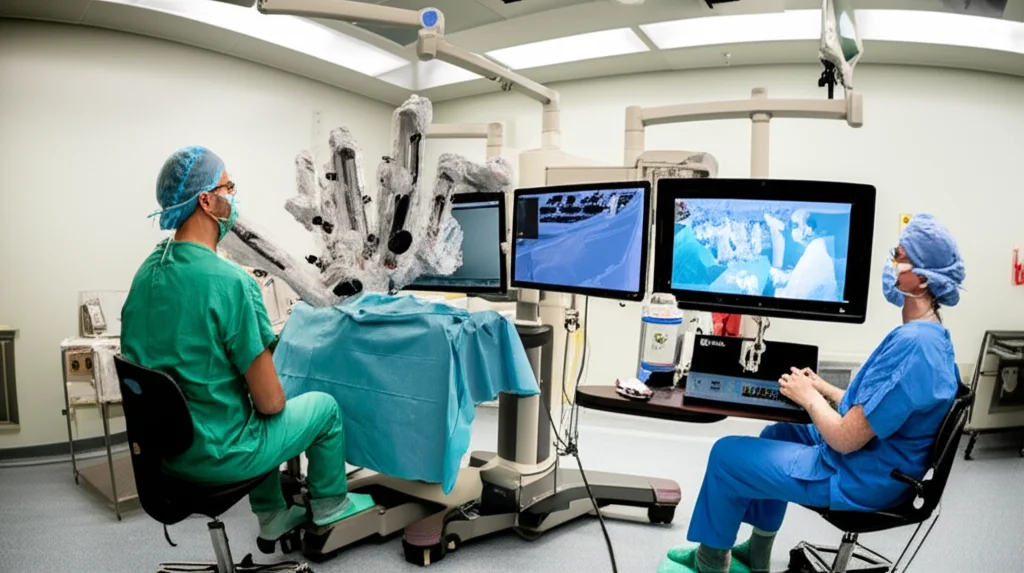
Now, add the secret sauce: the dual console. The da Vinci system has this awesome feature where both the trainee and the supervising specialist have their own console. The specialist can watch, guide, and, most importantly, take control instantly if things get tricky. It’s like having a co-pilot who can grab the stick at any second. This setup is designed to let trainees get hands-on time and learn effectively while ensuring patient safety remains the top priority.
Putting the Training to the Test: The Study Setup
So, researchers in Australia decided to see if this modular training approach, backed by the dual console, actually works in the real world. They looked at RALPs performed at a busy robotic surgery center over about a year and a half. They had a mix of cases, some led predominantly by experienced specialists and others where trainees, who were going through this modular program, did most of the heavy lifting.
How did they define ‘trainee-led’? Simple: they broke down the entire RALP procedure into 13 specific steps, from setting up the robot to taking out the prostate. If a trainee completed more than 75% of these steps (that’s 10 out of 13), the case was counted as ‘trainee-lead’. They then compared a bunch of stuff between the two groups:
- Patient characteristics (like age and BMI)
- Details about the surgery itself (how long it took, blood loss)
- Any issues during or right after the surgery (complications, hospital stay)
- And crucially, the pathological outcomes – basically, how well the cancer was removed (were the edges clear? was the PSA undetectable later?).
The Big Reveal: Trainees Hold Their Own!
Alright, drumroll please… What did they find after looking at 126 cases? Get this: There was no significant difference in the operative parameters or the pathological outcomes between the cases where trainees were in the driver’s seat (with supervision, of course!) and those done mostly by the seasoned specialists. Zip. Nada. The outcomes were remarkably similar!
This is a huge deal! It suggests that with the right training method – breaking it down step-by-step and having that expert safety net via the dual console – trainees can perform complex robotic surgery procedures like RALP just as safely and effectively as experienced surgeons, at least in terms of how the surgery goes and how well the cancer is removed.

Diving Deeper into the Numbers
Let’s peek behind the curtain a bit. The study looked at things like the total time the robot was being used, how much blood was lost, the need for transfusions, and any complications that popped up within 30 days. They used a standard grading system for complications (the Clavien–Dindo system). They also checked the surgical margins (making sure no cancer cells were left behind at the edges) and whether PSA levels were undetectable at 6 and 12 weeks post-op, which is a good sign the cancer is gone.
The results were really encouraging. Even with trainees doing the majority of the work in their designated cases, the rates of complications, blood loss, hospital stay, and those all-important clear surgical margins and undetectable PSA levels were comparable to the specialist-led cases. This wasn’t just luck; it points to the effectiveness of the structured, supervised training.
It’s worth noting that the specialists likely handled the *most* technically challenging parts in some cases, even in the ‘trainee-lead’ group, or took on the overall more complex patients. But the fact that trainees could complete over 75% of the steps and still achieve equivalent outcomes speaks volumes about the training method’s ability to build competency safely.
Benchmarking Against the World
How do these results stack up globally? Pretty well, actually! The outcomes seen in this study compare favorably with results from other high-volume centers around the world. While comparing studies can be tricky because everyone does things slightly differently (especially how they grade complications), the data here holds its own against established benchmarks.
This study adds to a growing body of evidence supporting structured, modular training for robotic surgery. Other training programs internationally also incorporate similar ideas, using simulations, e-learning, and step-wise progression. The dual console is consistently highlighted as a key tool, enabling that crucial real-time guidance and intervention.
The Road Ahead for Robotic Training
So, what’s the takeaway? This study strongly suggests that training the next generation of robotic surgeons using a modular, step-by-step approach with the safety net of a dual console is effective and, most importantly, safe for patients. It helps trainees climb that steep learning curve without compromising the quality of care.
Given the increasing use of robotic surgery, especially for procedures like RALP, having formalized training programs is becoming essential. This research supports the idea that implementing structured, modular curricula, perhaps focusing resources like dual consoles at specific training centers, can help trainees gain proficiency earlier in their careers. It’s about building skills methodically and safely, ensuring that as robotic surgery becomes more common, the expertise is there to match it, delivering the best possible outcomes for patients.

It’s an exciting time in surgical training, and studies like this show that with the right tools and methods, we can train highly skilled surgeons ready to tackle the complexities of modern medicine.
Source: Springer