Blending Robot Brains: The Secret to Coexistence with Humans
Hey there! So, imagine a world where robots aren’t just stuck in factories doing the same thing over and over. Picture them out and about, sharing our spaces – maybe helping out in a care home, delivering groceries, or even just navigating a busy public area. Sounds cool, right? But here’s the catch: when robots step out of controlled environments and into our messy, unpredictable world, they’re not just interacting with one dedicated human user. They’re sharing space with *everyone*. And not everyone has the same goal as the robot, or even each other!
The Challenge of Sharing Space
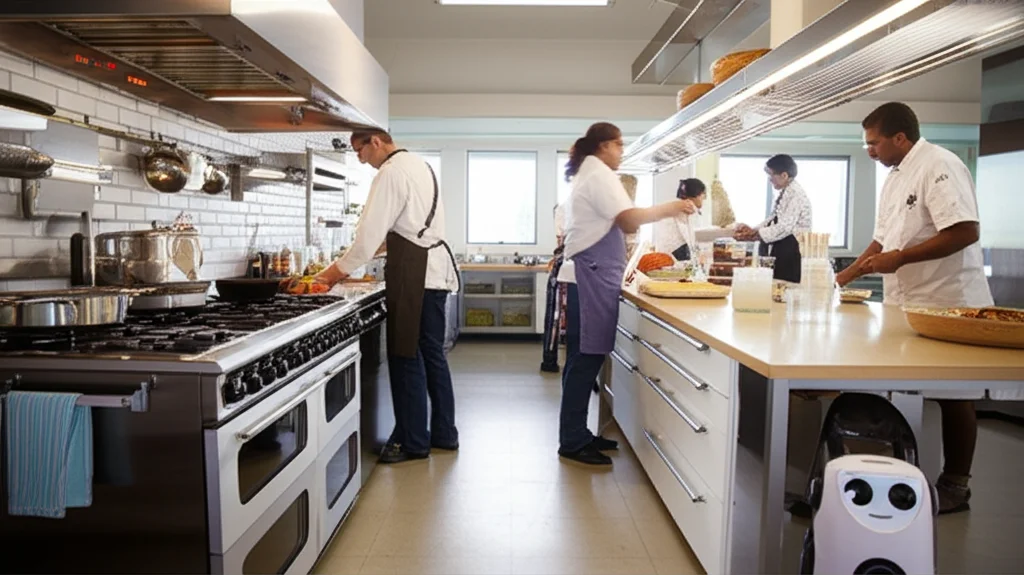
For ages, the focus in robotics has been on making robots *collaborate* with humans. Think of a robot arm handing a tool to a factory worker, or a helper robot working with a person towards a single, shared objective. That’s great for specific, defined tasks. But what happens when the robot is trying to make a sandwich for Grandma, and Grandpa walks into the kitchen needing to use the same counter space to make tea? They don’t have a shared goal, but their actions impact each other. This is what the folks behind this research call a “coexistence” environment.
Traditional ways of teaching robots, like standard reinforcement learning, kind of fall flat here. Why? Well, they often train a robot for a specific situation or a small group of collaborators. If the number of people changes, or their tasks are different, you often have to start the training all over again. Plus, these methods don’t easily teach a robot to be helpful to others *without* completely abandoning its own primary job. We need robots that can be good neighbors, not just single-minded task completers.
A Fresh Approach: Decomposing and Blending
Enter this really neat research! They’ve come up with a clever framework to tackle this “coexistence” problem. Instead of trying to teach a robot one giant, complex policy that covers everything, they break it down. They teach the robot two main things separately:
- Task Policies: How to do its own job (like making that sandwich).
- Interaction Policies: How its actions *impact* other agents (humans or other robots) who are doing *their* own thing.
The magic happens *when* the robot needs to act. It figures out what its own task is, tries to guess what the other agents are trying to do (that’s the “goal inference” part), and then *blends* these different learned behaviors together on the fly to decide what to do next. What’s really neat is they use something called “entropy” to guide this blending process.
What’s Coexistence, Anyway?
Now, they call this “coexistence” environments, and it’s important to understand how it’s different from just cooperation or competition.
In a *cooperative* environment, everyone has a shared goal. Think of a team of robots moving a heavy object together. In a *competitive* environment, agents are fighting for a limited resource, and one winning usually means others lose.
Coexistence is somewhere in between. Agents are in the same space, their actions *can* affect each other (like needing the same dish rack), but they don’t necessarily share a goal, and it’s possible for *everyone* to still achieve their own objectives, maybe just not optimally. It’s not a zero-sum game.
This is related to “Ad-Hoc Teamwork” (AHT), where an agent has to join a team of unknown agents and work together. But AHT usually assumes there’s *some* kind of shared goal, even if it’s mixed-motive. Coexistence, as defined here, is broader – the agents might have totally independent or even slightly opposing goals. The key is that they *impact* each other, often just by sharing space or resources.
The Clever Bit: Entropy-Based Blending
Okay, so how does this blending work? The robot has learned its task policy (how to make a sandwich) and several interaction policies (how its actions affect someone trying to make tea, or someone trying to set the table, etc.). When it’s time to act, it looks at its own goal and tries to figure out the goals of the others nearby using its goal inference model.
Then, it uses an entropy-based mechanism to combine the “suggestions” from its task policy and the relevant interaction policies. Think of entropy as a measure of uncertainty or randomness in the policy’s action choices. If the task policy is super confident about the *one* best action to take (low entropy), the framework leans heavily on that. If the task policy is less certain and sees multiple good options (high entropy), it has more “room” to incorporate suggestions from the interaction policies, allowing it to be helpful or considerate to others without messing up its main job.
This approach helps manage the “regret” – basically, how much worse off the robot is for trying to be a good neighbor. By using entropy, they can ensure that blending in helpful behaviors doesn’t significantly harm the robot’s ability to complete its own task, especially when the task is critical. It’s a smart way to balance personal goals with social awareness in a multi-agent world.
Putting the Framework to the Test
Alright, time to see if this actually works outside of theory. The researchers tested their framework in a few different simulated environments:
- CookingZoo: A complex kitchen environment where agents have different recipes (goals) and need to share tools and ingredients. This is a prime example of a sparse-reward coexistence environment – you only get a big reward when you finish your recipe, and interactions (like moving an ingredient for someone) might only help much later.
- Particle Environment: Agents need to reach specific target areas, but their position also affects others’ rewards. This is a simpler, dense-reward coexistence environment.
- Level-Based Foraging (LBF): A classic cooperative environment where agents need to work together to collect apples. This was used as a baseline to see how the framework fares in a purely collaborative setting compared to methods designed specifically for cooperation.
They trained the task and interaction policies separately, trained a goal inference model to guess what others were doing, and then evaluated the full system with the entropy-based blending. They compared it to a traditional “joint learning” approach (where one big policy is trained to optimize everyone’s reward together) and sometimes to agents just focusing on their own task.
What the Results Showed
Turns out, this entropy-based blending thing is pretty darn good, especially in those tricky coexistence scenarios.
In the CookingZoo and Particle environments, the framework consistently outperformed the joint learning method. It was better at getting its *own* task done *and* better at improving the overall performance of the group. The joint learning method struggled, likely because figuring out how to share credit and coordinate actions for different goals is really hard when you train one big policy. The sparse rewards in the kitchen made this even tougher for the joint learner.
What’s cool is that the framework’s performance was very close to an agent that *only* cared about its own task, showing that it could be helpful to others without sacrificing its primary goal.
They also tested how well the system handled not knowing what the other agents were trying to do (task uncertainty). The goal inference model got better over time in an episode, though it wasn’t perfect. Even with this uncertainty, the entropy-based blending framework performed almost as well as a version that *knew* everyone’s goals perfectly. This suggests the framework is quite robust.
However, in the purely cooperative LBF environment, the story was a bit different. Here, specialized cooperative methods (like the joint reward learner and GPL) did better. The researchers think this is because the entropy-based method, while great for exploration and robustness in complex coexistence, introduces a bit more randomness or “uncertainty” in action choices. In environments like LBF where speed and direct coordination for a shared goal are key, this extra entropy can slow things down compared to a policy trained purely for optimal joint execution. It’s a trade-off between flexibility/robustness and pure speed in specific cooperative tasks.
They also compared the entropy-based blending to a simpler approach that just averaged the policies equally. The entropy method was better in coexistence environments, helping the robot avoid getting “stuck” or making suboptimal choices when the task and interaction policies suggested different actions. The entropy weighting helps the robot prioritize its task when needed, while still being open to helping when it can.
Limitations and What’s Next
Now, it’s not perfect yet. This work focused on environments where actions are discrete (like moving in one of four directions, or picking up an object). Applying this to robots that need to make smooth, continuous movements is a future step. Also, the interaction policies were trained with just *one* other agent at a time. Scaling this to learn how to interact effectively with *groups* of agents simultaneously, especially when coordinated group actions are needed, is another challenge. And, of course, the big one: testing this framework with actual humans, who are way more complex and unpredictable than simulated agents!
Wrapping Up
So, what does this all mean? This research offers a really promising way forward for building robots that can truly share our world. By breaking down the problem into task-solving and interaction-awareness, learning them separately, and then cleverly blending them using entropy based on inferred goals, they’ve created a system that’s more scalable and adaptable than traditional methods. It allows robots to pursue their own goals while being mindful and even helpful to others around them, paving the way for more complex and harmonious multi-agent, multi-human environments in the future. It’s a big step towards robots becoming not just collaborators, but good cohabitants.
Source: Springer