

Quantum Entanglement’s Wild Ride: Three Atoms, Tricky Light, and a Funhouse Mirror Cavity!
Hey there, fellow quantum enthusiasts!
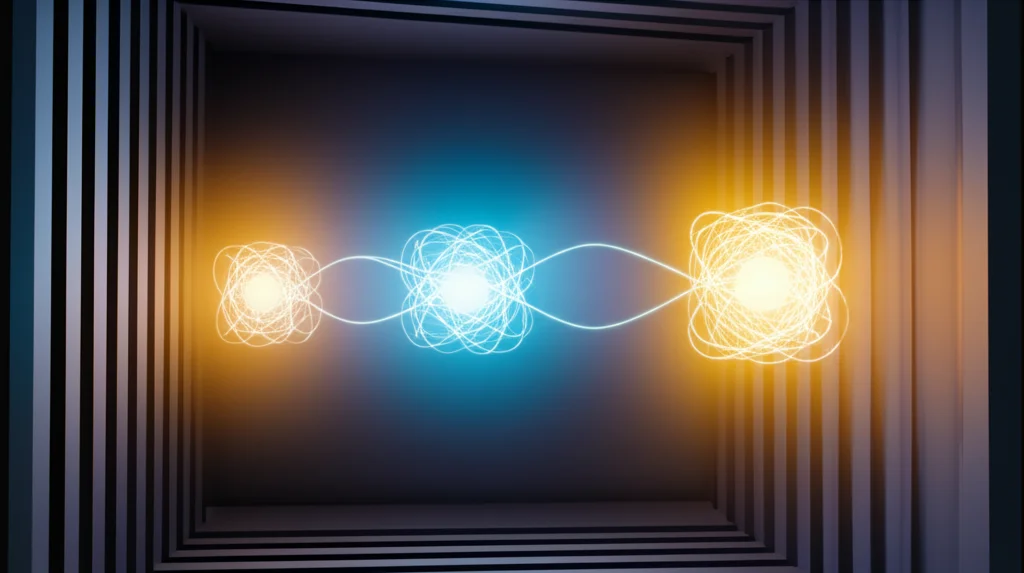
Or maybe you’re just curious about the weirdest stuff the universe does. Either way, welcome! I’ve been diving deep into the fascinating world where light meets matter, specifically in a setup that sounds a bit like a quantum funhouse. We’re talking about three tiny atoms hanging out in a special box called an optical cavity, where light bounces around, and things get seriously interesting thanks to something called a Kerr medium. Think of the Kerr medium like a funhouse mirror for light – it makes things behave in unexpected, nonlinear ways.
At the heart of this exploration is quantum entanglement. If you’re not familiar, picture this: two or more particles become so deeply linked that they share a single destiny, no matter how far apart they are. Measuring something about one instantly tells you something about the others. It’s spooky, non-classical, and absolutely essential for building the futuristic tech we dream about – stuff like quantum computers, super-secure communication, and even teleportation (yes, really!).
Creating and controlling these entangled states is a huge challenge, but systems where atoms interact with light in cavities (like the one we’re studying) are fantastic playgrounds for this. They naturally generate entanglement between the atoms and the light field. This process not only shows off the wild side of quantum theory but also has massive practical implications.
The Jaynes-Cummings Model and Its Wild Cousins
Our work builds on a classic, foundational model in quantum optics called the Jaynes-Cummings model (JCM). It’s the simplest description of a single atom talking to a single mode of light in a cavity. It’s been super useful for understanding basic interactions and even for proposing ways to generate cool quantum states.
But the universe isn’t always simple! So, scientists have been busy generalizing the JCM to include all sorts of extra effects. We’re talking about:
- Adding Kerr nonlinearity (our “funhouse mirror” effect).
- Considering multi-level atoms (ours are two-level, but others study more complex ones).
- Looking at multi-photon transitions (where atoms absorb or emit more than one light particle at once).
- Scaling up to multi-atom interactions (like our three atoms!).
- Dealing with multi-mode fields (more than one type of light in the cavity).
- Introducing intensity-dependent coupling (where how strongly the atom and light interact depends on how much light is there).
That last one, intensity-dependent coupling, is particularly cool because it’s been seen experimentally! It’s linked to the idea of nonlinear coherent states, which are promising for creating nonclassical light. Our specific model is a kind of “f-deformed” version of the JCM, where the light operators are replaced by nonlinear versions, incorporating both intensity-dependent coupling and the f-deformed Kerr nonlinearity.
What We Did (Without Getting *Too* Technical)
So, in this paper, my colleagues and I decided to dive into the dynamics – how things change over time – for our system of three identical two-level atoms interacting with a single light mode in that Kerr medium with f-deformed nonlinearity. We also threw in the possibility of multi-photon transitions.
We specifically looked at two main things:
- Atomic Population Inversion: This tells us about the energy exchange between the atoms and the light field. Are the atoms excited or in their ground state? How does this change over time?
- Entanglement Dynamics: How does the entanglement between the atoms and the light, and even between the atoms themselves, evolve?
We used some pretty involved math (solving the time-dependent Schrödinger equation, if you’re curious!) to figure out the state of the system over time and then calculated quantities like atomic inversion and entanglement measures (von Neumann entropy for atom-field, concurrence for atom-atom). We played with different parameters: the strength of the intensity-dependent coupling, whether the atom and light frequencies were perfectly matched (detuning), the strength of the Kerr nonlinearity, the specific type of f-deformation, and the number of photons involved in the transition (one-photon vs. two-photon).
Atomic Population Inversion – The Energy Dance
What I found really cool is how the energy sloshes back and forth between the atoms and the light. We call this atomic population inversion. When we plotted how this inversion changes over time, we saw some classic quantum phenomena like collapse and revival. It’s like the energy exchange dance temporarily stops (collapses) and then starts up again (revives).
We saw that the Kerr and f-deformed Kerr nonlinearities significantly influenced this dance. They could change the patterns, sometimes making them quite complex, especially when combined with intensity-dependent coupling. The detuning parameter also played a role; when the frequencies weren’t perfectly matched, the oscillations became less symmetric. It really showed how sensitive this energy transfer is to the details of the interaction.

Atom-Field Entanglement – Getting Tangled Up with Light
Okay, now for the really mind-bending part: entanglement! This is where the atoms and the light get so deeply linked that you can’t describe one without the other. We measured this using something called von Neumann entropy. A higher entropy value here means more entanglement between the atoms (as a group) and the light field.
What we saw was pretty exciting: those Kerr effects, the “funhouse mirror” stuff, actually boosted the entanglement between the atoms and the field. The intensity-dependent coupling also helped enhance this link. However, the detuning parameter, where the frequencies are off, generally *reduced* the amount of entanglement. It’s like trying to dance together when you’re not quite in sync – it’s harder to get truly tangled up!
There was a notable exception, though, particularly when we looked at the two-photon transition case… but more on that in a bit! The key takeaway here is that we have knobs (like the Kerr strength, the type of coupling, and detuning) that we can turn to influence how much the atoms and the light get tangled.
Atom-Atom Entanglement – Atoms Linking Up
But wait, there’s more entanglement! The atoms themselves can get tangled up with each other, not just with the light. For this, we used a different tool called concurrence to measure the entanglement between pairs of atoms (specifically, we looked at Atom 1 and Atom 2, but the system was symmetric).
It was interesting to see how the intensity-dependent coupling affected this. Sometimes it increased the maximum entanglement achieved, but in one specific case (with the `1/sqrt(n)` nonlinearity function), it actually seemed to shut down the atom-atom entanglement completely. The Kerr nonlinearity generally decreased this type of entanglement, and the f-deformed version seemed even more effective at reducing it. Just like with atom-field entanglement, detuning generally reduced the entanglement between the atoms.
This shows that controlling entanglement is a delicate balancing act. What helps one type of entanglement (atom-field) might hinder another (atom-atom), depending on the specific parameters and nonlinearities involved.
The Two-Photon Twist: A Game Changer?
Now, let’s talk about a neat trick: the multi-photon transition. Instead of just one light particle (photon) being exchanged between the atom and the field, we looked at what happens when two are involved (`k=2`). And wow, did this make a difference!
Comparing the one-photon (`k=1`) and two-photon (`k=2`) cases revealed something significant. In the two-photon case, the detuning parameter, which usually messes with entanglement and reduces it, had a *much less pronounced effect*. Even better, the two-photon transition seemed to significantly enhance and even stabilize the atom-field entanglement. It reached higher maximum values and stayed entangled for longer periods compared to the one-photon case under similar conditions.
This is a big deal! It suggests that using multi-photon transitions, particularly the two-photon one, could be a powerful way to generate more robust and stable entanglement in these kinds of systems. This enhanced entanglement is incredibly valuable for potential quantum technologies.
Pulling the Quantum Strings: Controlling Correlations
So, what’s the big takeaway from all this quantum juggling? It’s all about control. By carefully adjusting things like how the atoms and light interact (the intensity-dependent coupling), whether their frequencies match (detuning), how the cavity medium behaves (Kerr and f-deformed Kerr effects), and even the type of transition (one-photon vs. two-photon), we can actually shape and tune the entanglement dynamics.
Our study highlighted the significant impact of the Kerr and f-deformed Kerr nonlinearities on both the energy exchange (inversion) and the entanglement. While detuning often reduced entanglement, the intensity-dependent coupling and, crucially, the two-photon transition offered promising ways to counteract this and even boost entanglement.
Understanding this level of control is absolutely key if we want to build the quantum computers, communication networks, and sensors of the future. These systems rely on precisely engineered quantum correlations, and our work provides valuable insights into how to achieve that in multi-atom systems embedded in nonlinear environments. It’s a complex dance, but one that holds incredible promise for unlocking the full power of quantum mechanics!
Source: Springer


