
Cosmic Echoes: Hunting Primordial Black Holes with Gravitational Waves
Hey everyone! Let’s dive into one of the most exciting, and honestly, mind-bending topics in cosmology right now: primordial black holes (PBHs) and how we might find them using gravitational waves (GWs) born from the very first moments of the universe, during a period called inflation. It’s like being a cosmic detective, piecing together clues from billions of years ago!
What Exactly Are Primordial Black Holes?
So, picture this: the universe, right after the Big Bang, is a super hot, dense soup. Primordial black holes are theorized to have formed back then, presumably while the universe was still dominated by radiation. This idea isn’t new; folks like Stephen Hawking were thinking about this over fifty years ago.
The cool thing about PBHs is that their mass could be *anything*. Seriously, from something as tiny as the Planck mass (we’re talking ~10-5 grams, smaller than a speck of dust!) all the way up to masses comparable to massive galaxies (~1012 solar masses). That’s a *huge* range!
Now, you might ask, “A black hole is a black hole, right? How do you know if it’s primordial or just one formed from a collapsed star?” Great question! Black holes, according to the “no-hair theorem,” don’t keep a memory of how they were born. But there’s a simple trick: look for black holes with masses *smaller* than the Sun. Our standard understanding of how stars die says you can’t make a black hole less massive than the Sun that way. So, finding a sub-solar mass black hole would be a smoking gun for PBHs. People have looked, but no definitive proof yet. For a long time, PBHs were kind of a niche topic.
The Gravitational Wave Game-Changer
Then came 2015. Boom! The first direct detection of gravitational waves by LIGO, from a binary black hole merger (GW20150914). This was monumental on its own, but there was a surprise: the black holes were around 30 solar masses. At the time, this was *larger* than what many expected from typical stellar collapse models. This immediately sparked the idea: could these be primordial black holes? This single event kicked off an explosion of research into PBHs – how they form, what masses they might have, and how we can spot them. We’ve learned a ton since then!
How Do PBHs Form from Inflation?
Okay, let’s get a bit more technical, but I promise to keep it simple. The standard picture is that PBHs form from regions in the early universe that had a particularly large “bump” in their spatial curvature. Think of the universe as a fabric; these were spots where the fabric was really warped positively, like a tiny closed bubble.
These “bumps,” or curvature perturbations, are thought to have been generated during the period of cosmic inflation – a hypothesized era of super-rapid expansion just after the Big Bang. While we have strong constraints on these perturbations on large scales (thanks to observations like the cosmic microwave background, or CMB, and large-scale structure, LSS), on *small* scales, we know practically nothing! This is where inflation models get interesting. We can design models where inflation creates *huge* perturbations on these tiny scales, much bigger than the ones we see in the CMB.
When one of these large, positive curvature regions becomes about the size of the “Hubble horizon” (basically, the observable universe size at that moment), it starts acting like a little closed universe. And a closed universe, especially one filled with radiation, will eventually stop expanding and collapse. If the initial bump was big enough (around O(1) in amplitude), it collapses into a black hole.
The mass of the resulting PBH is determined by the size of the Hubble horizon when that particular scale crossed it. So, the time of formation dictates the mass.
It’s important to remember that PBH formation must be a *rare* event. If it happened too often, the universe would have been dominated by black holes way too early, which we know didn’t happen. This rarity means that PBH formation is super sensitive to the *extreme peaks* in the distribution of these curvature perturbations. Even tiny deviations from a simple “Gaussian” (bell curve) distribution can drastically change how many PBHs form.
Inflation models, especially those involving more than one field (like the “curvaton” model), can easily produce these enhanced, potentially non-Gaussian perturbations on small scales. In the curvaton model, a field that was just a “spectator” during inflation can end up being the one that determines the universe’s structure later on. By tweaking the parameters, you can get a scenario where PBHs in a specific mass range (like 1018 to 1022 grams, which are currently hard to constrain observationally) could make up all the dark matter! And the cool part is, the non-Gaussianity in this model can either boost or suppress the number of PBHs formed, depending on the details.
The Crucial Link: Induced Gravitational Waves
Here’s where it gets really exciting for modern astronomy. The same enhanced curvature perturbations that *might* collapse to form PBHs *also* generate gravitational waves. How? Well, the vast majority of these regions *don’t* collapse. They just slosh around like sound waves after they enter the Hubble horizon. These sloshing density variations, even if they don’t form black holes, create ripples in spacetime – gravitational waves – at what we call “second order” in perturbation theory.
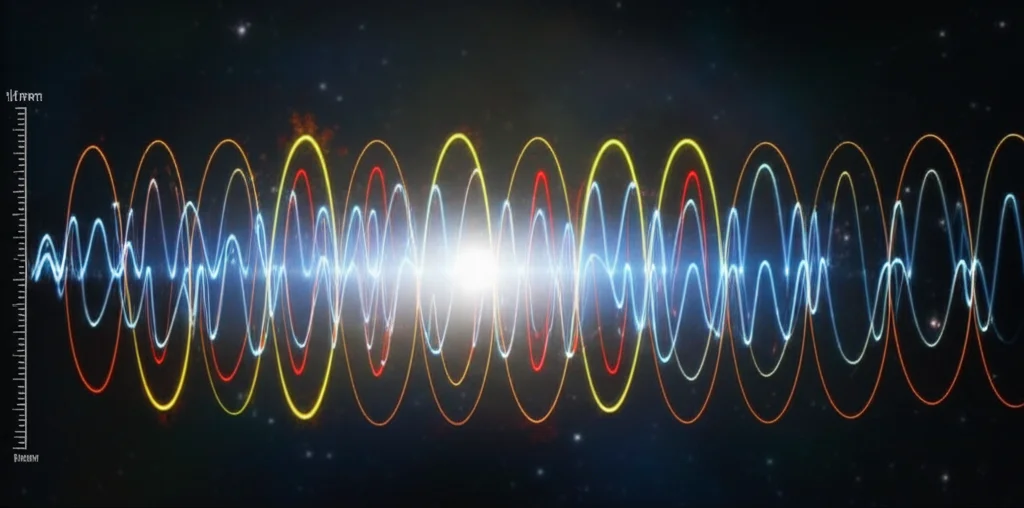
The really key point here is the correlation: the mass of a potential PBH and the frequency of the induced gravitational waves are tightly linked. Why? Because both are determined by the *same* scale crossing the Hubble horizon at the *same* time in the early universe.
While PBH formation is sensitive to the *extreme tail* of the perturbation distribution (those rare, huge bumps), the amount of induced GWs is mostly determined by the overall *power* of the perturbations on that scale. So, you can have induced GWs without PBHs (if the bumps aren’t quite big enough to collapse), but if you have PBHs formed this way, you *almost certainly* have induced GWs!
This gives us a fantastic way to test the idea that PBHs make up the universe’s dark matter. If they do, the associated induced GWs *must* be there, waiting to be detected. For example, if PBHs around 1020 grams are the dark matter, the corresponding induced GWs would have a frequency around 10-3 Hz. Guess what? That’s exactly the target frequency range for future space-based GW detectors like LISA! The expected signal is predicted to be well within LISA’s reach, pretty much regardless of how non-Gaussian the perturbations were.
Even the heavier PBHs, like the 10-100 solar mass ones seen by LIGO/Virgo/Kagra (LVK), have a corresponding GW frequency range (10-8 to 10-9 Hz) that can be probed by Pulsar Timing Arrays (PTAs). PTAs are already putting interesting constraints on the idea that *all* or even a significant fraction of the LVK black holes are primordial.
What About Tiny, Evaporating PBHs?
What if the PBHs are super tiny, say less than 109 grams? These would have evaporated completely by now via Hawking radiation, long before the universe was even a second old! You might think, “Well, no way to see those.” But recent work shows that even these tiny guys could leave a mark. If they were abundant enough to briefly dominate the universe before vanishing, their random distribution would create large inhomogeneities. These inhomogeneities, in turn, would induce gravitational waves with a unique signature that future detectors might be able to spot.
The Takeaway
So, we’ve talked about how primordial black holes could form from large bumps in the early universe generated by inflation. The really cool part is the strong connection to gravitational waves. If PBHs are a significant part of the universe (especially dark matter), the induced GWs from the same early universe processes should be detectable by upcoming observatories like LISA.
Even if PBHs aren’t the dark matter, finding them would tell us *so much* about the physics of the very early universe, a time that’s otherwise incredibly hard to probe directly. PBHs, linked to inflation and observable through gravitational waves, have truly become a central target in cosmology, both for theorists like me trying to understand how they fit into our models, and for observers trying to find that elusive signal. It’s an exciting time to be looking up (or, well, at spacetime ripples!).
Source: Springer