
Unlocking the Secrets of Inflammation: A New PET Tracer Steps Into the Spotlight!
Hey there! Ever wonder what’s going on deep inside our bodies and brains, especially when things aren’t quite right? We’re talking about stuff like neuroinflammation or those tricky tumor-associated macrophages. These tiny cellular players are super important in how diseases like neurological disorders and even cancer develop. And guess what? They often depend on a specific signaling pathway linked to something called Colony-stimulating factor 1 receptor, or CSF1R for short.
Why does this matter? Well, if we could *see* where these CSF1R-expressing cells are and what they’re doing *without* needing to take a biopsy, that would be a game-changer! It could help us understand diseases better, track how they’re progressing, and even see if treatments are working early on. That’s where imaging techniques like Positron Emission Tomography (PET) come in. PET lets us use special molecules, called tracers, that light up specific targets in the body.
The challenge? Finding the *perfect* tracer for CSF1R. Existing ones, like [11C]CPPC and [11C]GW2580, have been developed and show promise, even being used in studies with animals and humans. But honestly? They often have limitations. Sometimes they aren’t specific enough, binding to things they shouldn’t, or they just don’t give a strong enough signal to be truly useful. We need something better, something more sensitive and specific.
Meet [11C]FJRD: The New Candidate
So, we’ve been working on a new candidate tracer. It’s a molecule called FJRD, and we’ve labeled it with Carbon-11 (that’s the “[11C]” part, making it radioactive and visible to the PET scanner). FJRD is part of a family of compounds known for having a really high affinity for CSF1R. Think of it like a key that fits a specific lock – FJRD seems to fit the CSF1R lock really well, at least in lab tests (it has a super low IC50 of 1.4 nM, which is scientist-speak for “binds tightly”).
Our mission was to see how well this new [11C]FJRD tracer actually works, both *in living animals* (that’s “in vivo”) and *in tissue samples* in the lab (that’s “in vitro”). And, of course, we wanted to stack it up against those other two tracers we mentioned, [11C]CPPC and [11C]GW2580, to see if our new guy is an improvement.
Making the Magic Happen (Briefly!)
Whipping up a tracer like [11C]FJRD involves some pretty cool chemistry. It’s a multi-step process starting with simpler ingredients and building up the molecule piece by piece. We managed to synthesize the non-radioactive FJRD and its precursor molecule. Then, we performed the radiosynthesis, which is basically attaching that special Carbon-11 atom. We got a good yield and purity, and the tracer stayed stable long enough for our experiments. Success on the chemistry front!
Testing It Out: The In Vivo Story
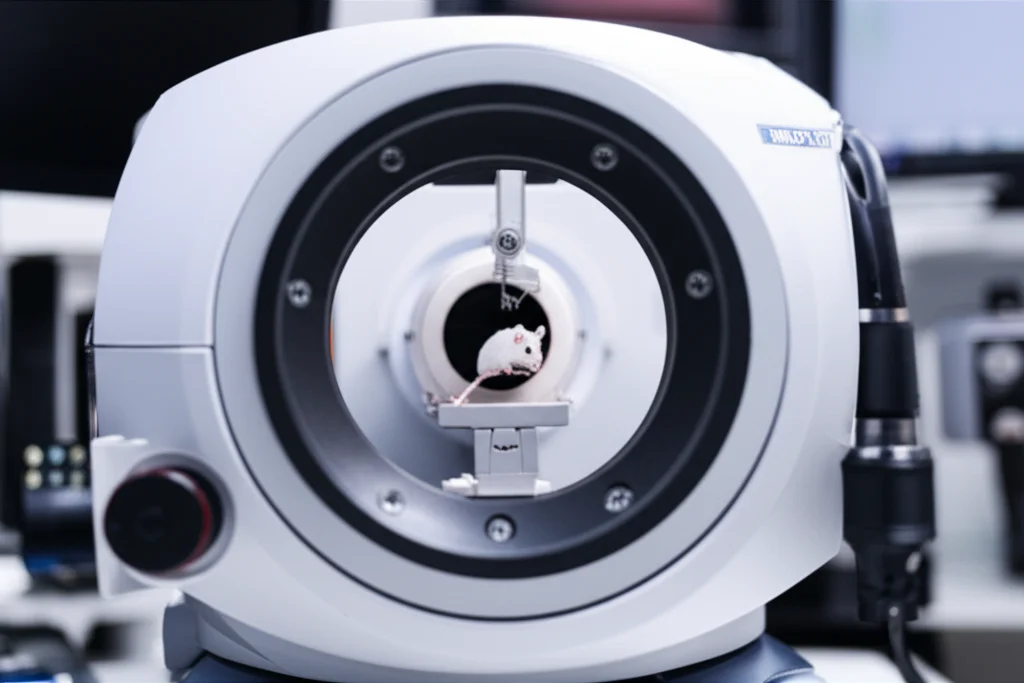
First up, we wanted to see what [11C]FJRD does in living creatures. We used normal mice and rats and scanned them using PET.
What did we see?
- The tracer spread quickly throughout the body.
- Brain uptake was pretty low in these *normal*, healthy animals.
- We saw specific binding in many peripheral organs (like the spleen, liver, and lungs), but interestingly, not so much in the kidneys.
We also tried giving the animals a dose of *non-radioactive* FJRD before the tracer to see if it would block the radioactive tracer from binding (this tells us if the binding is “specific”). In the brain, heart, liver, and lungs, giving the cold FJRD didn’t really change the uptake. In the kidneys, it decreased uptake a bit (around 25%).
We looked specifically at different parts of the rat brain too (like the striatum, hippocampus, thalamus, and cerebellum), but didn’t see any major differences in how the tracer got in or washed out. The overall brain uptake in rats was similar to mice – low in healthy animals, and pre-treating with cold FJRD didn’t show detectable specific binding in the brain.
Getting Up Close: The In Vitro Story
Next, we moved to the lab bench for *in vitro* tests using tissue slices from various organs. This lets us look at binding more directly. We incubated tissue slices with [11C]FJRD and then added different non-radioactive CSF1R inhibitors (FJRD itself, CPPC, GW2580, and BLZ945) to see if they could block the binding of the radioactive tracer.
Here’s where things got really interesting:
- When we added non-radioactive FJRD (self-blocking), the binding of [11C]FJRD decreased significantly in *all* organs tested (brain, spleen, lungs, kidneys, heart, liver). This suggests [11C]FJRD *can* bind specifically to something in these tissues.
- When we added CPPC, it *partially* blocked [11C]FJRD binding, but the blocking effect varied a lot depending on the organ (from 9% in kidneys to 67% in the spleen). This partial blocking by CPPC is a clue that FJRD and CPPC might share a binding spot on the CSF1R molecule.
- Now, for GW2580 and BLZ945 – adding these other inhibitors resulted in only *minimal* blocking of [11C]FJRD binding in *any* organ. This is a big deal! It strongly suggests that a significant chunk of the binding we saw with [11C]FJRD (the part *not* blocked by CPPC, GW2580, or BLZ945) is actually *off-target* binding to molecules other than CSF1R.
We also did the same *in vitro* tests with the other tracers, [11C]CPPC and [11C]GW2580.
- [11C]CPPC showed detectable specific binding mainly in the spleen.
- Shockingly, [11C]GW2580 showed *no* detectable specific binding in *any* of the organs tested under these *in vitro* conditions. This is a bit puzzling, especially since it’s used in *in vivo* studies.
We crunched the numbers on the *in vitro* binding. When we consider the binding blocked by CPPC as specific binding to CSF1R (since CPPC is known to bind CSF1R tightly), we found that [11C]FJRD actually showed higher percentages of this “CSF1R-specific binding” in the heart, lung, and brain compared to [11C]CPPC. This hints that [11C]FJRD *could* be more sensitive for detecting CSF1R in these organs *if* we could sort out the other binding issues. But yeah, that “off-target binding” (the binding *not* blocked by CPPC) was definitely noticeable, ranging from 19% to 72% depending on the organ.

Where Does CSF1R Live?
To help make sense of the binding data, we also looked at where CSF1R protein is actually expressed in normal mouse organs using immunohistochemistry. Turns out, CSF1R is super abundant in the spleen, appearing in a patchy pattern. This matches perfectly with where [11C]CPPC showed strong specific binding *in vitro*. In contrast, we saw very little CSF1R expression in the brain, lung, kidney, heart, and liver in these healthy animals, except for a weak signal in the liver. This confirms that CSF1R levels are much higher in the spleen than in these other organs under normal conditions.
The Brain Barrier Challenge
Okay, so the *in vivo* brain uptake of [11C]FJRD was low in normal animals. We looked at its physical properties (like how “fatty” or “watery” it is, its size, etc.), and they *almost* fit the criteria for a molecule that should cross the blood-brain barrier (BBB) easily. The BBB is like a security system for the brain, keeping lots of molecules out. We didn’t specifically test for it, but maybe efflux transporters (like P-gp or BCRP), which are like pumps that push molecules back out of the brain, are playing a role. However, the peak brain uptake wasn’t *super* low like you’d expect for a really strong substrate of these pumps, so it’s a bit of a head-scratcher.
The Specificity Puzzle
Let’s circle back to that off-target binding issue we saw *in vitro*. The fact that GW2580 and BLZ945 didn’t block [11C]FJRD binding much, even though they are also CSF1R inhibitors, suggests that FJRD might bind to a different spot on the CSF1R molecule than these others. It also reinforces that a lot of FJRD’s binding isn’t to CSF1R at all.
We know from studies on similar molecules that proteins like VEGFRs (Vascular Endothelial Growth Factor Receptors), PDGFR-α, RET, and c-Kit could be potential culprits for this off-target binding. Interestingly, VEGFRs are highly expressed in the kidneys, which aligns with our finding of high off-target binding in the kidneys *in vitro*.
Comparing our findings to other tracers out there:
- Another related compound, [11C]5, showed high specific binding *in vitro* in the brain, but couldn’t get into the brain well *in vivo*.
- [11C]CPPC, despite some concerns about binding to other kinases, showed specific binding in the spleen that lines up perfectly with CSF1R expression there. So, its spleen binding is likely legit CSF1R binding.
- A different tracer, [11C]4, which is brain-permeable and shows specific binding *in vivo* in the healthy mouse brain (a rare feat!), is missing *in vitro* data, which makes it hard to fully evaluate its specificity compared to others like [11C]GW2580 (which, remember, showed *no* specific binding *in vitro* in our study).

What We Learned and What’s Next
So, what’s the takeaway from all this? We’ve successfully created [11C]FJRD, a new potential CSF1R-PET tracer. Our *in vitro* studies suggest it might be more sensitive than [11C]CPPC and [11C]GW2580 for detecting CSF1R in certain organs like the heart, lung, and brain. That’s promising!
However, there are definitely areas for improvement. Its *in vivo* brain uptake in normal animals was modest, and more importantly, our *in vitro* data clearly shows a significant amount of binding that isn’t to CSF1R – that pesky off-target binding.
This study gives us some key insights for future tracer development:
- The spleen is a great place to test CSF1R binding, as it has high expression and both FJRD and CPPC seem to bind there, likely sharing a spot on the receptor.
- While [11C]FJRD shows potential for better CSF1R detection in some organs *in vitro*, we really need to work on making it more specific for CSF1R and better at crossing the blood-brain barrier for it to be a truly useful tool for imaging neuroinflammation.
Developing the perfect tracer is a bit like being a detective – you find clues, test hypotheses, and keep refining your approach. [11C]FJRD is a step forward, highlighting both the potential of this class of molecules and the challenges we still need to overcome to get that ideal CSF1R imaging agent. Onwards!
Source: Springer