Boosting Alfalfa: How One Gene Makes Plants Taller and Bushier
Hey there! Let me tell you about something pretty cool we’ve been working on with alfalfa, that amazing plant known for feeding livestock and making soil happy. You know, alfalfa (*Medicago sativa* L.) is a superstar forage crop – high yield, great quality, and tough as nails when it comes to adapting. But here’s the thing: breeding new and improved alfalfa varieties using fancy biotech stuff like genetic modification or gene editing is a bit of a puzzle because of its unique genetics (it’s tetraploid and cross-pollinates like crazy).
Anyway, we were curious about this one gene, *MsJAR1*. It’s involved in the jasmonic acid (JA) pathway, which is like a plant’s internal communication system, handling things from defense to growth. We thought, “What would happen if we gave alfalfa *more* of this gene?” So, we decided to try overexpressing *MsJAR1* in a popular alfalfa variety called ‘Zhongmu No.1’.
The Gene and Where It Lives
First off, we wanted to know where the protein made by the *MsJAR1* gene hangs out inside the plant cells. Using some neat microscopy tricks, we found that the *MsJAR1* protein loves to be in the chloroplasts. You know, those little green factories where photosynthesis happens? That’s a pretty interesting place for it to be, suggesting it might be doing something important related to energy production or light sensing.
Making the Super Alfalfa
Getting the *MsJAR1* gene into the alfalfa wasn’t a walk in the park, but we used a common method involving a helpful bacterium called *Agrobacterium*. It’s like using a tiny delivery service to drop the new gene into the alfalfa cells. We went through steps like:
- Mixing alfalfa pieces with the *Agrobacterium* to get the gene transferred.
- Selecting the cells that successfully got the gene using a special screening process.
- Growing those selected cells into tiny shoots.
- Helping those shoots grow roots.
- Finally, planting our new transgenic alfalfa plants in pots.
We checked to make sure the gene was really there, and sure enough, we got two lines of transgenic alfalfa (we called them OE-1 and OE-2) where the *MsJAR1* gene was expressed way, way higher – like three to four times more – than in the regular wild-type (WT) alfalfa. Success!
What We Saw: Taller, Bushier Plants
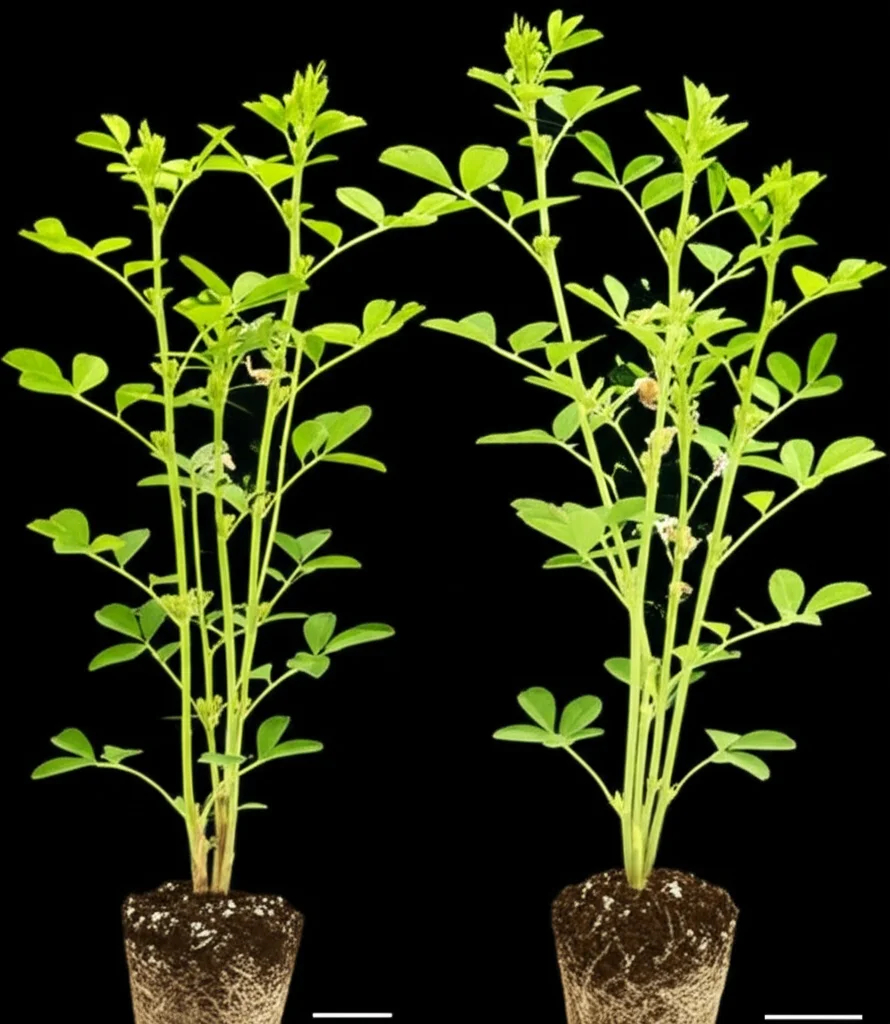
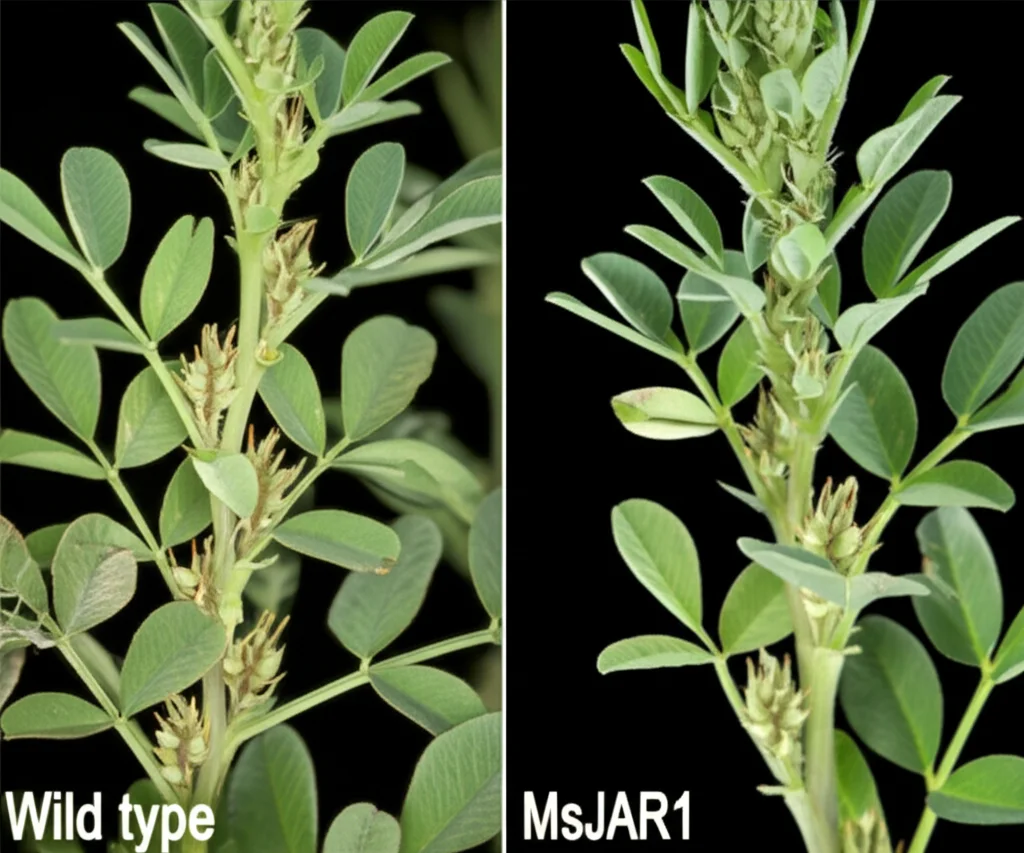
Now for the exciting part – what did these *MsJAR1*-overexpressing alfalfa plants look like? We grew them side-by-side with the regular alfalfa, and the differences were pretty striking. While the transgenic plants had slightly smaller leaves and shorter distances between the nodes on the stem (the internodes), they showed something really desirable for a forage crop: significantly *increased lateral branches* and *increased plant height*! Imagine alfalfa plants that are naturally taller and bushier – that means potentially more biomass, more yield!
Peeking Inside: Structure and Photosynthesis
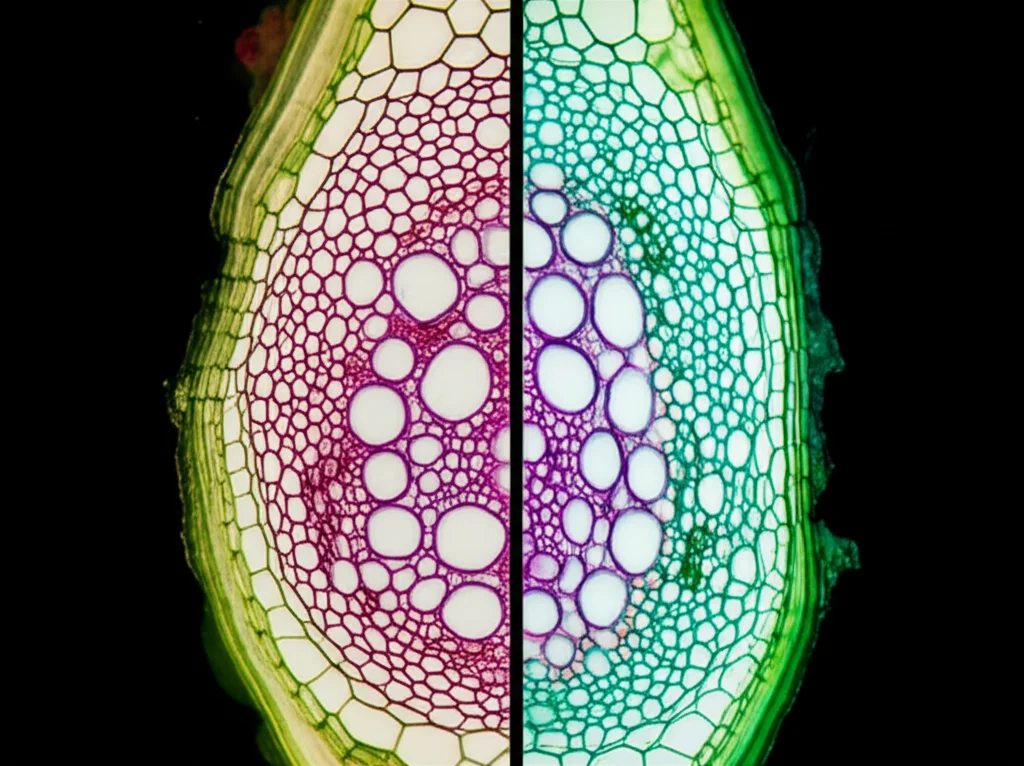
It wasn’t just the outside that changed. We took a look at the internal structure by making thin slices of the leaves and stems. In the leaves of our transgenic plants, the areas responsible for transporting water and nutrients (the xylem and phloem) were actually smaller. But get this – in the *stems*, the xylem and phloem areas were much, much larger! It seems like the plant was redirecting its resources, maybe strengthening the stem to support all that extra height and branching.
We also checked how well these plants were doing photosynthesis. Turns out, the *MsJAR1*-overexpressing alfalfa was like a photosynthesis powerhouse! They had significantly higher stomatal conductance (how much they open their pores to take in CO2), higher net photosynthetic rates (how much sugar they’re making), and higher transpiration rates (how much water they’re releasing). Interestingly, the CO2 levels *inside* their leaves were lower, suggesting they were gobbling up CO2 really efficiently. Plus, they had more soluble protein, which is often linked to better photosynthesis and growth.
The Engine Room: Metabolism and Genes
To dig deeper into *why* these changes were happening, we looked at the genes being expressed in the leaves – basically, taking a snapshot of which instructions the plant’s cells were following. We found over 12,000 genes that were being expressed differently between the transgenic and wild-type plants. When we looked at what these genes do, we found they were heavily involved in core metabolic pathways. We saw enrichment in pathways like:
- Ribosome (making proteins)
- Glycolysis / Gluconeogenesis (sugar metabolism)
- Tricarboxylic Acid Cycle (Citrate Cycle – energy production)
- Photosynthesis (light energy conversion)
This really reinforced the idea that *MsJAR1* is messing with the plant’s fundamental energy and building block production systems. We even measured the activity of some key enzymes in the glycolysis and citric acid cycles, and yep, their activity was significantly higher in the transgenic plants.
Connecting the Dots
It all seems to tie together beautifully. Our analysis showed strong correlations: the genes involved in photosynthesis, glycolysis, and the citric acid cycle were linked to the changes we saw in plant height, branching, leaf size, and internode distance, as well as the photosynthetic rates and enzyme activities.
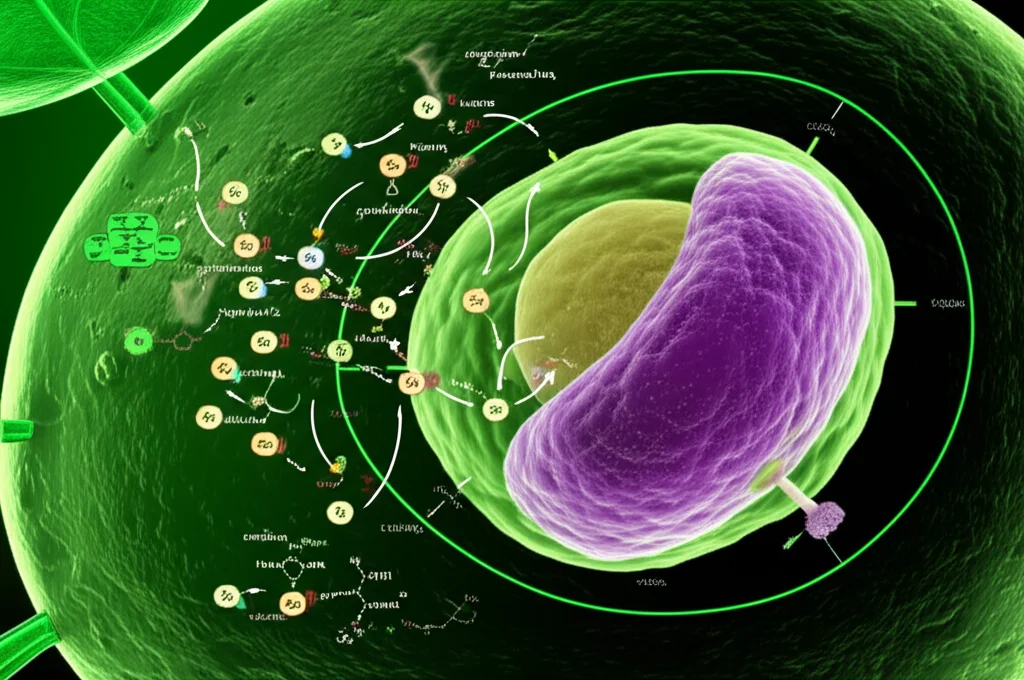
Basically, it looks like overexpressing the *MsJAR1* gene, which localizes to the chloroplasts, ramps up the plant’s metabolic engines – photosynthesis, sugar metabolism, and energy production. This extra energy and metabolic activity seems to fuel the increased growth, leading to more lateral branches and taller plants. The changes in stem structure (more xylem/phloem) likely help support this enhanced growth.
What This Means
So, what’s the big takeaway? Our study shows that the *MsJAR1* gene plays a significant role in regulating alfalfa’s growth and development, specifically boosting traits like plant height and lateral branching, which are super important for yield. By understanding how *MsJAR1* influences photosynthesis and core metabolic pathways, we’re getting closer to finding new ways to improve alfalfa through breeding and biotechnology. This research gives us valuable insights and a potential target for developing alfalfa varieties that are even more productive in the future. Pretty neat, right?
Source: Springer