Leather Waste to Green Fuel: My Journey into Supercritical Biodiesel!
Hey there! So, you know how we’re all getting more and more concerned about relying on fossil fuels? They’re a big reason for climate change, and let’s be honest, they won’t last forever. Plus, the price of oil jumping around can really mess things up globally. It feels pretty urgent, right? That’s why finding cool, renewable energy sources is super important, especially for things like getting around.
Biofuels are often seen as a fantastic stand-in for traditional fuels, particularly for our cars and trucks. Fun fact: diesel engines were actually designed to run on vegetable oils way back when! But petroleum diesel took over because it’s less thick and just worked better with the engines of the time. Modern diesel engines need fuels that flow easily; using raw vegetable oils can gunk things up and cause long-term damage.
To fix this, folks have come up with all sorts of ways to make vegetable oils less viscous, making them suitable for fuel. The most popular trick in the book is called transesterification. Basically, it’s a process that turns the fats (triglycerides) in oils into fatty acid methyl esters (FAME), which behave a lot like regular diesel. This method is key to making biodiesel because it’s efficient and gets the job done.
Biodiesel itself is this neat renewable fuel made from the fatty acids found in plants or animal fats. It’s a more sustainable option than the usual diesel. You can make it in different ways – using acid or base catalysts, enzymes, or even non-catalytic methods. The best way depends on what kind of oil or fat you’re starting with, especially how much water or free fatty acids (FFA) it has.
The Challenge of Waste Biomass
Now, turning waste biomass into biodiesel has been explored quite a bit. We’ve got catalytic methods (acid or base), enzymatic methods, and even thermal ones like pyrolysis or hydrothermal liquefaction. But when you’re dealing with stuff like leather tanning waste (LTW), which is loaded with FFA and moisture, things get tricky.
Base catalysts are fast, but high FFA content turns them into soap – not what you want for fuel! Acid catalysts can handle FFA better but need harsh conditions and often require drying out the waste first, which adds cost and steps. Enzymatic methods are gentler and tolerate impurities, but the enzymes are expensive and can be slow or unstable. Thermal methods can process wet waste but give you a complex mix that needs more refining.
This is where supercritical alcohol transesterification comes in, and it’s pretty exciting! It’s a non-catalytic method that works under high pressure and temperature. The cool part? It can convert the fats directly without needing pretreatment, making it perfect for that high-FFA LTW. It avoids the soap problem, handles moisture, and can do the whole conversion in one go.
Supercritical Magic: A Cleaner Path
Comparing it to other methods, supercritical transesterification really shines. Some integrated methods get high yields but involve multiple steps, increasing complexity and energy use. Others use novel catalysts, which are great for yield but might need a lot of the catalyst or take a long time.
Supercritical transesterification offers some serious environmental perks. No catalysts mean less chemical waste and simpler cleanup. It can handle different types of waste fats and oils, making biodiesel production more sustainable and potentially cheaper. I saw one study where they got a 97% yield from high-FFA waste cooking oil *without* any catalyst or pretreatment using this method! Others are even looking into integrating it with energy recovery systems to make it more efficient.
Building on this, my colleagues and I introduced something new: using nitrogen (N2) as a co-solvent. N2 is inert, safe, abundant, and cheap. It helps lower the required temperature and pressure, making the process more energy-efficient. Unlike some other co-solvents, N2 doesn’t react and helps keep things stable, which is super important when you’re working with waste materials that can degrade easily.
Why Leather Tanning Waste?
Okay, let’s talk about LTW specifically. In places like Egypt, the leather industry is a big deal – lots of jobs, lots of income. But it also produces a *massive* amount of waste. We’re talking about 70-80% of the raw hide ending up as scraps and by-products. In Egypt alone, that’s estimated to be around 100,000 tons every year!
This waste is full of moisture, FFA, and other organic bits. Sounds like a problem, right? But it also means it’s packed with potential energy! Turning this waste into valuable products like biodiesel is a fantastic way to tackle both environmental issues and economic challenges.
The main hurdle with LTW is that high water and FFA content I mentioned. High water encourages the fats to break down further into more FFA. And if the FFA gets too high, it messes up those traditional catalyst methods by making soap.
Researchers have tried different ways to handle lipid waste like LTW. Some use multi-step processes with heat and catalysts. Others use special catalysts. Single-step methods using alcohol under subcritical or supercritical conditions are promising because they don’t need a catalyst and are faster. Supercritical is even quicker than subcritical and great for high-FFA feedstocks.
However, the downside has been the extreme temperatures and pressures needed, plus requiring a lot of alcohol, which drives up costs. People have tried using co-solvents or combining different processes to lower these requirements, but adding more chemicals or steps also adds cost and complexity.
Understanding the kinetics – basically, how fast the reaction happens and what affects it – is crucial for making the process efficient and designing reactors for large-scale production. Lots of studies look at transesterification kinetics experimentally. But you can also use simulation software like Aspen Plus. It has built-in models and powerful tools to estimate kinetic parameters, which is super helpful for complex reactions. It’s been used for designing large-scale biodiesel plants, showing it’s reliable for industrial applications.
Our Approach: Single-Step Supercritical Methanolysis
So, in our work, we decided to tackle this by exploring biodiesel production from LTW using that single-step, catalyst-free supercritical methanolysis method I told you about. We wanted to find the absolute best conditions for the reaction – the perfect reaction time, temperature, pressure, and the ratio of methanol to LTW.
We used a smart statistical method called Response Surface Methodology (RSM) combined with a Box–Behnken experimental design (BBD). Think of BBD as a way to test different combinations of variables efficiently without having to try *every single possibility*, especially avoiding unsafe extreme conditions. This helps us maximize the biodiesel yield while keeping energy and material use as low as possible.
We used LTW as the feedstock and, as I mentioned, N2 gas as a co-solvent. We then checked the quality of the biodiesel produced against the European standard (EN 14214). We also dug into the kinetics of the reaction and built a reactor model using Aspen Plus based on our experimental data. This simulation part was key to estimating the kinetic parameters and understanding the process better for potential scaling up.
The goal was to integrate this optimization with the Aspen Plus simulation to figure out how to make the process energy-efficient and ready for commercial use. It’s all about finding a sustainable and efficient way to turn LTW into biodiesel, helping both the environment and the leather industry’s bottom line.
Getting Down to Experiments
We got the LTW from a tannery in Egypt. First, we washed it really well to get rid of any dirt. Then, we dried it completely at 120 °C and filtered it. The fat was extracted from the dried LTW using a Soxhlet extractor with n-hexane as the solvent. This took about 6–8 hours. After that, we used a rotary evaporator to remove the solvent, leaving us with the crude LTW oil.
We analyzed the oil to see how much fat and FFA it contained using standard methods. We also looked at the specific types of fats (triglycerides or TGs) in the oil using fancy equipment called high-performance liquid chromatography (HPLC). This gave us a detailed profile of the different TGs present, which was super important for the simulation part later.
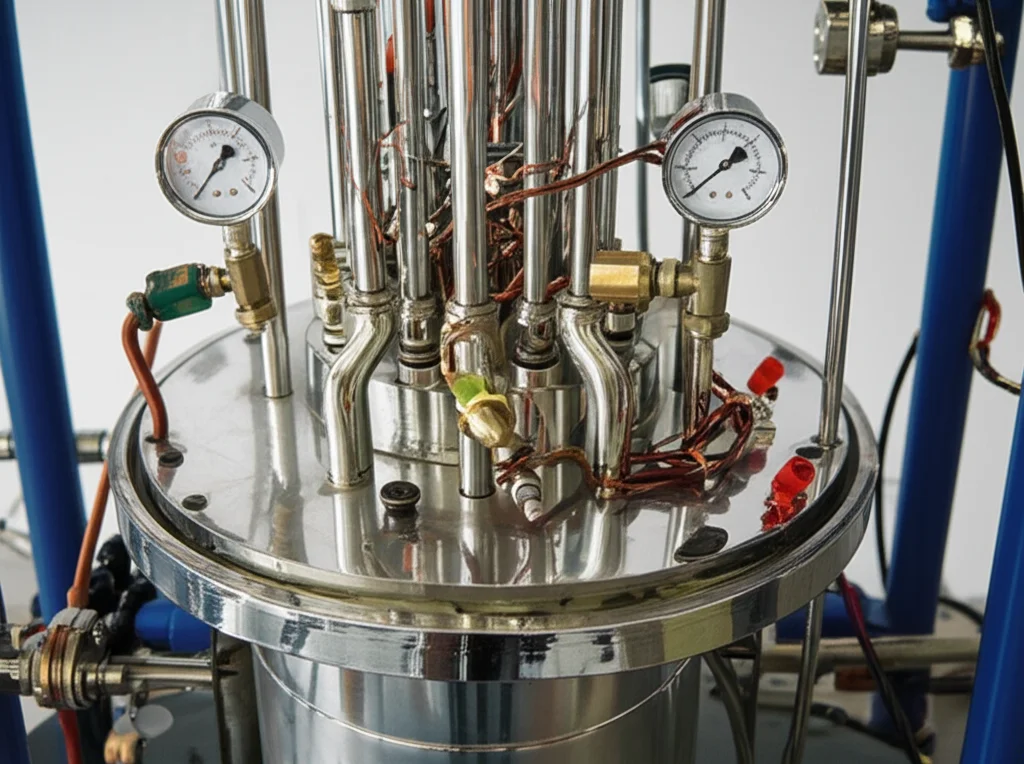
For the actual supercritical transesterification, we used a 50 cm3 stainless steel reactor. It had all the necessary bits – a pressure gauge, a thermometer, and an external heater. We hooked up the N2 gas cylinder to get the pressure we needed.
We put the LTW oil and methanol into the reactor in the right ratio and started heating. As the methanol heated up, it created some pressure, and we added the rest with the N2 gas. It took about 20 minutes to get to the target temperature and pressure. We only started timing the reaction *after* these conditions were reached to keep things consistent.
Once the reaction time was up, we quickly cooled the reactor down in an ice bath to stop everything. Then, we carefully released the pressure and separated the products into biodiesel and glycerol. We heated the biodiesel to evaporate any leftover methanol, and then we analyzed its properties to see if it met the EN 14214 standard.
Finding the Sweet Spot with RSM
RSM is a powerful statistical tool that helps you understand how different variables affect an outcome and find the best combination. We used it to optimize our biodiesel production process. We looked at four main variables: the methanol-to-LTW molar ratio (rmo), temperature, pressure, and reaction time. We tested each variable at three different levels.
We used the Box–Behnken Design (BBD) because it’s great for optimizing processes with four variables using fewer experiments than a full factorial design (29 runs instead of 81!). It also avoids testing extreme combinations that might be unsafe or impractical. This design helps us build a robust model and systematically explore the experimental space to find those optimal conditions.
We ran the experiments in a random order to make sure that any results we saw weren’t just due to the sequence of runs. We calculated the biodiesel yield for each run based on the experimental data.
We used a standard quadratic equation to model the relationship between our variables and the biodiesel yield. This equation helps us see the linear effects, the quadratic effects (how the effect changes as the variable increases), and the interaction effects between variables. We checked how good our model was using statistical measures like R-squared values and Analysis of Variance (ANOVA). ANOVA tells us which variables are statistically significant using the F-test and p-values. A low p-value (less than 0.05) means the variable has a significant impact.
We used Design Expert software for all the experimental design, analysis, and optimization. The goal of the optimization was to maximize the biodiesel yield while minimizing the energy-intensive variables like temperature, pressure, and time.
The ANOVA results confirmed that our RSM model was highly significant, with a very low p-value. The lack-of-fit test also showed that the model fit the experimental data well. The R-squared values were high, meaning the model explained most of the variation in the experimental results.
We looked at plots comparing the predicted yields from our model to the actual experimental yields, and they matched up really well, showing the model is reliable. A residuals plot showed that the differences between predicted and actual values were random, which is a good sign for the model’s accuracy.
We also used perturbation plots to see how each variable affected the yield when others were kept constant. Variables like the methanol ratio, temperature, and pressure showed strong curves, confirming their significant impact, just like the ANOVA told us. For example, increasing the methanol ratio initially boosted the yield, but going too high caused a slight dip, which is something others have seen too – maybe due to dilution.
Temperature had a direct positive effect, but going too high (above 374 °C) caused the yield to drop slightly, likely because the biodiesel started breaking down at those extreme temperatures. Pressure also helped up to a point (around 250 bar), after which its effect lessened or slightly decreased the yield. Reaction time increased the yield initially, but longer times (over 25 min) also led to a slight decrease, possibly due to degradation of the biodiesel, especially the unsaturated types, at high temperatures.
Hitting the Optimal Conditions
Using the Design Expert software, we set the goal to maximize the biodiesel yield while minimizing temperature, pressure, and time (since they use a lot of energy). We allowed the methanol ratio to be more flexible, as unused methanol can be recycled.
The software crunched the numbers and found the optimal conditions: a methanol-to-LTW ratio of 32.35:1, a temperature of 322.938 °C, a pressure of 219.073 bar, and a reaction time of just 14.26 minutes! Under these conditions, the model predicted a biodiesel yield of 89.35%.
We then ran experiments using these exact optimal conditions to check if the model was right. And it was! The experimental yield was super close to the predicted value (89.351%), with a tiny error. This really validated that our optimization method and model were accurate and reliable.
Checking the Biodiesel Quality
We analyzed the biodiesel produced under these optimal conditions to make sure it met the European standard (EN 14214). The density was spot on, within the acceptable range. Viscosity is important for how well the fuel sprays in the engine, and ours met the standard too. In fact, most of the properties we measured, like density and viscosity, complied with the EN 14214 requirements, confirming that we produced high-quality biofuel from this waste.
Simulating the Process with Aspen Plus
To really understand the process and get it ready for potential industrial scale, we used Aspen Plus simulation software. First, we needed to know exactly what kind of fats were in our LTW oil feedstock. We used HPLC to identify and quantify the 13 main types of triglycerides (TGs) present. This detailed composition was crucial for building an accurate model in Aspen Plus.
We represented these TGs, along with methanol, glycerol, and the resulting FAMEs (the biodiesel components), in the software. Since methanol and glycerol are polar and interact strongly, we used a specific thermodynamic model (NRTL) in Aspen Plus that’s good for systems like this.
We modeled the reaction using a Continuous Stirred Tank Reactor (CSTR) in Aspen Plus. We needed to figure out the reaction kinetics – how fast the reaction goes and what affects it. Since the kinetics of converting TGs step-by-step are complex, we simplified it. We assumed the overall reaction was irreversible and followed pseudo-first-order kinetics (meaning the rate mainly depends on the concentration of the fats, as we used a lot of methanol). We also assumed side reactions were negligible.
We set up two reactors in the simulation: a stoichiometric reactor (R-STOIC) based on the known chemical reaction and experimental conversion, and the kinetic reactor (R-CSTR). We used a tool in Aspen Plus to adjust the kinetic parameters in the R-CSTR (like the rate constant, k, and activation energy, Ea) until the amount of products matched what we got from the R-STOIC (which was based on our experimental yield). This way, we could estimate the kinetics without needing more experiments.
We assumed that all 13 different TGs in the LTW oil reacted with the same kinetics because they share a similar reaction mechanism. This simplification is common and works well when you have a complex mix.
Unpacking the Kinetics
Using the Aspen Plus simulation, we estimated the kinetic parameters. We found the activation energy (Ea) to be 45.085 kJ/mol and the pre-exponential factor (A) to be 86.24 s⁻¹. The rate constant (k) at our optimized temperature (322.938 °C) was 0.0098 s⁻¹. We plotted the rate constant against temperature (Arrhenius plot), and it showed a strong linear relationship, confirming our parameters were reliable.
The simulation also showed that the rate constant increased with temperature, which makes sense – higher temperatures usually mean faster reactions because molecules collide more often and with more energy.
Interestingly, the kinetic parameters (k and Ea) were found to be the same for all 13 different TGs in the LTW feedstock. This uniformity, despite the chemical differences, is likely because the main step in the reaction is similar for all of them, and the supercritical conditions help smooth out any differences. The relatively low activation energy we found is probably due to the mix of TGs, especially the presence of unsaturated fats which tend to react more easily, and the favorable conditions of the supercritical state.
Validating the Model
We validated our kinetic model by running the R-CSTR simulation with the estimated parameters and comparing the predicted TG conversion to our experimental results at the optimized temperature. The simulation predicted 89.49% conversion, which is incredibly close to our experimental yield of 89.35%! The difference was tiny, just 0.16%, showing excellent agreement and confirming that our estimated kinetic parameters and the assumption of uniform kinetics were valid.
We also compared the simulated and experimental TG conversion at different temperatures, and the errors were consistently low. This further validated the accuracy and robustness of our kinetic model across a range of conditions.
Sustainability and Advantages
Achieving an 89.35% biodiesel yield from LTW using a catalyst-free supercritical process is a pretty big deal. While some conventional catalytic methods might get slightly higher yields, they often need a lot of catalyst (up to 20% by weight!), take much longer (hours compared to our 14 minutes!), and can’t handle the high FFA in LTW because of soap formation.
Our method completely avoids the need for catalysts, which means no chemical waste from catalysts and simpler purification. It’s much faster than many other methods. Using N2 as a co-solvent also makes the process less harsh and safer compared to using flammable gases.
This work really establishes supercritical methanolysis as a sustainable, single-step way to valorize LTW. It tackles technical challenges and helps overcome economic barriers in biodiesel production from this difficult waste.
The environmental benefits are huge. No catalysts mean no chemical waste ending up in groundwater or needing expensive cleanup. While supercritical conditions need high heat, the super-short reaction time means less overall energy use compared to longer catalytic processes. Turning LTW into biodiesel diverts tons of waste from landfills, reducing methane emissions. It avoids hazardous chemicals like sulfuric acid used in some other methods and uses less water because there’s no need for post-reaction washing. Using N2 instead of flammable co-solvents also improves safety.
This aligns perfectly with global sustainable development goals – clean energy, sustainable industry, and responsible consumption. It positions supercritical methanolysis as a cornerstone for sustainable biodiesel production, especially in industries that generate a lot of waste like leather tanning.
Wrapping It Up
So, there you have it! We successfully showed that you can produce high-quality biodiesel from leather tanning waste using a catalyst-free supercritical methanolysis process. By using RSM and BBD, we found the optimal conditions: a methanol-to-LTW ratio of 32.35:1, 322.9 °C, 219.1 bar, and just 14.26 minutes of reaction time, giving us a fantastic 89.35% biodiesel yield.
The Aspen Plus simulations backed this up beautifully, with simulated conversion matching experimental results almost perfectly. The kinetic studies revealed a simple pseudo-first-order reaction with a low activation energy, likely thanks to the unique waste composition and the supercritical conditions. The fact that all the different fats in the waste reacted with the same kinetics simplified things nicely without losing accuracy.
The biodiesel we made met the European standard, confirming it’s ready to be used as a renewable fuel. This work isn’t just about making fuel; it’s about turning a big environmental problem – leather waste – into a sustainable solution, contributing to the circular economy and helping us move away from fossil fuels.
Next steps? Figuring out how to make this work on a much larger, industrial scale and looking into the economics to make sure it’s not just good for the planet, but also makes sense business-wise. It’s exciting stuff!
Source: Springer