Cool Crystals: Making X-ray Imaging Materials Easy
Well, hello there! Let me tell you about something really neat that’s happening in the world of materials science. You know how we use X-rays for all sorts of things, from checking for broken bones to scanning luggage at the airport? A crucial part of that technology relies on materials called scintillators. These clever substances take high-energy X-ray photons and turn them into lower-energy visible light photons that our detectors can actually see. It’s like a translator for light!
For a while now, scientists have been looking at metal halides for this job. They’re pretty good at absorbing X-rays and converting them. Lead-based ones were showing promise, but, well, lead is toxic, isn’t it? And they had this little problem called “self-absorption” where the light they produce gets re-absorbed before it can escape. Not ideal for clear images.
So, the hunt was on for something better, something lead-free, less toxic, and with properties that make for clearer, brighter signals. Enter the lanthanides! These are those cool elements down in the f-block of the periodic table, known for their unique light-emitting abilities. Using trivalent lanthanide ions (Ln3+) in metal halides seemed like a great idea because they’re less toxic and have these lovely large Stokes shifts (meaning the light they emit is quite different in energy from the light they absorb, reducing that pesky self-absorption).
The catch? Making lanthanide-based metal halides with good crystal quality has been a bit of a headache. Traditional methods often involve high temperatures or complicated processes like solvothermal synthesis or hot-injection. Lanthanides can be tricky; they love oxygen and water, and their halides don’t always play nicely together in mixed solutions during synthesis. We needed a simpler, faster, milder way to get these materials.
A Cool New Way to Make Them
Guess what? Someone figured it out! The brilliant minds behind this research came up with a fantastic new method using simple recrystallization, and get this – they did it *at room temperature*! No need for intense heat or pressure.
The trick was picking the right pair of liquids: methanol as the solvent (where things dissolve) and ethanol as the anti-solvent (where the dissolved stuff doesn’t like to stay dissolved, so it precipitates out).
Here’s the basic recipe, simplified:
- Take some Cesium Chloride (CsCl) and a Lanthanide Chloride (like TbCl3).
- Dissolve them separately in methanol.
- Mix the two solutions.
- Slowly add ethanol to the mixture.
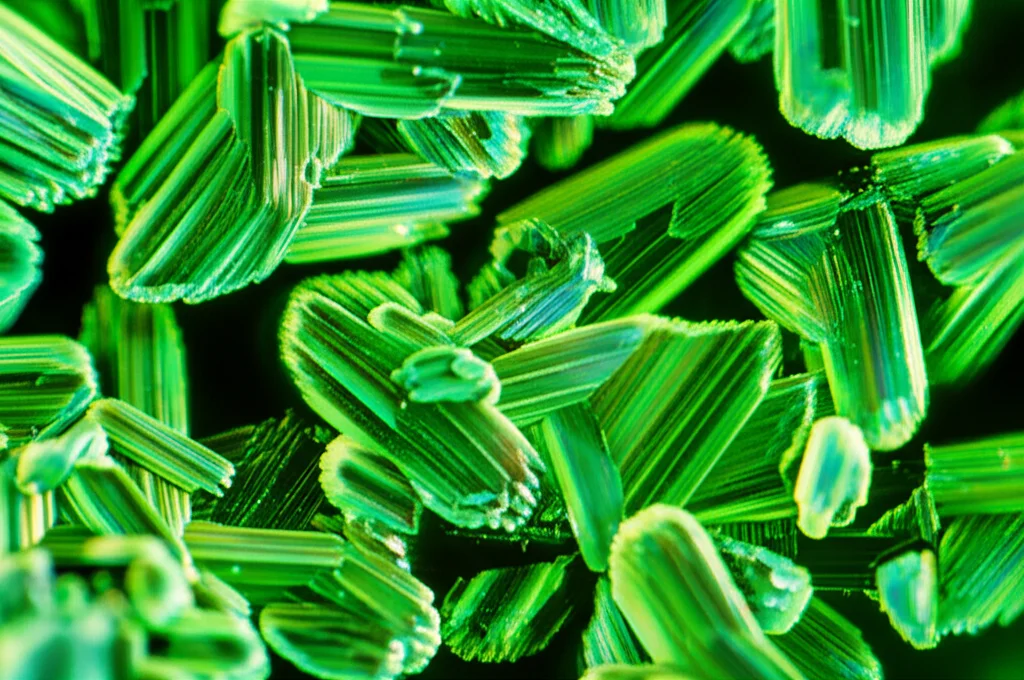
Boom! Almost instantly, within about 2 minutes, tiny crystals (microcrystals, or MCs) of the Cs3LnCl6 metal halide form and precipitate out. You just collect the powder and dry it a little. That’s it! Room temperature, super fast, and mild conditions. This is a game-changer because it makes these materials much more accessible to make.
They successfully made a whole bunch of these Cs3LnCl6 MCs with different lanthanides (Ce, Pr, Nd, Sm, Eu, Gd, Tb, Dy, Ho, Er, Tm, Yb, Lu). They even checked their crystal structures using X-ray diffraction (XRD) and looked at their shapes with scanning electron microscopy (SEM). It turns out the shapes change depending on the lanthanide, going from thin plates to flower-like structures, which is pretty cool and tells us something about how fast they crystallize.
Beyond Single Elements: Large Scale and High Entropy
Now, here’s the really neat part about this method. It’s not just for making tiny lab samples. They showed that you can scale this up easily. By just increasing the amounts of the starting materials proportionally, they could make a significant amount (like 11 grams!) of Cs3TbCl6 MCs in one go. Imagine doing that with a high-temperature method – much more energy and complex equipment needed!

But wait, there’s more! They also demonstrated that these crystals can be recycled. If you need to use them for something specific and then recover them, you can dissolve them back in methanol and then precipitate them out again with ethanol. This is fantastic for sustainability and resource efficiency.
And for the materials science enthusiasts out there, they even used this method to create *high-entropy* metal halide crystals. High-entropy materials are a hot topic right now because mixing several different elements in roughly equal proportions can give you unique and enhanced properties. Usually, making these requires super high temperatures (like 1000°C!). But using this room-temperature recrystallization method, they successfully made a five-element crystal, Cs3{TbDyHoErTm}1Cl6, just by slowly diffusing the anti-solvent into a mixed solution over 12 hours. They confirmed it was a single-phase, high-entropy crystal, which is a significant achievement at room temperature.
Shining Bright: Optical Properties
Okay, so they can make them easily. But do they work well as scintillators? That depends on their optical properties – how they absorb and emit light.
They looked at the photoluminescence (PL) of these Cs3LnCl6 MCs. This is basically seeing how much light they emit when you shine UV light on them. Different lanthanides emit different colors, which is why they are used in things like TV screens and LED lights.
Some of these materials showed really strong emissions. Cs3CeCl6 and Cs3PrCl6 emitted bright blue light, Cs3TbCl6 gave off a lovely green (at 547 nm), and Cs3EuCl6 glowed red (at 592 nm and 612 nm). Cs3YbCl6 even showed strong emission in the near-infrared (around 1000 nm).
The key to their brightness lies in how they absorb energy. Some lanthanides (like Ce, Pr, Tb) have transitions called 4f→5d transitions, and others (like Eu, Yb) have charge transfer transitions from the chlorine atoms to the lanthanide ions (Cl→Ln). These transitions are really good at absorbing light and then transferring that energy to the lanthanide ions, which then emit their characteristic light. This is better than the “parity-forbidden” 4f→4f transitions that are weaker absorbers.
To understand this better, they even did theoretical calculations (Density Functional Theory or DFT) to look at the electronic structure. The calculations showed that in the materials with strong absorption and emission (like Cs3CeCl6 and Cs3EuCl6), the energy levels for these 4f→5d or Cl→Ln transitions were favorably aligned, making them more likely to happen under UV light.
Now, the big number for how efficiently a material converts absorbed light into emitted light is called the Photoluminescence Quantum Yield (PLQY). And here’s where Cs3TbCl6 really shines! It had the highest PLQY among all the Cs3LnCl6 MCs tested, hitting an impressive 90.8%! That’s higher than most other lead-free metal halides reported. High PLQY is a great indicator that a material will be a good scintillator.
They also checked the stability of these materials. They showed excellent structural stability up to high temperatures (600°C) and great air stability, retaining most of their luminescence even after being stored for 300 days. That’s important for practical applications.
Ready for X-ray Action!
With that high PLQY and large Stokes shift, Cs3TbCl6 MCs looked like a prime candidate for X-ray scintillators. So, they put them to the test.
First, they looked at how well Cs3TbCl6 absorbs X-rays compared to commercially available scintillators like NaI:Tl and LuAG:Ce. At typical X-ray energies (8-10 keV), Cs3TbCl6 had a higher absorption coefficient than NaI:Tl and was comparable to LuAG:Ce. Good start!
Next, they measured the Light Yield (LY) under X-ray irradiation. This is the number of visible light photons produced per unit of absorbed X-ray energy (photons/MeV). Using LuAG:Ce as a reference (which has a LY of 25,000 photons/MeV), Cs3TbCl6 MCs showed an outstanding LY of ~51,800 photons/MeV! That’s more than double the reference and higher than many other reported lanthanide-based metal halide scintillators made with those difficult high-temperature methods. This high LY means they are very efficient at converting X-ray energy into light.
They also checked the material’s response to different X-ray dose rates – it was linear, which is exactly what you want for accurate imaging. The detection limit was also incredibly low (63 nGy s−1), much lower than required for medical X-ray diagnosis standards. And they showed excellent radiation hardness; the material’s performance didn’t degrade even after a significant cumulative X-ray dose.
Seeing Through Things: X-ray Imaging Performance
The ultimate test is using these materials to actually create X-ray images. To do this, they mixed the Cs3TbCl6 MCs powder with a flexible polymer called PDMS (polydimethylsiloxane) to make thin films. These films are easy to handle and can be placed in an X-ray imaging system.

They used these films to image everyday objects like a smartphone, a headset, and a wireless network card. And guess what? The images were clear enough to distinguish the internal structures! This demonstrates their potential for non-destructive testing.
One key metric for image quality is spatial resolution – how fine the details you can see are. Using a standard line-pair card, they measured the spatial resolution of the Cs3TbCl6@PDMS thin film to be 12 lp mm−1 (line pairs per millimeter). This is excellent and exceeds the resolution of most other reported scintillator thin films based on lanthanide metal halides. A higher lp/mm means you can see finer details.

Why This Is a Big Deal
So, let’s wrap this up. What we have here is a fantastic new method to make a whole family of lanthanide-based metal halide microcrystals. It’s:
- Ultrafast: Takes just minutes.
- Mild: Done at room temperature with simple liquids.
- Scalable: Easy to produce large quantities.
- Recyclable: The materials can be recovered and reused.
- Versatile: Can even make complex high-entropy crystals.
And critically, these materials, especially Cs3TbCl6, show outstanding performance as X-ray scintillators, with high light yield and excellent spatial resolution in thin films.
This work doesn’t just give us a new way to make these materials; it highlights their huge potential as safer, more efficient scintillators for future X-ray imaging applications, from medical diagnostics to security screening and industrial inspection. It’s pretty exciting to think that a simple room-temperature process could lead to clearer X-ray vision!
Source: Springer