
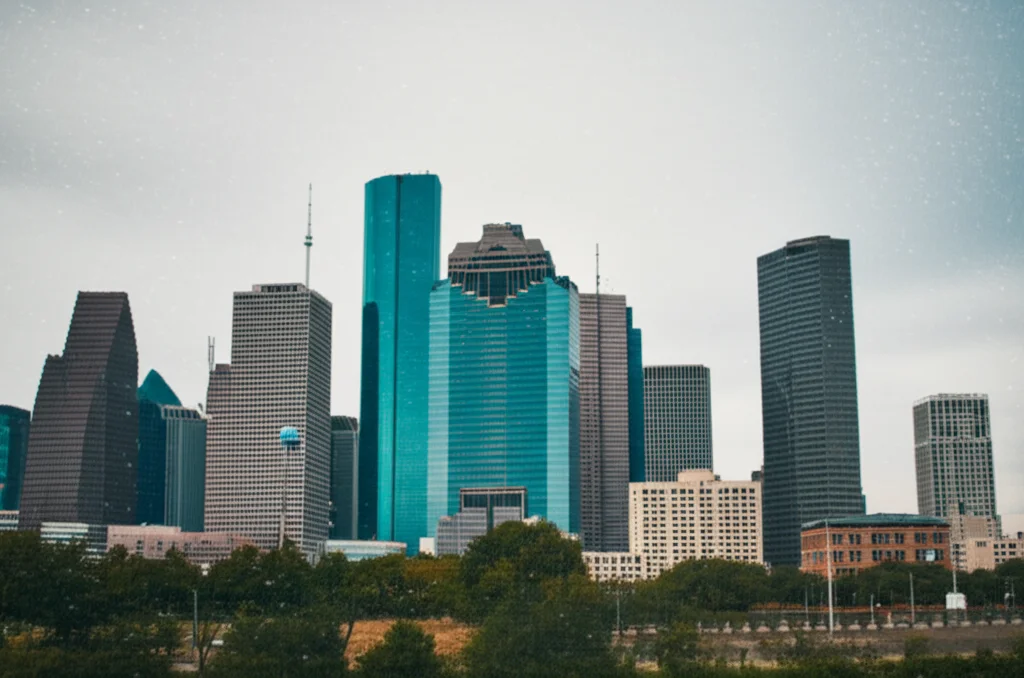
Houston’s Air Secret: Organics Crash the Aerosol Nucleation Party!
Hey There, Air Watchers! Let’s Talk Houston Haze
You know, sometimes you look up at the sky, especially in a big city, and you see that bit of haze. Ever wonder what’s really going on up there? Well, I’ve been digging into some pretty cool science, and it turns out the air above places like Houston is a lot more dynamic and mysterious than you might think. We’re talking about something called aerosol nucleation – basically, how tiny particles are born directly from gases floating around. These little guys aren’t just innocent bystanders; they seriously mess with our air quality, our health, and even the climate.
For a while now, the big brains studying this stuff in polluted urban areas, especially those massive cities in China, figured it was mostly a tag-team effort between sulfuric acid and certain base compounds, like amines. It seemed like organics (you know, carbon-based molecules) were important for making the particles *grow* bigger, but not really for getting the whole nucleation party started. But here’s the kicker: is that the whole story for *every* city? A recent deep dive into the air over Houston, Texas – America’s fourth-largest and pretty polluted city – suggests maybe not!
The Houston Hustle: Setting the Scene
So, picture this: a bunch of scientists set up shop right on the University of Houston campus. They brought out all the fancy gear to sniff the air and see exactly what chemical players were present and what the tiny particles were doing. Houston’s a fascinating place for this because it’s got a mix of emissions from refineries, power plants, ships, and just plain old city life. Plus, being in a warm, subtropical climate adds another layer to the puzzle.
They measured everything from the usual suspects like sulfuric acid and gases like SO2 and NOx, to base compounds like ammonia and amines, and even these tricky things called oxygenated organic molecules (OOMs). They also tracked the birth rate and growth rate of new particles, and how many pre-existing particles were already hanging around (that’s called the condensational sink, and in a polluted city, it’s usually pretty high, making it harder for new particles to survive).
Guess what they found? Frequent bursts of new particle formation, even when there were lots of bigger particles already there! And it turns out, cooler temperatures seemed to help kick things off, which makes sense in a warmer climate. But the really interesting part was *what* chemicals were present during these nucleation events.
The Usual Suspects (and a New Friend)
During the days when new particles were forming like crazy, the levels of sulfuric acid were way higher – sometimes ten times higher! – than on non-event days. This wasn’t a huge surprise, as sulfuric acid is known to be a key player. Ammonia and amines (like dimethylamine, or DMA) were also elevated. These bases are like chaperones for sulfuric acid, helping its molecules stick together to start forming clusters.
But here’s where the Houston story gets spicy: the levels of those low-volatility OOMs were *twice* as high on nucleation days compared to quiet days. Twice! That’s a pretty strong hint that these organic molecules weren’t just sitting on the sidelines waiting for growth; they were right there in the thick of it from the very beginning.
- Sulfuric acid: A classic initiator, definitely needed.
- Bases (Ammonia e Amines): Help stabilize sulfuric acid clusters.
- Low-Volatility Organics (OOMs): Turns out, they’re crucial too, at least in Houston!

Organics Steal the Show
So, what makes these Houston OOMs so special? The scientists did some serious chemical detective work. They found that the OOMs in Houston were different from those seen in places like Beijing. For starters, they were bigger molecules, including a significant amount of “dimers” – basically, two organic molecules that have hooked up.
Turns out, Houston’s air has a mix of volatile organic compounds (VOCs) – the stuff that gets oxidized to form OOMs – coming from both natural sources (like trees, think monoterpenes) and human activities (like burning fuel and even things like paints and cleaning products, think aromatics). This mix is different from cities where anthropogenic VOCs dominate.
More importantly, the way these VOCs got oxidized in Houston seemed to favor the creation of *low-volatility* OOMs and those crucial dimers. In places like Beijing, high levels of NOx (nitrogen oxides from combustion) tend to interfere with the process that forms these low-volatility dimers. But in Houston, the conditions allowed these organic molecules to become highly oxygenated and sticky enough to participate directly in the nucleation process. They had more oxygen atoms and fewer nitrogen atoms compared to their Beijing counterparts. This unique chemical makeup meant they were volatile enough (or rather, *low* volatile enough!) to jump from the gas phase and help form new particles.
Putting the Pieces Together
With all this data, the researchers built a computer model to see if they could explain the observed nucleation rates (how fast new particles were forming). And guess what? A model that included sulfuric acid, base compounds (using DMA as a stand-in for the mix), *and* those low-volatility OOMs did a fantastic job of matching the real-world measurements. The relationship wasn’t just with sulfuric acid and bases; adding the organics made the picture complete.
They also looked at how fast the newly formed particles grew. Again, the same players were involved. While sulfuric acid and OOMs condensing onto the particles were important, the coagulation (sticking together) of those base-stabilized sulfuric acid clusters also played a role, especially for rapid growth. The OOMs, however, were absolutely essential for helping these tiny clusters grow large enough to survive in the polluted urban air – contributing a whopping 20-70% to the initial growth!
This is a big deal because it confirms that in Houston, the organics aren’t just for growth later on; they’re part of the initial birth process *and* the crucial early growth phase.

Houston vs. The World (Well, China)
So, the key takeaway here is that urban aerosol nucleation isn’t a one-size-fits-all phenomenon. What drives it can be different depending on the specific chemical environment of the city. In Houston, with its particular mix of biogenic and anthropogenic VOCs and different NOx levels compared to some Chinese mega-cities, the organic molecules play a much more direct and significant role in the nucleation process itself.
This study in Houston is actually the first time scientists have been able to use simultaneously measured concentrations of all these key precursors (sulfuric acid, bases, *and* OOMs) at an urban site to successfully explain both the nucleation and initial growth rates. It even validates some complex experiments done in large chambers that tried to mimic urban conditions!
Looking Ahead
This research isn’t just about understanding Houston’s air; it has implications for cities everywhere, especially in the US and Europe, which might have similar emission profiles. As cities continue to grow globally, and as emission patterns change (think more VOCs from everyday products, potentially less SO2 from cleaner fuels), the way new particles form will likely evolve too. Rising temperatures from urban heat islands could also influence these processes.
Understanding this complex, multicomponent nucleation process – where sulfuric acid, bases, and low-volatility organics all team up – is going to be absolutely crucial for developing effective strategies to clean up urban air and protect public health in the future. It highlights the need for global models to account for these regional differences in atmospheric chemistry.
Source: Springer