Connecting the World: How a Global Solar-Wind Grid Powers Our Future
Hey folks! We’ve all heard the buzz about ditching fossil fuels and embracing renewables, right? It’s a huge part of hitting those net-zero emission goals we keep hearing about. But let’s be real, building a global power system that runs mostly on solar and wind? That sounds like a pretty massive undertaking, full of challenges. Solar and wind are awesome, but they’re kinda moody – they only work when the sun shines or the wind blows. This variability is a big headache when you need power 24/7.
Traditionally, we’ve leaned on things like big batteries or hydropower to smooth out those bumps. But relying *just* on storage can get super expensive, and you’re still vulnerable to things like extreme weather knocking out regional grids. Remember that cold snap in Texas back in 2021? Widespread blackouts. As we move towards systems potentially powered 100% by renewables, these generation-demand mismatches could become even more critical.
So, what’s the game-changer? Connecting everything. Trans-regional interconnection of power systems isn’t a brand-new idea – folks like Buckminster Fuller dreamed of a global energy grid way back when. We’ve seen smaller-scale versions pop up, like Spain and Morocco linking up, or countries in Central America sharing power. These pioneering projects show it’s possible, and recent studies are really digging into the potential benefits on a larger scale.
But here’s the thing: while the idea is out there, getting a clear picture of how to actually build a *globally interconnected solar-wind system* aimed at net-zero emissions has been a bit fuzzy. Previous looks were often too high-level, missing the nitty-gritty geographic and temporal details. We needed a way to figure out not just *where* the potential is, but *how* to connect it, store it, and get it to where it’s needed, hour by hour, across the entire planet.
The Big Picture: Our Global Renewable Potential
So, we rolled up our sleeves and dove deep. We integrated high-resolution data – down to 500 meters spatially and hourly temporally – to really map out the global potential for solar and wind energy. We looked at what’s actually exploitable, accessible, and interconnectable. And let me tell you, the theoretical potential is mind-blowing – way more than humanity could ever need.
But focusing on the practical stuff, what we found is pretty neat. The total electricity generation from global interconnectable solar-wind potential could hit a staggering 237.33 ± 1.95 × 10³ TWh/year. To put that in perspective? That’s about 3.1 times the projected global electricity demand for 2050, and still 1.2 times the demand for 2100! So, the raw resource is definitely there.
However, it’s not evenly spread out. Densely populated areas often have less potential due to land use competition, while less populated regions can be absolute powerhouses. And even with global connections, you still have those pesky seasonal and diurnal differences. This highlights a crucial point: you absolutely need comprehensive energy storage solutions alongside the grid.
Here’s another kicker: just building solar and wind everywhere and hoping for the best doesn’t work. Without smart planning, you’d have to build enough to meet the absolute peak demand at the worst possible moment globally. This leads to massive energy wastage – over 75% of electricity generation could be curtailed (basically, thrown away) during times of overproduction. That’s not just inefficient; it’s a total bummer. This is why optimization isn’t just a nice-to-have; it’s essential.
Building the Grid: An Optimized Pathway
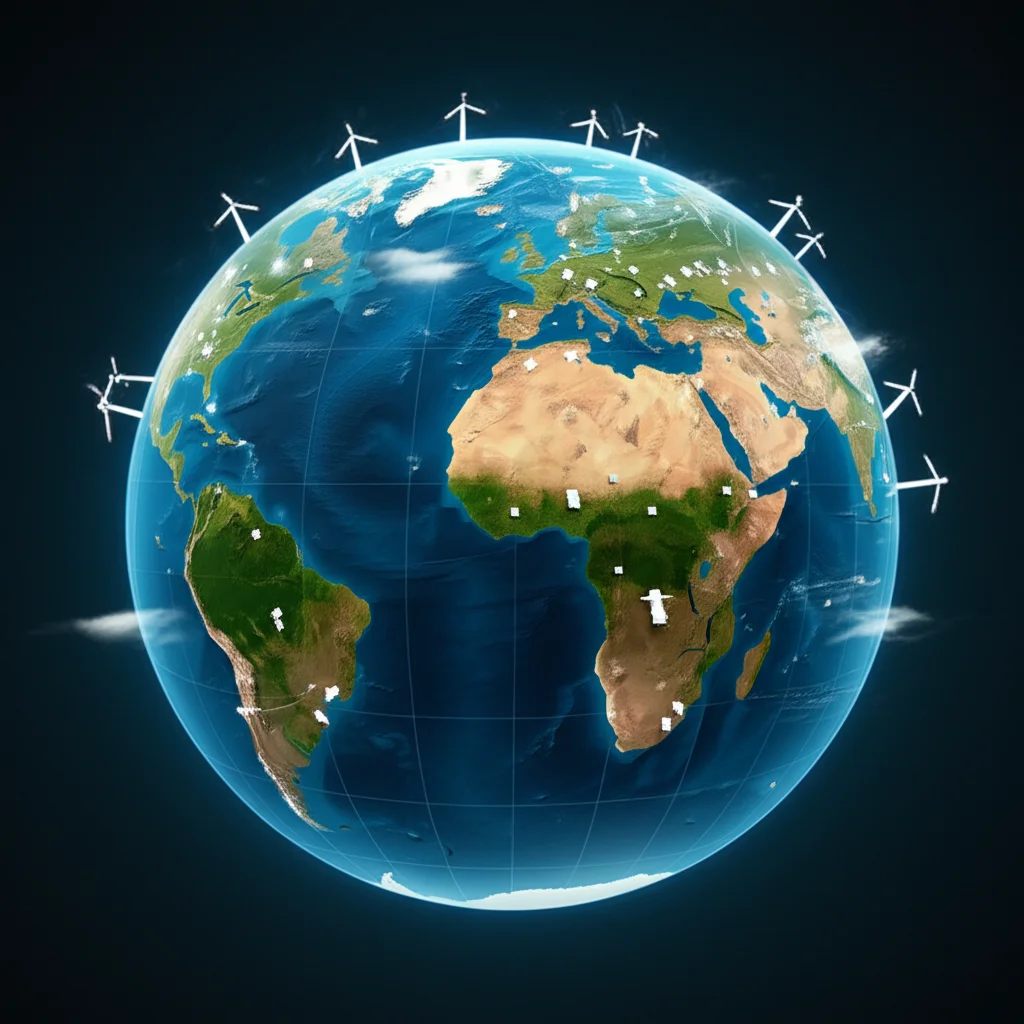
Okay, so we know the potential is huge but messy. How do we build this thing smartly? We designed a comprehensive multi-objective optimization framework. Think of it as a super-smart planner trying to balance a bunch of goals at once: minimize costs, maximize solar-wind use, and minimize wasted energy. It looks at where to put solar panels and wind turbines, how much storage capacity each region needs, and how much power needs to flow between regions, hour by hour.
Our vision for this global system unfolds in phases, kinda like building blocks. We see adjacent regions connecting in the 2030s, expanding to continental links in the 2040s, and finally achieving a full global interconnection by the 2050s. This aligns with low-emission scenarios and just makes practical sense – you build outwards.
Interestingly, our optimization shows that early on, deployment will likely stick closer to where people live to ensure local supply. As the grid gets more connected, development can shift to those resource-rich areas with better sun or wind, even if they’re far away. Storage is key in the early, less-connected phases, but its urgency lessens as the grid becomes more integrated. Why? Because you can rely on power from somewhere else when your local sun or wind isn’t cooperating.
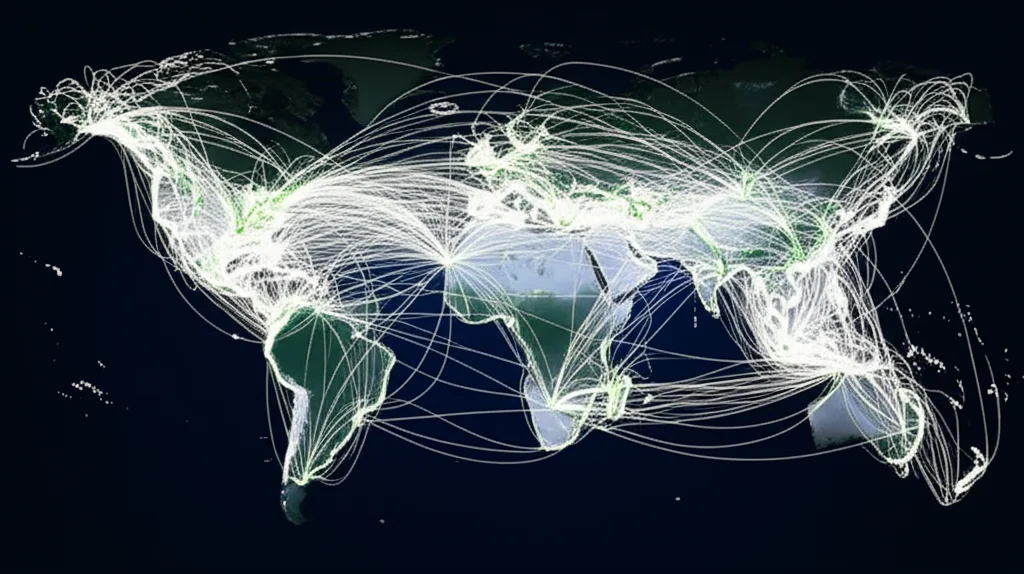
The big push for transmission infrastructure happens in the later stages. We’re talking about major transcontinental corridors – like between North America and Eurasia, or South America and Africa. These aren’t small lines; they need to handle terawatts of power flowing back and forth! Future tech like ultra-high-voltage direct current (UHVDC) could help, but the basic idea of where these connections are needed stays pretty consistent.
And the cost? Our estimates, based on current prices, show that the initial investment for our preferred optimized scenario is about $116.9 trillion USD. Sounds like a lot, right? But that’s only about 54% of the cost if you just tried to build everything without this smart optimization and interconnection. There are significant savings to be had by doing this right.
The Benefits: Stability, Equity, and Efficiency
Beyond just meeting demand, a globally interconnected grid brings some serious perks. One of the biggest is tackling that variability issue head-on. By spreading solar and wind farms across different geographic locations, you naturally smooth out the power output. When it’s night here, it’s day there; when it’s calm here, it’s windy there. We saw a massive decrease in the volatility of the overall global generation curve – from over 50% down to below 8%! That’s a huge deal for grid stability.
This system also promotes energy availability by enabling huge amounts of power sharing across regions. We project trading volumes could reach nearly 38.5 thousand TWh/year by the 2050s! Regions with surplus resources can export to those with deficits. This dynamic redistribution is expected to significantly reduce energy access inequality. We saw the Gini index, a measure of inequality, drop from 0.327 in a disconnected scenario to 0.173 with global interconnection. That means more equitable access to clean energy for everyone.
Plus, it eases the economic burden of decarbonization, especially for less-developed regions. In a disconnected world, some regions might have to invest over 5% of their cumulative GDP just to get high solar-wind penetration. With global interconnection, the economic pressure is reduced for all regions, and the disparity in investment relative to GDP narrows significantly. It’s a win-win for the planet and for fairness.
Stress Tests: A Resilient Future
Okay, but what about when things go wrong? We put this optimized global grid through some tough stress tests. What about future climate change making weather more unpredictable? Our simulations show that even with projected increases in solar, wind, and demand variability, the uncertainties in global power supply within the interconnected grid remain consistently below 0.1%. And the more connected the grid is, the lower these uncertainties become.
What about extreme weather events like that Texas freeze, causing regional blackouts? This is where global interconnection really shines. If a single regional grid goes completely down in a globally connected system, the average decline in global solar-wind supply is only about 2.6%. Compare that to declines of 5.8%, 15.1%, and a whopping 26.4% in continental, adjacent, and regionally independent scenarios, respectively. It’s incredibly robust against regional failures.
However, it’s not invincible. The system is still susceptible to disruptions from things like incompatible regional policies, geopolitical tensions, or aggressive market competition. If some regions decide to prioritize energy self-sufficiency (acting more like the disconnected scenario), it messes up the global balance, leading to increased energy wastage (curtailment) in some places and shortages elsewhere. Geopolitical issues could disrupt key transmission nodes or lines, impacting power flow, especially for regions heavily reliant on imports.
Even market competition could cause problems. If wealthier regions outbid others for surplus power, disadvantaged regions could face supply gaps. These findings underscore that while the technical potential and resilience are high, making this work in the real world requires coordinated global planning, stable geopolitical environments, and equitable market conditions.
Making It Happen: Challenges and the Way Forward
So, where does this leave us? Our findings strongly suggest that a globally interconnected solar-wind system isn’t just a nice idea; it’s a compelling and feasible pathway to meet future electricity demands and achieve net-zero emissions. It leverages the uneven distribution of resources, smooths out variability, enhances resilience, reduces inequality, and lowers the overall cost of the energy transition compared to disconnected approaches.
It’s not without its hurdles, though. Building this kind of global infrastructure requires massive investment and innovative engineering across diverse terrains and even under oceans. More importantly, it needs unprecedented international cooperation. We’re talking about needing robust global agreements and maybe even a supranational entity to coordinate investments, manage the grid, and ensure fair energy flows. Geopolitical instability is perhaps the biggest wild card.
There are also challenges like energy sovereignty concerns, resistance from existing energy players, and local opposition to projects. But our stress tests show that the system, by its very nature of being interconnected and diversified, is remarkably resilient to many unforeseen disruptions. The risk of widespread cascading failures seems low.
Compared to previous studies that just looked at potential, we’ve tried to provide a more concrete, actionable roadmap. We’ve quantified the potential, identified optimal pathways, highlighted the benefits in terms of efficiency, equity, and resilience, and examined the risks. This moves the conversation beyond theory towards practical implementation.
Pioneering projects are already happening – regional grids linking up. The call from COP28 to double renewable capacity and efficiency just adds urgency. These steps are building the foundation. While challenges remain, the potential benefits – a stable, affordable, equitable, and resilient clean energy future for the entire planet – make pursuing this vision absolutely essential. It’s a big dream, but one that our analysis suggests is well within reach with concerted global effort.
Source: Springer