
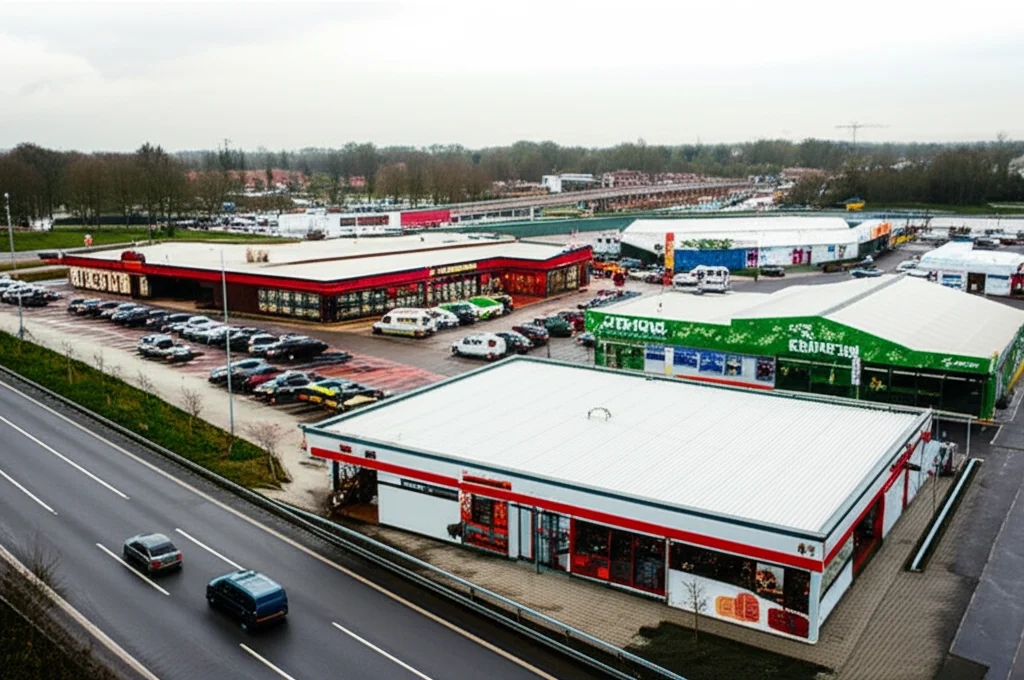
Why Dutch Motorway Stops Are Still Junk Food Jungles (And How We Might Actually Change That)
Alright, let’s chat about something many of us encounter way more often than we’d like: the food situation at motorway stops, especially here in the Netherlands. You know the drill – you’re on a long drive, tummy rumbles, and you pull over hoping for something decent. More often than not, you’re faced with a sea of snacks, sugary drinks, and quick, greasy bites. It’s a bit of a junk food jungle out there, isn’t it?
Now, this isn’t just about a disappointing pit stop sandwich. This unhealthy environment plays a real role in those bigger health challenges we hear about, like obesity and other long-term illnesses. Our diets are a huge factor, and where we grab our food matters. The places we stop when we’re on the go are a prime example of a “food environment” where the deck is stacked against making healthy choices.
The Dutch government has actually said, “Hey, we need to do better here!” They even put it in their National Prevention Agreement. But here’s the kicker: actually *changing* this environment is proving to be a really tricky nut to crack. Why? Because it’s not just one simple problem. It’s a whole tangled mess, a complex system influenced by tons of different players – from the folks running the stops and the companies supplying the food, all the way up to government policies and even our own habits as drivers.
So, how do you even begin to untangle something like that? Well, that’s where a bunch of smart folks, including yours truly (well, representing the collective ‘we’ who looked into this!), decided to roll up their sleeves and really dig in. We wanted to understand the *underlying dynamics* – the hidden forces and cycles that keep this unhealthy food environment stuck the way it is. And crucially, we wanted to figure out where the best places, the “leverage points,” might be to actually make a difference.
The Problem on the Pavement
Let’s be honest, motorway stops are incredibly convenient. Millions of people in the Netherlands pass through them every single day. We’re talking about 1.3 million visits to petrol station shops daily on average! And guess what? Nearly half of the people surveyed (47%, to be exact) are buying food or drinks there.
What are they buying? Mostly snacks, candy, crisps, and cold sugary drinks like soda and energy drinks. It seems a lot of these purchases are just impulse buys – you see it, you grab it. Truck drivers, who spend a lot of time on the road, are also frequent customers, with over a third buying something at a petrol station shop at least weekly during work hours.
So, we have this massive daily exposure to a food environment that’s heavily skewed towards the unhealthy stuff. The government *wants* it to be healthier, but the “how” has been a bit of a mystery. This study was all about shining a light on that mystery.
Diving into the System
Think of the motorway food environment not as a single shop, but as a giant, interconnected machine. It’s got lots of moving parts: the companies selling the food, the suppliers, the government setting rules (or not setting them), the drivers buying the food, and even broader things like what society thinks is normal to eat on the go. All these parts influence each other in complicated ways.
To understand this complex machine, we used something called System Dynamics. It helps us see how different parts affect each other, how things adapt, and how cycles (called feedback loops) keep things going. We used a specific method called Group Model Building (GMB), which is basically getting all the key players – the “stakeholders” – in a room together to map out the system as *they* see it.
We held two workshops, bringing together a really diverse group: people from roadside restaurants, petrol stations, food producers, retail groups, public health organisations, policymakers, truck drivers, and experts from various trade groups. It wasn’t easy to get everyone there – some groups were tough to reach – but we managed to get 36 people in the first workshop and 38 in the second, representing 11 different stakeholder types. Many of them were also road users themselves, giving them insights from both sides of the counter!
Mapping the Maze: The Causal Loop Diagram
In those workshops, we collectively built what’s called a Causal Loop Diagram (CLD). Think of it as a big, visual map showing all the factors influencing the unhealthy motorway food environment and how they connect with arrows. A plus sign means if one factor increases, the other increases (or if it decreases, the other decreases). A minus sign means if one increases, the other decreases (or vice versa). When these connections form a circle, you get a feedback loop – a cycle that keeps reinforcing a particular outcome.
We identified 52 interconnected factors, grouped into six main areas, or “subsystems”:
- Food providers (the shops and restaurants)
- Supply chain collaboration (how the different businesses work together)
- Government (policies and rules)
- Road users (us, the drivers and travellers)
- Social culture (what’s considered normal)
- Global trends (bigger societal shifts)
And we found six key reinforcing feedback loops that are really powerful in keeping the unhealthy system going:
* R1: The Profit Cycle: This is a big one. It turns out that contracts with suppliers of unhealthy products often lead to lower purchase prices for those items. This means food providers make *more profit* on unhealthy stuff than healthy stuff. What happens then? They’re incentivised to make *more* contracts for unhealthy products. It’s a cycle driven purely by profit margins.
* R2: The Lobbying Power: Unhealthy food producers have a lot of power. More power means a stronger food lobby. A strong lobby can influence government, leading to a *lack* of legislation and policies for healthy food options. And guess what? Less legislation means the unhealthy producers keep their power. Another self-reinforcing cycle!
* R3: The Responsibility Gap: There’s a real lack of collective responsibility among businesses in the supply chain for creating a healthier environment. This means no one develops an ambitious vision together. No shared vision means no partnerships form to tackle the issue. No partnerships mean less encouragement for transport companies to help their drivers eat healthily. And that brings us right back to a lack of collective responsibility.
* R4: It’s All Your Fault (The Individual Responsibility Belief): The lack of government rules on healthy food at motorway stops feeds a societal idea that eating healthy is *solely* up to the individual. This belief means the government doesn’t put much emphasis on improving healthy options, which slows down progress on things like the National Prevention Agreement, which in turn means fewer rules get made. See the cycle?
* R5: The “Guilty Pleasure” Perception: Food providers often *believe* that consumers on the road just want unhealthy options. This makes them less likely to offer healthy alternatives, leading to a mostly unhealthy supply. This normalises unhealthy eating at motorway stops, making people feel more okay indulging in “guilty pleasure” foods because they’re anonymous. This normalisation reinforces the demand for unhealthy food, which strengthens the providers’ belief that it’s what we want. Phew, that’s a tangled one!
* R6: The Snacking Society: As our lives get busier, traditional meal times shift towards more frequent, smaller eating moments – the “on-the-go” culture. This means more food purchases happen while travelling, often at motorways where, you guessed it, the food is mostly unhealthy. This increases the demand for quick, convenient food, which further encourages fragmented eating throughout the day.

These feedback loops are crucial. They show us *why* the system is so resistant to change. It’s not just one factor; it’s the way they all push and pull on each other in these cycles.
Finding the Sweet Spots for Change (Leverage Points)
Okay, so we’ve mapped the messy system and found the cycles keeping it unhealthy. The next step was to find the “leverage points” – the places where an intervention might have the biggest impact. Think of it like finding the right spot on a seesaw to lift something heavy.
We identified 14 potential leverage points. When we looked at them through a model that classifies points based on how deep they are in the system (from surface-level ‘events’ to deep-seated ‘beliefs’), we found most were at the ‘structures’ level (like policies or relationships), but crucially, some were at the deeper ‘goals’ and ‘beliefs’ levels.
And here’s the really interesting part: the points with the highest potential for *systemic* change were often related to those powerful feedback loops we just talked about. These include:
* The overall economic goal that prioritises profit over health (linked to R1).
* The belief that healthy eating is purely an individual’s responsibility (linked to R4).
* The food providers’ belief about consumer preferences for unhealthy food (linked to R5).
* The belief that our fast-paced society *requires* an on-the-go, fragmented eating culture (linked to R6).
These are the biggies. Changing beliefs and goals is incredibly hard – they’re deeply ingrained in society and in how businesses operate. But if you *can* shift them, the ripple effect throughout the system can be massive. This tells us that simply telling people to eat healthier isn’t enough; we need to tackle the fundamental reasons why the unhealthy options are so dominant and appealing in the first place.
Actions on the Horizon
Armed with this understanding of the system and its leverage points, the stakeholders in our second workshop got down to business: brainstorming actions. They came up with 31 unique ideas for how to improve the motorway food environment.
These actions weren’t just surface-level fixes. Because we focused on the system, the ideas spanned all levels:
- Events Level: Things like informing consumers at the point of purchase (e.g., better labelling, signs).
- Structures Level: Ideas around collaboration between companies, developing new healthy products, creating new concepts for motorway stops, or showcasing businesses that are doing well with healthy options.
- Goals Level: Actions aimed at setting more concrete guidelines or objectives for healthy food offers, maybe even integrating healthy food into government permits for new stops.
- Beliefs Level: Actions focused on mandatory regulations (like rules on availability, pricing, or promotions of unhealthy food) or exploring financial incentives for companies that offer healthy options.
Some actions focused directly on supporting consumers to make better choices, like educating them or providing information. Others targeted employers in the transport sector, encouraging them to support their drivers’ health. Many ideas revolved around the need for collaboration within the industry or creating market opportunities for healthier products.
A significant chunk of the proposed actions zeroed in on the need for stronger guidelines and regulations. This included lobbying the government for clearer rules, making the ambitions in the National Prevention Agreement more concrete, or even setting EU-level objectives. There were also ideas about making healthy food a requirement when companies bid for permits to operate motorway stops, or implementing mandatory rules on what kind of food is available, how it’s priced, and how it’s promoted.
Finally, stakeholders suggested monitoring and benchmarking the motorway food environment to track progress and even offering financial compensation or incentives to companies that achieve healthy food goals.
It’s great that the stakeholders came up with ideas across all levels, not just the easy, surface-level stuff. While educating people is important, these findings really highlight that we need mandatory rules and changes to the fundamental goals and beliefs driving the system if we want to see lasting change. Voluntary efforts by the industry alone haven’t been enough, and policies that only focus on individual behaviour just won’t cut it.

What We Learned and Where We Go
So, what’s the takeaway from all this? The unhealthy motorway food environment in the Netherlands is a genuinely complex beast. It’s shaped by dozens of interconnected factors and powerful cycles that reinforce the status quo, particularly the drive for profit and the societal belief that eating choices are purely personal.
The good news is that by understanding this system, we’ve identified potential leverage points – places where interventions could have a significant impact. The highest-impact points are those related to the economic goals and the beliefs about individual responsibility and consumer preferences.
The stakeholders involved in this study came up with a whole raft of actions targeting these different points and operating at different levels of the system. This confirms what the research tells us: you need a multifaceted approach. No single action will fix this. It requires a coherent plan involving lots of different people and organisations, tackling issues from multiple angles, and importantly, being committed for the long haul. Systemic change takes years, even decades.
Of course, this study wasn’t perfect. We couldn’t get *every* single type of stakeholder involved, so some perspectives might be missing. And while the CLD reflects the views of the Dutch stakeholders, it might not be exactly the same in other countries.
But it gives us a fantastic starting point. We now have a clearer picture of *why* things are the way they are and *where* we might push for change. Future steps should involve figuring out how to actually *implement* these actions and seeing if they work. How can we make it financially viable for motorway stops to offer healthy food? Can we create incentives or subsidies for the “frontrunners” who want to make the shift? And how do we get all the different players – government, industry, transport sector, public health – to work together on a shared vision?
Ultimately, changing the motorway food environment isn’t just about adding a salad to the menu. It’s about fundamentally shifting the system so that health becomes a priority, not just profit. It’s a big challenge, but by understanding the underlying dynamics, we’re one step closer to finding the right path forward.
Source: Springer