

Dodging the Leak: What Increases Risk After Stomach Surgery?
Hey there! Let’s chat about something pretty important in the world of surgery, specifically when folks have to get part or all of their stomach removed. This is often done for stomach cancer, which, you know, is unfortunately quite common globally and a big deal when it comes to cancer deaths.
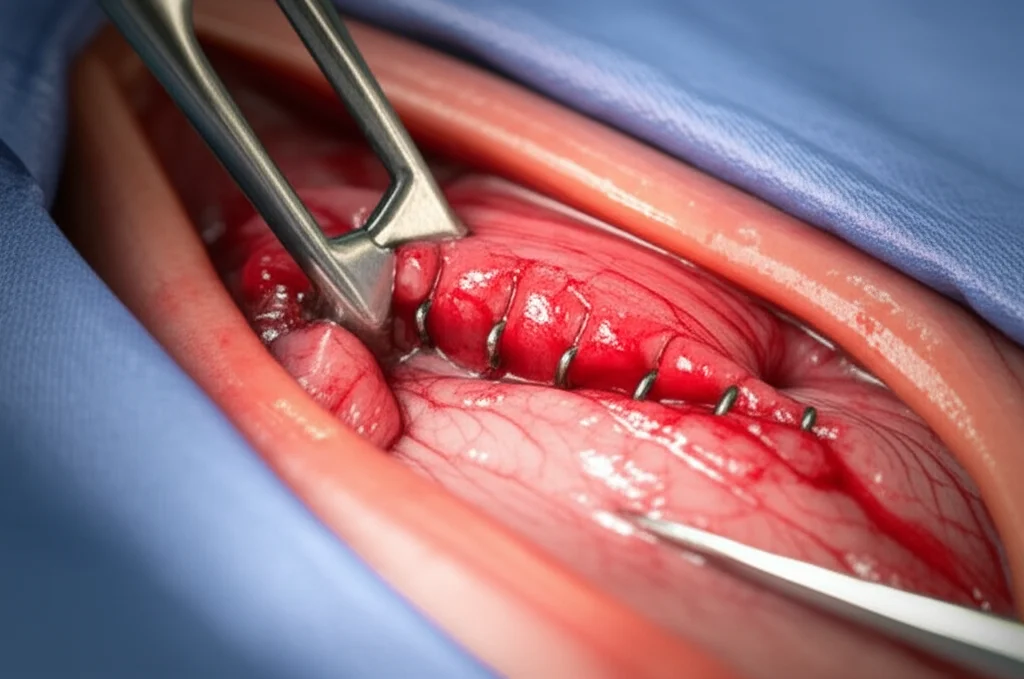
Now, when surgeons take out the stomach, they have to deal with the end bit that connects to the small intestine, called the duodenum. They close this off, either by hand or with special staplers. Most of the time, things go smoothly. But sometimes, just sometimes, this closure doesn’t hold perfectly, and you get what’s called a duodenal stump leakage. Sounds messy, right? It can be, and it’s a complication that surgeons really try hard to avoid because it can cause some serious problems.
Enter the Duodenal Stump Leak
So, how common is this? Well, the text I looked at mentions it happens in about 3% of cases. That might not sound like a lot, but when it does happen, it’s a big deal. We’re talking a morbidity rate (meaning, other problems arising from it) of about 75% and, sadly, a mortality rate that can climb up to 20%. That’s why understanding and preventing these leaks is super important.
When a leak happens, it’s not just the leak itself. Patients often end up staying in the hospital for way longer than planned. They can also face a whole bunch of other issues like infections inside the belly, bleeding, pancreas problems, severe nutritional issues, and even pneumonia. Yikes!
Luckily, many leaks can get better with just careful watching and treatment like antibiotics and drainage. But sometimes, surgery is needed again to fix things up.
So, What Did This Study Look At?
Because this complication is such a concern, researchers are always trying to figure out *why* it happens and if certain things make it more likely. The study this article is based on looked back at data from patients who had stomach surgery for cancer at a specific hospital in Turkey between 2014 and 2020 (though the study period in the main text seems to extend to 2022 for some data points – science, right?).
They gathered info on 618 patients. They wanted to see if things like the patient’s age, gender, overall health (did they have other medical problems?), the type of surgery they had, how the duodenal stump was closed, or even the cancer stage played a role in whether a leak occurred.
They checked out different types of surgery, mainly:
- Distal Subtotal Gastrectomy (DSG): Taking out the lower part of the stomach.
- Total Gastrectomy: Taking out the whole stomach.
And they looked at how the remaining bits were reconnected, like Billroth II or Roux-en-Y reconstructions. They also checked if using extra stitches (reinforcement sutures) on the stapled stump made a difference.
What We Found: The Risk Factors
Okay, so after crunching the numbers from those 618 patients, the study found that 21 patients (that’s the 3% incidence we talked about) had a duodenal stump leakage. Now, here’s where it gets interesting – they compared the patients who leaked to those who didn’t to find the culprits.
Turns out, some things didn’t seem to make a significant difference in this study, like age, gender, or even the specific type of stapler used to close the stump. Even adding those reinforcement sutures didn’t statistically change the leakage rate in this group of patients, which is a bit different from what some other studies have suggested.
However, two things *did* stand out as increasing the risk:
- Having other health problems: They used a score called the Charlson Comorbidity Index. Basically, the higher the score, the more significant health issues a person has. Patients with a score of 3 or higher had a significantly higher rate of leaks. This makes sense, right? If your body is already dealing with other stuff, maybe it’s not as good at healing. The article suggests this might be related to blood supply issues in patients with heart problems, for example.
- The type of reconstruction after DSG: This one is a bit specific. For patients who had the lower part of their stomach removed (DSG), those who had a Billroth II reconstruction had a significantly higher rate of stump leakage compared to those who had a Roux-en-Y reconstruction. The thinking here is that with Billroth II, the loop of intestine leading to the stump (the afferent loop) might not empty properly, building pressure that stresses the closure line.
So, while the *method* of closure (stapler vs. sutures, reinforcement) didn’t seem to matter in this study, the patient’s overall health status and, specifically for DSG, the *way* the digestive tract was put back together (Billroth II) were identified as important risk factors.

How They Handled Leaks
For the patients who did develop a leak, the study also looked at how they were treated. Most were managed without needing another big surgery, often with antibiotics and drainage. The average time it took for them to recover from the leak was about 12 days in this study, which is actually a bit faster than reported in some other literature.
Interestingly, the study mentioned that patients who *did* have reinforcement sutures applied (even though the sutures didn’t prevent the leak in the first place) seemed to be managed conservatively more often if a leak occurred. But the numbers were small, so it’s hard to draw strong conclusions there.
Wrapping It Up
So, what’s the takeaway? Duodenal stump leakage after gastrectomy for cancer is a relatively rare but serious complication. This study, looking at a good number of patients, reinforces the idea that a patient’s overall health (especially if they have multiple other conditions) is a big factor in the risk. It also highlights that for partial stomach removal (DSG), the Billroth II way of reconnecting things might be riskier for stump leaks compared to Roux-en-Y.
What’s maybe a little surprising from this particular study is that the specific technique used to close the stump – like using a stapler or adding reinforcement stitches – didn’t show a clear impact on preventing leaks. This suggests that maybe patient factors and the overall surgical strategy (like the type of reconstruction) are more dominant influences than the fine details of the stump closure itself.
Science is always evolving, and the authors rightly point out that we need more studies, maybe bigger ones involving multiple hospitals, to really nail down all the factors and figure out the absolute best ways to prevent and manage these leaks. But for now, knowing that comorbidities and the Billroth II reconstruction in DSG are red flags is super valuable information for surgeons and patients alike.

Source: Springer