
Guess What? We’re Using Blockchain and AI to Fight COVID-19, Privacy First!
The COVID-19 Challenge: More Than Just a Bug
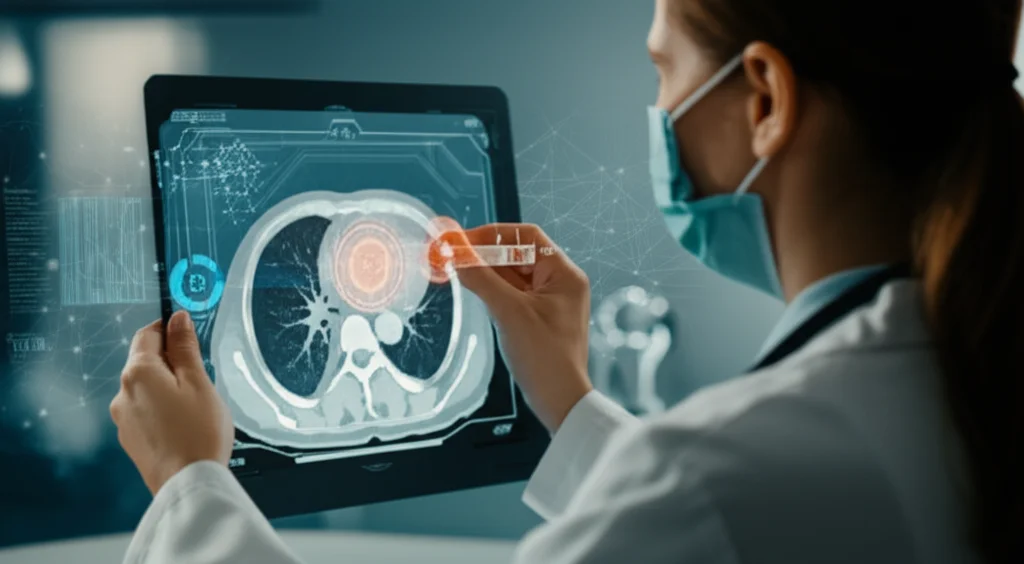
Okay, so remember when COVID-19 hit? It spread like wildfire, and honestly, our healthcare systems were scrambling. Diagnosing it quickly and accurately was a massive hurdle. You know how it is – doctors needed reliable tools, fast. Traditional methods, bless their hearts, often relied on keeping all the patient data in one big central spot. While AI got pretty good at looking at images, like lung CT scans, this centralized approach had some serious downsides. Think about it: managing all that data is complex, and more importantly, it raises big red flags about patient privacy. Sharing data globally, which you’d think would be super helpful in a pandemic, becomes a total headache because of these privacy worries.
So, what do you do when you need to collaborate globally but keep sensitive patient info locked down? That was the big question. We needed smart ways to diagnose, but we also needed to be super careful with people’s private health details. It became clear that we had to find a way for different hospitals and institutions to work together, learn from each other’s data, but without actually *seeing* each other’s raw data. That’s a tough balancing act, right?
Sharing is Caring, But What About Privacy?
The pandemic really hammered home the need for better diagnostic tools. Countries like India, with huge populations, faced immense pressure. The virus, SARS-CoV-2, often messes with the lungs, leaving tricky patterns on CT scans. Identifying these patterns accurately is key, but they can look similar to other lung issues, making a radiologist’s job really tough.
Now, imagine hospitals wanting to share these CT scans to train better AI models. Great idea for accuracy, right? But here’s the rub: patient privacy is paramount. Sharing sensitive medical images across institutions? That’s a non-starter for many, and totally understandable! The existing research world is kind of stuck because of these legitimate privacy concerns. Training powerful AI models often needs tons of data, and if you can’t easily and securely share it, building those super-accurate, collaborative models becomes incredibly difficult. We absolutely *had* to find innovative ways to break down these data-sharing barriers while keeping privacy intact.
Our Secret Sauce: Combining Forces Securely
This is where our research comes in, driven by that urgent need for better, privacy-aware diagnostic tools. We wanted to build something that could handle the complexity of lung CT patterns and improve diagnosis accuracy, but without sacrificing privacy. Existing AI models often need huge computing power, store data centrally (privacy risk!), and can get confused by similar-looking lung conditions. Plus, scaling them up for use across *many* hospitals is tricky.
So, we cooked up something pretty neat: the Combined Learning Collective Deep Learning Blockchain Model, or CLCD-Block for short. It’s a mouthful, I know, but stick with me! This framework is like a dream team, bringing together a few powerful technologies:
- Combined Learning (or Federated Learning): Instead of sending all the data to one place, hospitals keep their data *local*. They train a model on their own data, and then they only share the *updates* or *weights* of that model, not the raw images. This is a game-changer for privacy!
- Deep Learning (Capsule Networks e ELM): We use a hybrid network. Capsule Networks are great at picking out those tricky, intricate patterns in the CT scans, doing a better job than some older methods. Then, we use Extreme Learning Machines (ELM) for the final classification. ELM is known for being super fast and efficient, which is great for real-time diagnosis.
- Blockchain: This is where the “secure” part really shines. The model weights that the hospitals share? They’re exchanged and managed using a blockchain. Think of it as a super secure, transparent, and tamper-proof digital ledger. It ensures that the weight sharing is trustworthy and traceable, adding a crucial layer of security and privacy protection.
This combination means hospitals can collaborate, build a powerful global diagnostic model together, improve accuracy, and do it all while keeping sensitive patient data right where it belongs – locally and private. It’s designed for COVID-19, but honestly, this approach is versatile. It could totally be used for diagnosing other chronic diseases, managing future outbreaks, or just facilitating secure data sharing in healthcare in general. Our main goal? To build a system that’s accurate, private, and scalable, overcoming the limitations of older methods.

Under the Hood: A Collaborative Dance
Let’s get a little more technical, but I promise to keep it charming! The CLCD-Block concept is pretty cool. It starts with collecting data from different hospitals, even if they use different CT scanners. The first step is to make sure all this diverse data is on the same page, which we do through normalization techniques.
Then comes the deep learning part. We use our ensemble capsule network to really dig into those lung CT scans and find the COVID-19 patterns. This part is designed to be really good at generalizing, meaning it works well even on data it hasn’t seen before. After the capsule network extracts features, the Extreme Learning Machines (ELMs) step in to do the actual classification – deciding if it looks like COVID-19 or something else.
Here’s where the combined learning and blockchain magic happens. Instead of sharing the raw CT images, hospitals only share the *weights* from their locally trained ELM models. This weight sharing happens over a public network, but it’s secured by the blockchain. The blockchain ensures that these weight updates are handled securely and transparently, protecting patient privacy because the sensitive image data never leaves the hospital. This decentralized setup allows hospitals to build a collective, adaptive global model.
We even thought about the architecture of the blockchain itself. It’s layered, kind of like a cake, with different parts handling different jobs:
- Application Layer: This is what doctors and systems interact with – the diagnostic platforms, the medical record systems. We’ve put in safeguards like multi-factor authentication to keep it secure.
- Protocol Layer: This layer uses algorithms (like Proof of Work, but adapted for a controlled environment) to make sure all the nodes (the participating hospitals) agree and the data is consistent and can’t be messed with.
- Data Layer: This is where the medical info (scan results, predictions) is stored securely, like in a tamper-proof vault. We use fancy encryption here to protect sensitive data.
- Network Layer: This handles the communication between hospitals, making sure it’s secure and efficient. We use encryption and authentication to prevent eavesdropping or data tampering.
- Physical Layer: This is the hardware – the CT scanners, the sensors. We make sure only trusted devices can connect and that the data they collect is secure from the get-go.
This layered approach ensures that the whole system is secure from the ground up. Hospitals share their local model weights (like transactions) on the blockchain. The system even uses unique IDs and calculates “distances” between hospitals to figure out how to retrieve data efficiently from nearby nodes, all while keeping track of everything on the blockchain’s log tables.
Training the global model involves a consensus mechanism. All the participating nodes (hospitals) work together, using something called the Mean Prediction Accuracy Error (MPAE) to verify that the local models are contributing correctly. This consensus ensures the final global model is reliable. And remember, privacy is key! All data on the nodes is secured with strong encryption. The MPAE also reviews transactions before they’re added to the blockchain, adding another layer of security. The cool part is that hospitals only share the *trained models* when requested, not the raw datasets, which is a much safer way to collaborate.
Putting it to the Test: Show Me the Data!
Alright, enough theory! Does this CLCD-Block thing actually *work*? We put it through its paces using four different benchmark datasets of lung CT scans. These datasets came from various sources, included different types of cases (COVID-19 positive, negative, pneumonia, normal), and even different CT scanners. We split the data for training, testing, and validation – pretty standard stuff.
And guess what? The results were seriously impressive! Our model consistently outperformed existing methods. We looked at all the important metrics: Accuracy, Precision, Recall, Specificity, and F1-Score. On the four datasets, CLCD-Block hit accuracy rates between 97.3% and 98.7%. Precision, Recall, Specificity, and F1-Score were all consistently high, often exceeding 98%. That’s pretty fantastic for medical diagnosis!
We also looked at things like error distribution and loss curves during training. They showed a consistent pattern of the model learning effectively and minimizing errors. We even checked a confusion matrix, which shows how well the model classified different categories (Normal, Pneumonia, COVID-19). While there were a few minor mix-ups between categories (which is expected given how similar some lung conditions can look), the model correctly identified the vast majority of cases.
To really be sure our framework’s components were doing their job, we did an “ablation study.” This is where you take away parts of the model one by one to see how performance changes. Removing the blockchain layer, the collective learning part, or the deep ensemble all led to noticeable drops in accuracy. This proved that each piece of the CLCD-Block puzzle is important and contributes significantly to its strong performance.
We also used a statistical test called the Wilcoxon signed-rank test to compare our model’s performance against other existing models. The results showed statistically significant improvements across the board. This means the better performance isn’t just random chance; it’s a real, robust improvement over the baselines.
Fast and Lean: Performance That Counts
In healthcare, speed and efficiency matter. You don’t want doctors waiting around for a diagnosis. We analyzed the “complexity” of our model – basically, how much computing power and memory it needs.
Because CLCD-Block uses a distributed approach (hospitals train locally), it avoids the exponential complexity you get with traditional centralized models that have to process *all* the data in one place. We found our model was significantly faster and used less memory than other benchmarked approaches. For binary classification (COVID vs. Non-COVID), it took just around 0.218 seconds on a high-end system and still performed efficiently even on less powerful computers. Memory usage was also minimal, around 2.46 MB for binary classification. This makes our framework really suitable for real-time use, even in hospitals that might not have super-computers lying around.

Not Just for COVID: A Versatile Tool
While we designed CLCD-Block with COVID-19 in mind, its core idea – secure, privacy-preserving collaborative AI using blockchain – is super adaptable. Think about it:
- Diagnosing other chronic diseases that require analyzing medical images or data from multiple sources.
- Managing global health emergencies where rapid, secure data collaboration is critical.
- Facilitating secure data sharing between institutions for research or patient care, without compromising privacy.
This framework is built to be relevant not just for today’s challenges but for emerging health issues and other critical healthcare scenarios down the line.
What’s Next? Pushing the Boundaries
Now, it’s not all sunshine and rainbows just yet. Integrating blockchain into healthcare isn’t without its challenges. We’re talking about things like making sure the system can handle a *massive* number of users and transactions (scalability), reducing any delays (latency), and making sure different healthcare systems can talk to each other (interoperability). There are also considerations around the computational costs of blockchain and how its immutable nature fits with privacy regulations like GDPR.
Future work will definitely focus on tackling these head-on. We want to make the system even more scalable, optimize its real-time performance further (especially reducing blockchain latency), and improve cost-effectiveness. We also need to test it on even larger, more diverse datasets, including those with many different disease categories, to really prove its generalizability. And, of course, the ultimate goal is to do real-world pilot implementations with healthcare institutions to see how it works in practice and navigate regulatory hurdles.
Wrapping It Up
So, there you have it. We’ve developed a pretty cool framework, CLCD-Block, that brings together the power of deep learning (Capsule Networks and ELM) for accurate medical image analysis and the security and privacy benefits of blockchain and combined learning. It showed fantastic accuracy in diagnosing COVID-19 from CT scans, outperformed existing models, and did it all while protecting patient privacy by keeping sensitive data decentralized. It’s efficient, adaptable, and, we believe, offers a robust solution for the future of intelligent healthcare diagnostics. It’s a big step towards enabling secure, collaborative AI in medicine, which is something I think we can all get behind!
Source: Springer


