Bringing Ancient Sculptures to Life with Robot Artists? Automated Line Drawings from 3D Scans!
Alright, let’s chat about something super cool that bridges the ancient world and cutting-edge tech. You know those incredibly detailed line drawings you see in archaeology books or museum exhibits? The ones that show every curve, every chip, every important detail of an ancient sculpture or artifact? Well, for ages, creating those has been a monumental task, literally and figuratively!
The Old Way: A Labor of Love (and Time)
Imagine an archaeologist or a specialist sitting there, ruler in hand, meticulously measuring, sketching, and shading. It’s a process that requires immense skill, patience, and, let’s be honest, a *lot* of time. Think about documenting something huge, like those incredible stone sculptures from the Northern Song Dynasty royal tombs they talk about in the paper – civil officials, auspicious birds, massive elephants. These aren’t exactly easy to transport or handle, and getting every detail right by hand? Phew! It’s vital work for documenting cultural relics, showing up in everything from excavation reports to textbooks, but it’s slow.
Tech Steps In: From Photos to Point Clouds
Now, technology has been trying to lend a hand for a while. We moved from purely manual methods to things like photogrammetry, using photos to create 3D models. This was a big leap! You could get orthophotos – basically, geometrically corrected photos that are great for measuring – and even build 3D models. But even with these, getting those crisp, specific *line* drawings, especially for complex 3D shapes, still often required a lot of manual effort, tracing over images or models.
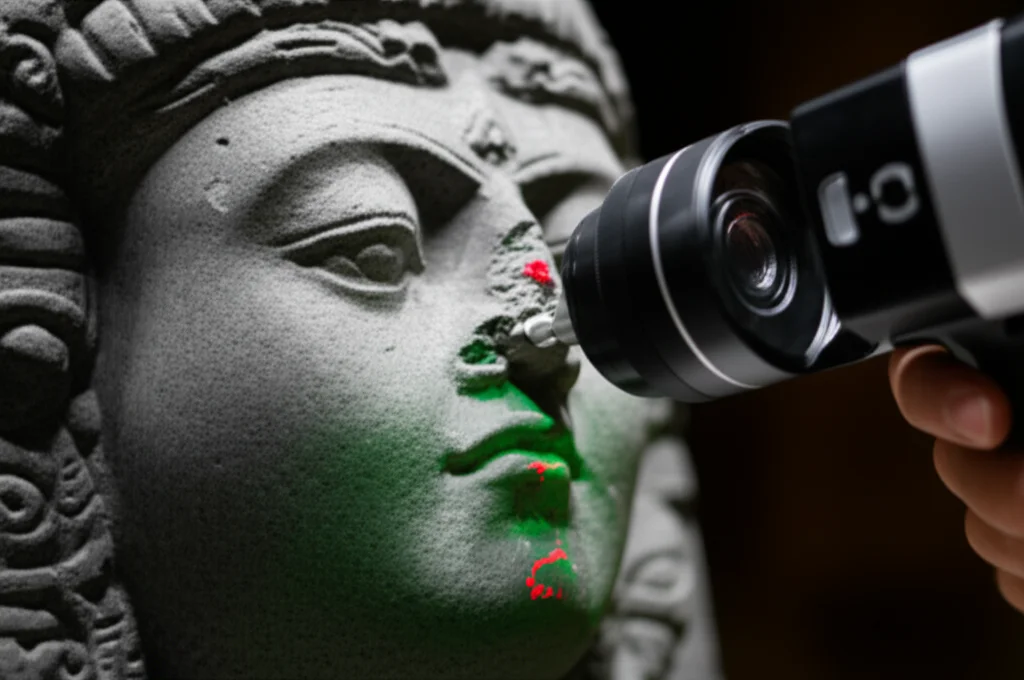
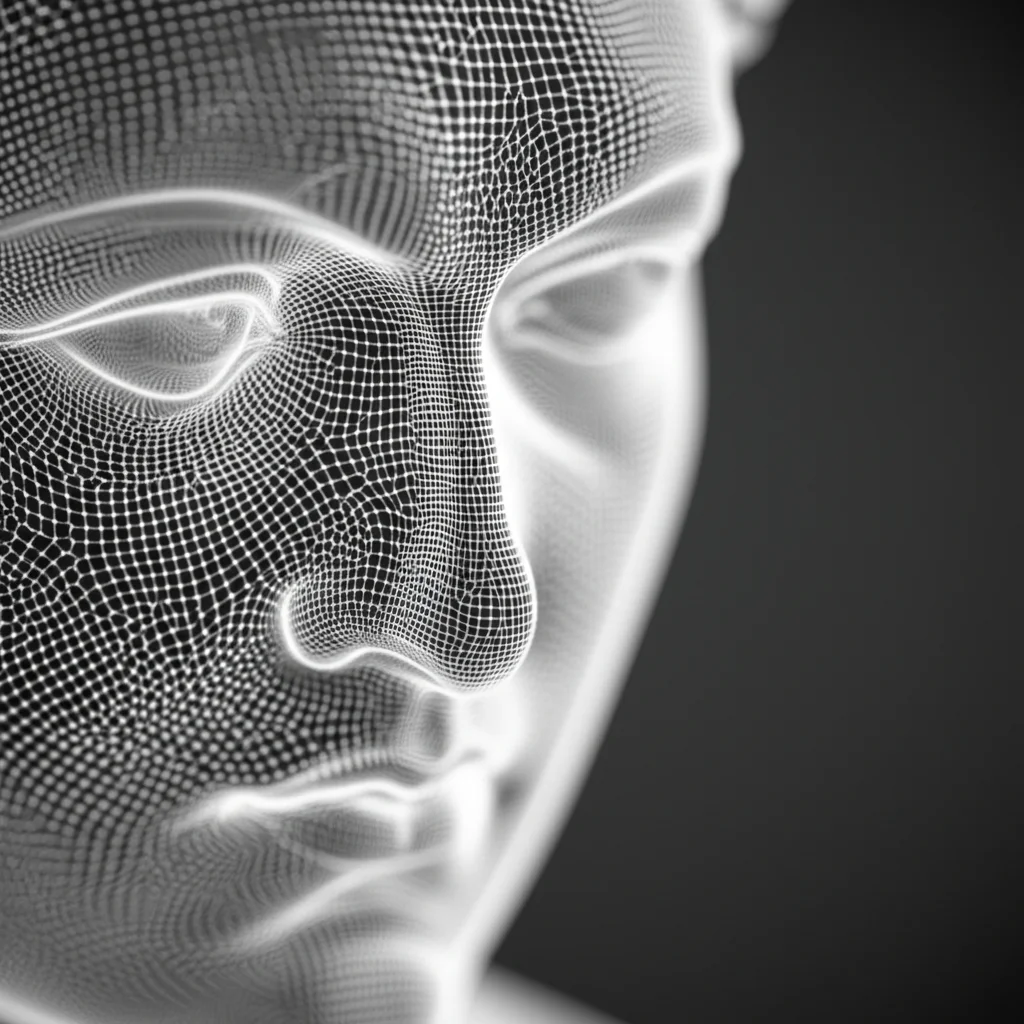
Then came 3D laser scanning and point clouds. Suddenly, we could capture millions upon millions of tiny points on the surface of an artifact, creating a detailed digital representation of its exact 3D shape. This is fantastic for preservation and analysis! But the challenge remained: how do you automatically turn that dense cloud of points into the clean, informative line drawings archaeologists need?
The New Magic: Weighted Centroid Projection
This is where the clever folks behind this paper come in. They’ve developed a rather ingenious method to tackle this exact problem, especially for those big, noisy stone sculptures. Their core idea is to automatically find the “feature lines” – the ridges, valleys, and boundaries that define the shape and details of the sculpture – directly from the 3D point cloud.
Think of it like teaching a computer to see the important edges and contours the way a human artist or archaeologist would, but based purely on the 3D geometry.
How do they do it? It’s a multi-step process, and they’ve added some smart twists:
Finding the ‘Interesting’ Bits (Feature Points)
First, they need to identify the points in the cloud that are on or near a feature line. These are usually where the surface changes direction significantly. They use something called the “centroid projection distance” as a metric. Basically, they look at a small neighborhood of points around a target point and see how far that target point is from the center (centroid) of its neighbors, projected onto the surface’s normal direction. Big distance? Probably a feature point.
But point clouds from real-world objects, especially weathered stone, can be *noisy*. A little bump from damage or scanning error shouldn’t be mistaken for a significant feature. So, they made the centroid calculation “weighted.” They give more importance (weight) to neighboring points that are part of the actual surface variation and less to those that look like random noise. They figure out these weights based on two things:
- Surface Roughness: How bumpy or smooth is the immediate area? More roughness might mean more detail, but also potentially more noise. They factor this in.
- Normal Difference: How much do the surface directions (normals) change from one point to its neighbor? Big changes mean a sharp feature.
By combining these, their “weighted centroid projection distance” metric is much better at spotting true features and ignoring noise.
Sorting and Tidying Up
Once they’ve found potential feature points, they classify them. Are they on a ridge (convex) or in a valley (concave)? They figure this out by looking at the direction of the weighted centroid relative to the surface’s normal.
These initial feature points might be a bit scattered, forming a “band” around the true line. So, they have a refinement step. They essentially project these points onto a line that best fits their local cluster, pulling them onto the estimated true feature line. Crucially, they refine ridge points and valley points *separately* to avoid mixing them up, which is a neat improvement.
Finding the Edges (Boundary Points)
To get a complete drawing, you also need the outline – the boundary of the sculpture. They use a standard method called the Angle Criterion. It looks at the angles between neighboring points around a target point. If there’s a large gap (a big angle), that point is likely on the edge of the object.
Connecting the Dots (Curve Growing)
Now they have all the important points: the refined feature points (ridges and valleys) and the boundary points. The next step is to connect them into continuous lines. They use an improved “curve growing” algorithm. Starting from a seed point, it intelligently searches for the next point to add to the line, considering both how close the point is *and* how well it aligns with the overall direction the line should be going. They grow the lines from both ends simultaneously, which helps efficiency.
They also added a clever step to connect lines that might break, especially where feature lines meet boundaries, aiming for complete, closed contours where appropriate.
Putting it to the Test
They didn’t just build this algorithm; they tested it thoroughly! They used point clouds from those Northern Song Dynasty stone sculptures (civil official, auspicious bird, mounting stone, stone elephant) – real-world data, often noisy and uneven. They also tested it on standard models like the Stanford armadillo and Happy Buddha.
They compared their results to several existing methods. And guess what? Their method consistently produced more comprehensive and detailed feature lines. For the noisy stone sculptures, it did a much better job of distinguishing actual features from noise compared to other techniques like Curvature or SSI. Even on complex models with fine details or multi-level features, their approach held up well.
Visually, the generated line drawings look great, capturing the essence of the sculptures’ forms and patterns.
Beyond the Drawing Board
The practical implications are pretty exciting. This automated process is significantly faster than manual drawing. Plus, it generates 3D lines, which contain more information than traditional 2D drawings derived from orthophotos. These 3D lines aren’t just pretty pictures; they can be used for other tasks like:
- Reconstruction: Helping to digitally rebuild damaged areas.
- Registration: Aligning different scans or models.
- Object Detection: Identifying specific features automatically.
While the expert-drawn lines (which still involve manual refinement) might look a bit more “artistic” or aesthetically pleasing, the automated 3D lines generated by this method are objective, efficient, and packed with geometric data, making them incredibly valuable for research and digital preservation.
Acknowleging the Bumps in the Road
Like any new tech, it has its limits. The paper notes that the method’s performance can decrease in areas with very low point density or if the point cloud has significant overall accuracy issues (lots of noise). If the errors are too large, the algorithm struggles to find the true features. This just highlights the importance of good quality scanning in the first place!
Looking Ahead
The researchers are already thinking about what’s next. They want to explore ways to make the generated lines even more aesthetically pleasing, perhaps by adding rendering or stylization techniques. Imagine getting the accuracy and efficiency of automation *plus* the visual appeal of a hand-drawn illustration!
In conclusion, this work represents a fantastic step forward in documenting cultural heritage. By automating the creation of detailed archaeological line drawings directly from 3D scans using a smart, noise-resistant approach, they’re saving countless hours of manual labor and providing archaeologists with powerful new tools for research and preservation. It’s like giving archaeology its own team of tireless, precise robot artists!
Source: Springer