
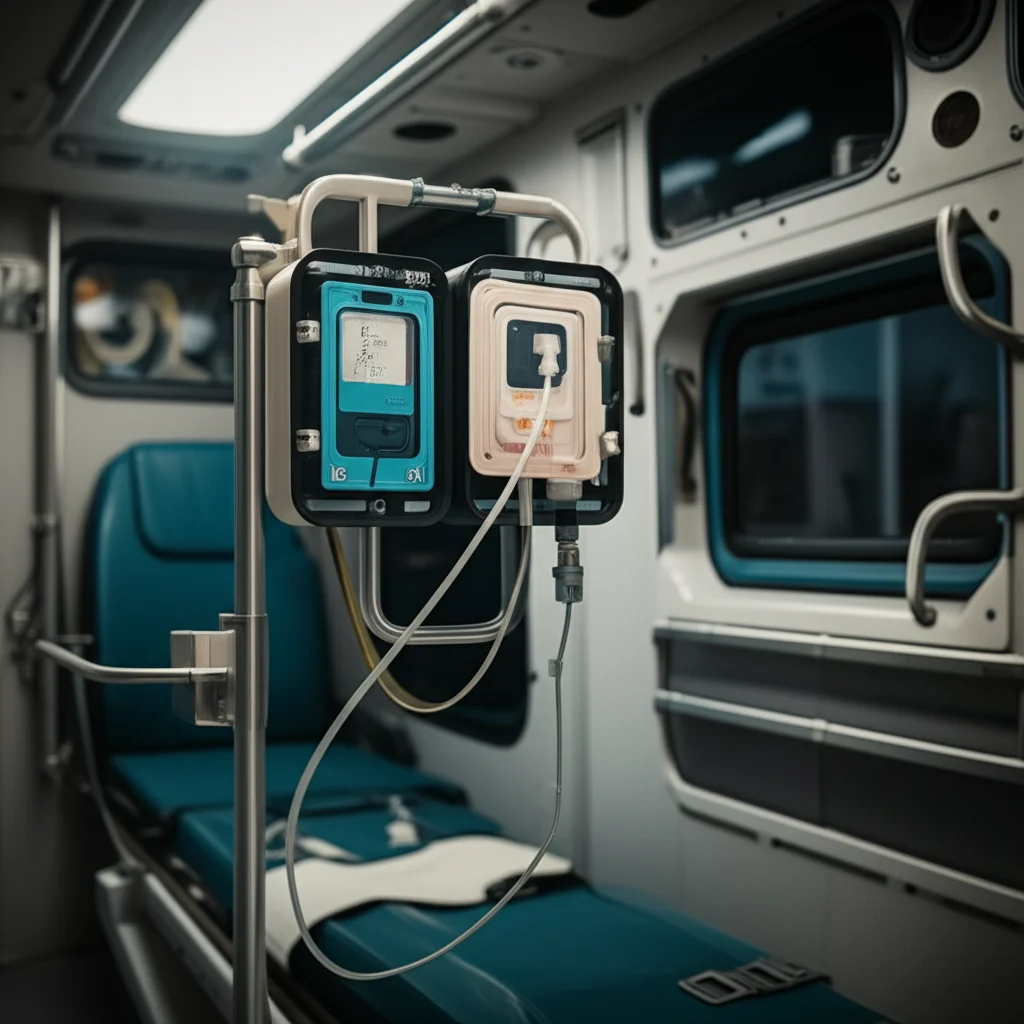
Keeping Critical Drips Steady: Navigating G-Force in Ambulance Transport
Hey there! Let’s talk about something super important, especially when folks are really unwell and need a bumpy ride in an ambulance. We’re talking about those vital medications, the ones that keep things stable, like heart rate or blood pressure. Often, these are given through a syringe pump, a clever bit of kit that pushes a tiny, steady stream of medicine into a patient.
The Challenge of the Road
Now, under normal, calm conditions, these pumps are brilliant. They’re certified to be really accurate, like within 2% accurate for standard infusions. That’s great when you’re in a nice, quiet hospital room. But an ambulance? That’s a whole different ballgame! Think about it – bumps, turns, sudden stops, vibrations. All that movement creates G-forces, and those forces can really mess with how smoothly that syringe pump is delivering its precious cargo.
For patients, especially critically ill children needing drugs with a short half-life (meaning they wear off quickly, so you need a constant, precise supply), even small variations in delivery can be a big deal. We’re talking about potentially unstable blood pressure or other vital signs, which is exactly what you *don’t* want during transport.
So, we got curious. Could we figure out *why* these pumps get wobbly under stress and, more importantly, *how* to make them more stable during an ambulance ride?
Our Ambulance Adventures (In-Vitro Style)
We decided to take this question head-on, but in a safe, controlled way. We set up shop in an actual ambulance and ran a bunch of experiments. We used BBraun Space Perfusor pumps, which are common, and instead of a patient, we tracked the movement of a tiny air bubble in the tubing. This bubble acted like our tracer, showing us exactly how consistently the fluid (and thus, the drug) was moving. Tracking it every 10 seconds with a GoPro gave us the data we needed.
We ran six different phases of experiments, each one building on the last. We tested things like:
- Where the pump was placed relative to the ‘patient’ (displacement).
- Which way the pump was facing (orientation – forwards, backwards, sideways, up, down).
- Trying to eliminate vibration (using a fancy self-stabilising gimbal).
- Using different syringe sizes (10 mL, 20 mL, 50 mL).
- Seeing if flow rate, plunger speed, or plunger pressure was the most important factor.
- Testing a concept called ‘net zero displacement’ (using two pumps pushing against each other) versus trying to get the pump physically super close (‘near zero displacement’).
We did each test three times to make sure our results were reliable. We even used a model to see how the delivery variations we observed would translate into actual drug levels in a patient’s bloodstream.
So, What Did We Find Out?
Loads of interesting stuff! The biggest takeaway is that the bumpy ride *does* matter, but we can do a lot to minimise its effects.
* Displacement is a Big Deal: If the pump is far away from where the tubing enters the patient, especially if that displacement is lined up with the direction of G-forces (like forward/backwards when the ambulance accelerates/brakes), you get a lot of variability. Keeping the pump close is key.
* Orientation Matters: Simply changing which way the pump faces made a difference. Positioning the pump *laterally* (sideways) was the most stable orientation we tested.
* Vibration Reduction? Maybe: Using a gimbal to smooth out vibrations helped, but mainly with the larger 50 mL syringes. It didn’t make a significant difference when we used smaller syringes. This was a bit of a surprise!
* The Critical Factor is Plunger Speed: This was a major finding. It wasn’t the overall flow rate or the pressure the pump was generating, but the *speed* at which the pump’s plunger was moving that most affected consistency.
* Smaller Syringes Win: Why does plunger speed matter? Because for a given flow rate (how much drug per hour), a smaller syringe means the plunger has to move faster. We found that using 20 mL syringes (and even 10 mL) resulted in much more consistent delivery compared to the standard 50 mL syringes. The higher plunger speed with the smaller syringes seemed to overcome some of the G-force effects.
* Near or Net Zero Displacement Works: Physically getting the pump right next to the patient’s line entry point (‘near zero’) is ideal but can be tricky in a crowded ambulance. We found that the ‘net zero’ concept (using two pumps effectively cancelling out hydrostatic pressure effects) gave similar good results for stability.
Putting all the best factors together – smaller syringe, lateral orientation, minimal displacement – dramatically improved the predicted drug levels in our model. Under standard, less-than-ideal conditions, the calculated drug concentration could swing wildly, from 96% to a whopping 216% of the target steady level. With our optimised setup? That range tightened right up to a much safer 103% to 123%. That’s a massive improvement in stability!
Putting It Into Practice
So, what does this mean for the real world? If you’re transporting a critically ill patient needing a continuous infusion of a short half-life drug, here’s what our study suggests:
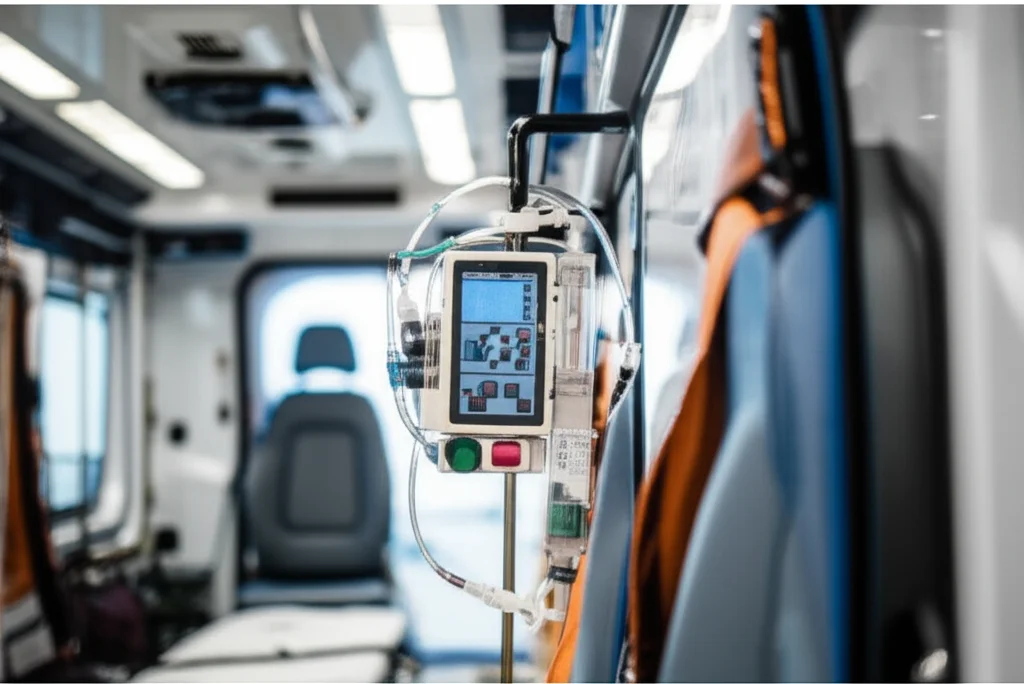
- Go Smaller: Use a 20 mL syringe instead of a 50 mL one. This increases the plunger speed for the same dose rate. Using a more dilute drug solution can also help achieve a higher plunger speed.
- Positioning is Paramount: Get that pump as close to the patient’s IV entry point as possible. Think ‘near zero’ displacement.
- Think Laterally: If you can, orient the pump so the plunger movement is sideways relative to the ambulance’s main direction of travel.
- Net Zero as an Option: If physical near-zero displacement isn’t practical (and it often isn’t, for safety and access), exploring a ‘net zero’ setup could be a good alternative.
Our findings really highlight that where and how you mount that syringe pump matters a *lot* more than you might think. Many transport trolleys mount pumps at the back, leading to big front-to-back and side-to-side displacements. Positioning the pump higher or lower, closer to the patient’s line, seems much better. This might even mean we need to rethink how patient transport trolleys are designed!
It’s important to remember this study was done in a lab setting (in-vitro) inside an ambulance, not on actual patients. Also, we controlled for hydrostatic pressure, which can vary in real life depending on the patient’s position and venous pressure. However, the fundamental principles of minimising displacement and maximising plunger speed to improve stability should still hold true regardless of these real-world variables.
Ultimately, anything we can do to make drug delivery more consistent during transport means better stability for the patient, and that’s the goal, right? This research gives us some concrete steps we can take right now to make those bumpy rides a little bit safer for the most vulnerable patients.
Source: Springer