Shining a Light on Chemistry: Making Bigger Molecules from Alkenes!
Hey there, fellow science enthusiasts! Let’s chat about something pretty neat happening in the world of chemistry. We’re talking about taking simple building blocks, like alkenes, and turning them into something bigger and more complex. It’s like taking a basic LEGO brick and, instead of just breaking it or keeping it the same, adding more pieces in a clever way to build a whole new structure. And guess what? Light and some special molecules called nitroarenes are the key players here.
The Usual Suspects: Old Ways of Oxidizing Alkenes
So, alkenes are super common. You find them everywhere, often starting from stuff like petroleum or plants. They’re incredibly useful because you can do all sorts of chemical magic with them, especially adding oxygen. This is called oxidation, and it’s how we make tons of important molecules found in medicines, natural products, and even things we use in farming.
For ages, chemists have used things like metal oxides – think Osmium tetroxide or Potassium permanganate. They work, sure, but they leave behind a bunch of metal waste, which isn’t exactly the ‘greenest’ approach, you know? So, folks started looking for better ways.
Enter non-metal oxidants! Ozone (O3) is a classic example. It’s great for breaking alkenes apart, usually chopping the carbon chain into shorter pieces, often giving you carbonyl compounds like aldehydes or ketones. This is what we call carbon chain-shortened oxidation, or basically, ozonolysis.
More recently, people discovered that photoexcited nitroarenes – that’s nitroarenes zapped with light – can act a lot like ozone, but sometimes even better! They can also break alkenes apart, and they can be a bit safer and cheaper. Plus, if you tweak the nitroarene with the right bits attached, you can fine-tune how oxidative it is.
Besides breaking chains, chemists also figured out how to oxidize alkenes while keeping the carbon chain the same length. This is carbon chain-retained oxidation. A cool example is turning alkenes into 1,2-diols (molecules with two alcohol groups next to each other), which are more complex than the simple carbonyls from ozonolysis. Researchers have done this using both ozone and, more recently, those photoexcited nitroarenes we just talked about.
The Elusive Goal: Making the Chain Longer
But here’s where things get interesting. While we got good at shortening or keeping the chain the same, the idea of *adding* carbons – making the chain *longer* – during alkene oxidation? That was the big, tricky challenge. Building more complex molecules is a core goal in modern chemistry, and chain elongation is a fantastic way to do that. It was something chemists really wanted to crack.
Picture this: you have a molecule, and you want to add more complexity, more atoms, maybe even build a ring structure, all in one go using a simple starting material like an alkene. That’s the dream of carbon chain-elongated oxidation. It remained pretty elusive for a while.
Our Breakthrough: Tandem Action with Light and Nitroarenes
Well, I’m excited to tell you about a new method we’ve developed that tackles this challenge head-on! We figured out a way to achieve photoexcited nitroarene-enabled carbon chain-elongated oxidation of alkenes. It’s a bit of a mouthful, but the core idea is pretty elegant. It works through a two-step, or “tandem,” process: first, the alkene is broken apart (that’s the oxidative cleavage bit), and then the pieces quickly react with another molecule in a special way (that’s the dipolar cycloaddition part).
The result? We can make a whole bunch of really useful molecules called isoxazolidines. These are ring structures containing nitrogen and oxygen, and they’re fantastic building blocks for making other important organic molecules, like those 1,3-aminoalcohols I mentioned earlier. And we can get them in really good yields – up to 92% in some cases! – from simple starting materials like enol ethers or styrene derivatives, using mild and straightforward conditions.
How It Works (The Nitty-Gritty, Simply Put)
Let’s dive a little deeper into the “how.” When you oxidize an alkene with something like ozone or a nitroarene, the first thing that happens is usually the formation of a short-lived ring structure. This structure then breaks apart into reactive fragments called 1,3-dipoles. In the case of nitroarenes, these are often carbonyl imines.
Normally, these 1,3-dipoles are super reactive and get snapped up by polar double bonds, like the C=O bond in a carbonyl compound. This leads to another unstable ring, which then breaks down to give you those carbon chain-shortened products (the typical ozonolysis outcome).
Our idea was: what if we could get the 1,3-dipole to react with something *else* instead? Something that wouldn’t cause it to break down further, but instead build a new, stable ring structure? We envisioned using a non-polar double bond, specifically a C=C bond from another alkene molecule, to trap the 1,3-dipole. If successful, this would form a stable ring, like an isoxazolidine, and boom – you’ve just elongated the carbon chain!
There were two big hurdles: the 1,3-dipole needed to hang around long enough to find another alkene molecule, and the C=C bond from the alkene had to be better at trapping it than any C=O bonds floating around.
Finding the Right Ingredients
We figured that nitroarenes with strong electron-withdrawing groups (like fluorine, chlorine, or nitro groups) would be good candidates because previous work suggested they could generate more stable 1,3-dipoles. So, we started testing different alkenes with a model nitroarene (3,5-dinitrotrifluorotoluene).
Turns out, not all alkenes were up for the job. Many common ones didn’t give the desired product. But then we tried enol ethers, specifically ethoxyethene. Bingo! It worked, giving us the isoxazolidine product, though the initial yield was modest.
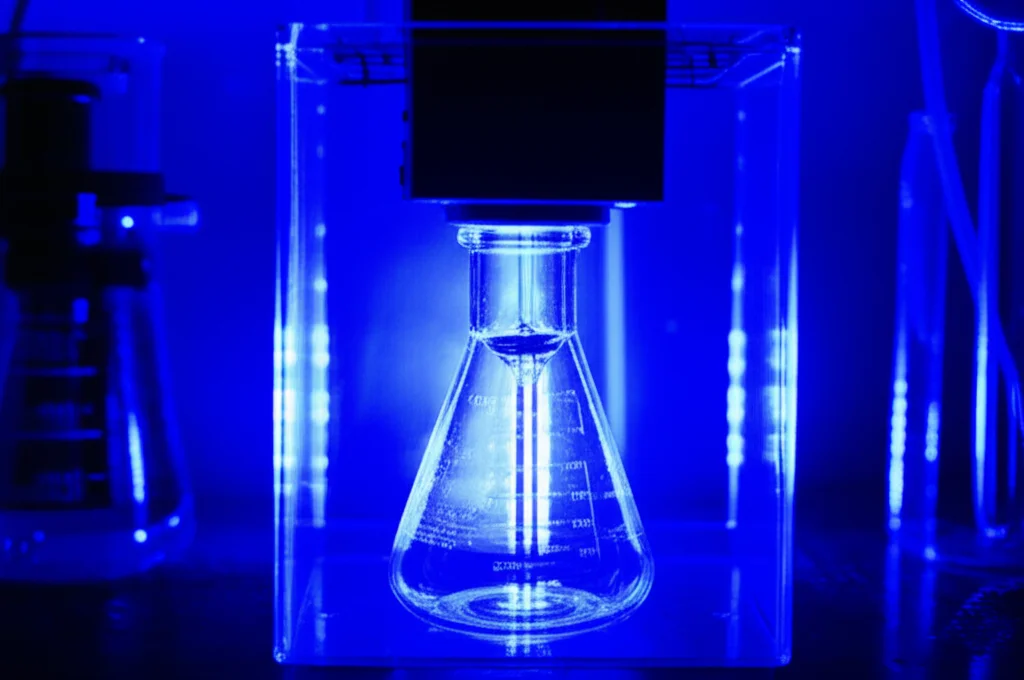
This was the green light! We then systematically optimized the conditions. We played with the light source (found that 385–390 nm LED light worked best), the light intensity, the amount of alkene used, and the solvent (acetonitrile, or MeCN, was the winner). After some tinkering, we hit the sweet spot: using 8 equivalents of ethoxyethene in MeCN under nitrogen gas with that specific LED light gave us a fantastic 92% yield!
Control experiments were key here. No light? No reaction. Oxygen present? Yield dropped dramatically. The specific wavelength and intensity of the light really mattered, as did using enough alkene and the right solvent. It’s like finding the perfect recipe – every ingredient and step counts!
Broadening the Horizons: What Else Works?
Once we had the optimal conditions, we explored the scope – basically, how many different types of nitroarenes and alkenes we could use. As expected, nitroarenes with electron-withdrawing groups were essential. We found that nitroarenes with three or more such groups, or even combinations of two groups like fluorine, chlorine, bromine, cyanide, trifluoromethyl, and nitro groups, worked really well, giving products in good yields (up to 91%). Even nitroarenes with just one electron-withdrawing group worked! Pretty versatile.
What about the alkenes? Enol ethers with various alkyl groups (straight chains, branched, bulky ones) and even those with other functional groups attached worked nicely, giving yields between 53% and 91%. Interestingly, if an alkene had *two* enol ether parts, only one reacted, which is kind of neat – selective oxidation!
We also found that 1,1-disubstituted alkenes (where two groups are attached to one carbon of the double bond) worked, though bulky internal alkenes (where the double bond is in the middle of the chain with groups on both carbons) were generally less effective. But here’s another cool bit: styrene and its derivatives, which are also common alkenes, worked too, giving the desired products, albeit sometimes as a mix of slightly different versions.
Putting the Products to Work
Okay, so we can make these isoxazolidines. But are they useful? Absolutely! To prove it, we scaled up the reaction to make a gram of product – a decent amount for further experiments – and it worked smoothly, giving a good yield.
These isoxazolidines, especially the ones with that ethoxyl group we started with, are like chemical chameleons. You can easily transform them into other valuable molecules. For instance, we showed that you can treat the isoxazolidine with a simple chemical (BF3·Et2O) to create a reactive intermediate, which can then react with various other molecules (like allyltrimethylsilane, trimethylsilyl cyanide, or trimethyl phosphite) in really high yields (90-95%).
Even better, we demonstrated that you can easily convert one of our isoxazolidine products into a 1,3-aminoalcohol using nickel chloride and sodium borohydride. Remember how 1,3-aminoalcohols are important? This shows a direct path from our new reaction product to a valuable class of compounds.
Peeking Behind the Curtain: The Mechanism
Scientists are always curious about *how* things work at the molecular level. We did some experiments to figure out the reaction mechanism. Adding substances known to trap radicals (very reactive species) completely stopped the reaction. This tells us that radicals are likely involved somewhere along the way.
Turning the light on and off confirmed that continuous light is essential – the reaction stops when the light is off and restarts when it’s on. This supports the idea that photoexcitation (using light to energize the nitroarene) is the crucial first step.
Based on our findings and previous research, here’s the proposed mechanism:
- First, the nitroarene absorbs light and gets excited, forming a highly reactive intermediate (a biradical).
- This biradical then adds to the alkene, creating a short-lived ring structure.
- This ring structure quickly breaks apart (fragments) into our key player: the carbonyl imine 1,3-dipole, along with an aldehyde byproduct.
- Finally, this reactive carbonyl imine finds *another* molecule of the starting alkene and reacts with it via a dipolar cycloaddition to form the stable isoxazolidine product. This last step is where the carbon chain elongation happens and the new ring is built.
It’s a clever sequence of events, orchestrated by light and the unique properties of the photoexcited nitroarene.
The Takeaway
So, what’s the big picture here? We’ve successfully developed a new way to oxidize alkenes that goes beyond the traditional methods of just breaking the chain (ozonolysis) or keeping it the same length (dihydroxylation/monohydroxylation). By using photoexcited nitroarenes and a smart tandem process involving oxidative cleavage followed by dipolar cycloaddition, we can actually *elongate* the carbon chain and create valuable, complex molecules like isoxazolidines in high yields and with great precision.
This work shows that there’s still plenty of room to explore and develop exciting new transformations using familiar tools like ozone or photoexcited nitroarenes. It opens up new possibilities for building molecular complexity from simple starting materials, which is always a win in the world of organic synthesis!
Source: Springer